When faced with a complicated, multi-faceted problem like election integrity, it’s often easier to get a much better grasp of it by using an analogy…
A home remodeling project might be a good comparison. Let’s say we have a 250-year-old, 3-story home, that has exceptional historical significance. (For example, let’s imagine that in this home a group of patriots met and drafted up the first version of the Constitution!) Additionally, it is an architecturally beautiful building.
Although the home mostly has “good bones,” it has fallen on hard times due to decades of neglect, disputes of ownership, self-serving actions by caretakers, etc.
Some of the current issues are: dilapidated siding, deuterating porches, large holes in the roof, a woefully inadequate electrical system, antiquated plumbing, floors that need refinishing, walls that must be painted or repapered, etc. Although the foundation needs minor attention, it still seems to be solid.
Since no one else is doing anything meaningful about this property (other than a lot of talk, blame, and obfuscation), a group of patriotic citizens decides that they will step in.
These selfless volunteers get permission and then (at their own expense!) energetically do the following: start cleaning up the mess, wallpapering and painting walls, sanding floors, upgrading the electrical system, installing new plumbing, fixing broken windows, repairing porches, pointing chimneys, and improving the landscaping.
Do you see any problems here in my made-up analogy?
I’ve phrased it in such a way that it’s clear that there is no professional oversight to organize and direct these excellent efforts, in an appropriate, effective way. For example, renovation of such a property needs to be done in the proper sequence. In this case, it is a waste of time, effort and money to be finishing interior walls and floors before ALL of the needed plumbing and electrical work is done.
The biggest error in this analogy is also a sequential failure. The number one priority of this renovation MUST be to fix the roof. Almost any work on the interior is likely wasted until the inside is no longer exposed to the elements.
So what’s the parallel with election integrity?
We have almost 250 years of election history, architecturally attractive, and built on a solid foundation. However, our election system has fallen on very hard times due to decades of neglect, disputes about responsibility, self-serving actions by those elected to be caretakers, etc.
One of the few positives about the 2020 election is that it woke up many citizens to the reality that our election system has become seriously deteriorated.
In response, many hundreds of patriotic people have dedicated considerable time, effort, and money in an attempt to renovate our election system. My point here is that unless the contributions of these volunteers are properly focused, it’s likely that the majority of it will do very little. (The 2022 elections should have been a wake-up call!)
So what is the elections parallel with starting by properly fixing the roof?
(See “The Solution” for election integrity: here.)
Without doing that, very little of the rest of the superior efforts will be of any avail!
Media Balance Newsletter: a free, twice-a-month newsletter that covers what the mainstream media does not do, on issues from COVID to climate, elections to education, renewables to religion, etc. Here are the Newsletter’s 2023 Archives. Please send me an email to get your free copy. When emailing me, please make sure to include your full name and the state where you live. (Of course, you can cancel the Media Balance Newsletter at any time – but why would you?
https://libertyfirst.org/wp-content/uploads/logo_v6_225x110.png00DrRichSwier.comhttps://libertyfirst.org/wp-content/uploads/logo_v6_225x110.pngDrRichSwier.com2024-02-29 23:51:432024-02-29 23:51:43An Election Integrity Analogy: Good Efforts do NOT assure Good Results
There’s a current movement to shut down landlines completely by “decommissioning” the copper wiring that enables this reliable form of communication. And this movement appears to be growing! Why? Perhaps because landlines work. And because the Powers that Be can’t monitor them and shut them off at will, as they can do with wifi and digital communication. Just a wild guess. You be the judge.
But it’s taking place in Britain and Australia as well as in America today. They plan to replace the copper service with either fiber or 5G. Sound good to you?
By the way, here’s an article from CNN, about a huge outage that happened today, February 22, 2024:
“AT&T’s network went down for many of its customers across the United States Thursday morning, leaving customers unable to place calls, text or access the internet.
By a little after 3 pm ET, roughly 11 hours after reports of the outage first emerged, the company said that it had restored service to all impacted customers.”
That’s 11 hours that people were left high and dry, without the ability to make or receive phone calls. This is why we need landlines, no matter what AT&T tells us, as it argues landlines, which are time-tested and never fail, are “antiquated.” I guess they mean like the Constitution, which is even older, and which Leftists also want to replace.
In California, AT&T is requesting that the CPUC—California Public Utilities Commission—allow it to end landline service permanently.
Fortunately, the public has the opportunity to weigh in with the CPUC, which has already received thousands of letters in support of maintaining landlines, which many people rely on.
AT&T’s power outage just this morning is proof positive that it must continue to maintain our landlines for our safety and security. They are far more reliable than WIFI, and there’s no legitimate reason to do away with them.
Here’s something else to consider: “This change may affect alarm systems, elevators, and call boxes reliant on landlines.”
Here’s the link to the CPUC’s website where you can read public comments, and if you live in California, you can use the link on that page to write your own comment prior to AT&T’s hearing.
https://libertyfirst.org/wp-content/uploads/logo_v6_225x110.png00DrRichSwier.comhttps://libertyfirst.org/wp-content/uploads/logo_v6_225x110.pngDrRichSwier.com2024-02-23 18:51:152024-02-23 18:51:15AT&T’s War on Landlines
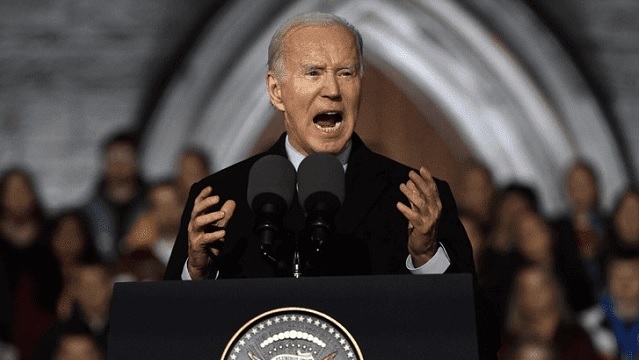
Critics of President Joe Biden have begun dusting off the “basement campaign” allegation now that the 2024 election cycle is in full-swing, but a low-profile, press-free campaign would fall right in line with how Biden has conducted his entire presidency.
During Biden’s run for president in 2020, the now 81-year-old was criticized for running a “basement campaign” as he often stayed in his home studio for media appearances and had limited, low-attendance rallies. Now, as the 2024 election approaches, similar critiques are bubbling after Biden ducked out on a traditional end of year press conference and opted out of a prime-time Super Bowl interview.
He can’t get away with a basement campaign, or a Rose Garden campaign, this time around. He’s trailing Trump too badly.
Going on his fourth year in office, Biden is averaging about 11 press conferences a year, according to data compiled by the University of California at Santa Barbara’s American Presidency Project. Biden’s average is the lowest since former President Ronald Reagan, who held office from 1981 to 1989, and averaged 5.8 press conferences per year.
The parallel between Biden and Reagan is not a coincidence, historian Barbara Perry, co-chair of the Presidential Oral History Program at the University of Virginia’s Miller Center, told the Daily Caller.
“I think it’s more than coincidental that you have these two presidents with an aging factor. And I don’t mean to say that he’s non compos mentis and he’s going down. I’m not saying that at all. I’m just saying I do think it’s more than coincidental that oftentimes as these presidents get older, they want to do these kinds of pressers less. Prior to that would be the third and most elderly president was Eisenhower, who was well known for having trouble with his syntax,” Perry told the Daily Caller.
“I just think that’s part and parcel of what happens when you have older presidents, that to be on the hair trigger and be able to respond immediately to let’s face it, and I think this is the role of the press is to press and ask pressing questions instead, sometimes may even be hostile or at the very least, be pointed, and ask presidents to explain what they’re doing and why they’re doing things and to be controversial,” Perry continued.
REPORTER: Why isn’t Biden doing more press conferences, especially compared to his predecessors?
KJP: The president is communicating with Americans in “non-traditional” ways. pic.twitter.com/EeZGf1nCLH
In addition to snubbing press conferences, Biden has participated in fewer interviews with media outlets than his predecessors, according to NBC News. Since his 2021 inauguration, Biden has done 86 interviews with media outlets, NBC tallied. Former President Donald Trump and former President Barack Obama trounce Biden’s numbers, each doing 300 and 422 interviews, respectively, at the same point in their presidency.
When Biden has done sit-down interviews with the media, his administration has often chosen to go the non-traditional route, sometimes avoiding hard-hitting journalists in favor of celebrity personalities. The president has done interviews with the Weather Channel, CBS News’ 60 Minutes, Ryan Seacrest and comedian Conan O’Brien.
In 2024, Biden has already foregone media opportunities. Biden turned down a prime-time Super Bowl interview for the second year in a row. His campaign then claimed that they wanted to give Americans a break from politics during the game, CNN reported. The NFL, however, is notoriously political, playing the black national anthem before the U.S. national anthem while players don helmet stickers reading “End racism” and “It takes all of us.”
“We are being less traditional because less people get their news from traditional mediums than ever before,” a Biden campaign official told CNN.
After giving an address on border initiatives being debated in Congress, Biden promised reporters on Feb. 5 that he would be back sometime during the week to answer questions. That same week the president unexpectedly gave a press conference to address a special counsel report that had been released that day discussing the president’s physical and mental state. It was widely panned after Biden mixed up the presidents of Egypt and Mexico and snapped at reporters who asked about his age.
Biden again promised to take questions from reporters following remarks on Ukraine funding stalling in Congress. White House press secretary Karine Jean-Pierre dismissed further questions about the president’s promise.
“On Tuesday, President Biden, he said, ‘I’m not going to answer your questions today. I will answer them tomorrow and the day after,’” a reporter asked Jean-Pierre during a press briefing. “What was he talking about?”
“Well, he was outside yesterday, and he took questions from some of you,” Jean-Pierre responded, referring to when the president told the media he was giving them up for Lent. Biden also continued to repeat “Happy Valentines day” as he was asked about a mysterious national security threat.
“And what about today?” the reporter followed up.
“Today I don’t have anything to share beyond what you all know, don’t have anything to add on his public schedule,” Jean-Pierre followed up.
“Happy Valentine’s Day,” President Biden wished me when I asked about reports that Russia is considering launching nuclear weapons into space pic.twitter.com/IZ3HWcgFeW
Mark R. Weaver, a GOP strategist, pointed to the quick-witted nature of press conferences as a reason Biden may be conducting less of them.
“It can be a little bit like playing ping pong. So in these gaggles, the reporter can serve the ping pong ball towards him, and he can hit once back, but he can’t hit the next shot or the next shot. He’ll walk away before he does. So [for example a reporter] will say ‘Mr. President, why are the prices still so high?’ And he is able to give a first response he will say ‘Well, that’s because the Republicans in Congress’ right, so we can get a first response out,” Weaver said.
“But then the reporter will follow up ‘no, Mr. President, you did you know, you did this policy, you forgave student loans and and that change this monetary policy, what do you have to say about that,’ and then he’ll mumble and walk away. He can’t hit that second shot,” Weaver continued.
The White House dismissed questions about the president’s lack of press interactions during a February press briefing.
“The numbers show that President Biden has engaged in about 33 news conferences. Compare that to Obama’s 66 and Donald Trump’s 52 by this time in their presidencies. Can you explain why the President isn’t doing more?” a reporter asked Jean-Pierre on Feb. 12.
“We’re always going to try to find ways — obviously, outside of press conferences as well — t0 — for the President to be out there. And we have found some nontraditional ways. We think it’s important to try and meet the American people where they are,” Jean-Pierre responded.
“As far as press conferences, we’re going to try and make sure when it’s the right time for — for those to happen, certainly we will — we will do so. But it doesn’t mean that this President does not engage with — with the press corps — with the White — White House press corps or with other reporters, journalists out there who have different — different ways with communicating with the American people as well. We think that’s important too,” the press secretary continued, pointing to the amount of times Biden takes questions from reporters while on the road.
Biden does appear more willing to speak to the press when it is spontaneous, whether that be during trips or following a speech.
As of Oct. 17, 2023, Biden has engaged with the press 492 times in an informal “gaggle,” which is more than any other president aside from Trump, the Washington Post reported. The president is averaging about 131 interactions with the press per year as of Feb. 20, according to the American Presidency Project. The number is less than Trump, though far more than Obama who averaged 25 exchanges with the press per year.
Ryan Seacrest asks Joe Biden about his favorite “memories” of 2023.
Biden’s reply: “So many people through the Midwest & in the center of the country, their factories were shipped overseas the last couple times out…”
Perry recounted a time she attended a December 2022 event at the White House and had an opportunity to speak to the president. Biden’s strength, Perry noted to the Daily Caller, is more personal, unexpected interaction.
“About 10 to 15 years, slid off his face between standing on that stage looking kind of tired and coming down and talking to each person standing behind the velvet rope line. And so I do think that part is a shame that to the extent that he is not out as much as maybe he would have been as a younger person meeting and greeting and pressing the flesh because that is his strength,” Perry told the Daily Caller.
While doing fewer press conferences, the Biden White House has still made an effort to meet the Americans through social media platforms such as Instagram and Tik Tok, the Washington Post previously reported. Throughout his presidency, Biden and his administration have leaned heavily on social media influencers in an effort to reach a younger crowd, though some argued to the outlet that the medium allows the White House to control the president’s messaging more.
“I think we should also point out that the press these days and in part may be trying to keep up with social media, may be more confrontational than at other times in long past,” Perry noted. “I mean, certainly the press was confrontational with Reagan, they were confrontational with Nixon, and I would compare him to someone like Trump, who really disliked the press. I don’t think Joe Biden dislikes the press, I think he probably misses the days when he could go toe to toe with them.”
https://libertyfirst.org/wp-content/uploads/logo_v6_225x110.png00DrRichSwier.comhttps://libertyfirst.org/wp-content/uploads/logo_v6_225x110.pngDrRichSwier.com2024-02-22 16:51:142024-02-22 16:51:14Forget Basement Campaign — It’s Been A Whole Basement Presidency For Joe Biden
The winners of November’s presidential and congressional elections will quickly face decisions on extending tax cuts scheduled to expire after 2025. President Biden and Republicans support starkly different tax plans.
Republicans generally want to extend all expiring tax cuts from the 2017 law former President Donald Trump signed. The price tag: $4 trillion over a decade.
Biden proposed extending Trump’s tax cuts for households making under $400,000 annually but said the rest should expire. Beyond that, he would raise taxes further on top earners and corporations. That plan, including tax increases the president hasn’t fully detailed, would generate more than $2 trillion beyond current forecasts.
That $6 trillion gap is on the ballot, and the ultimate resolution will affect family budgets, corporate profits and the federal government’s fiscal health amid rising debt.
If the upcoming election in November is reminiscent of the 1993 movie “Grumpy Old Men” with Jack Lemmon and Walter Matthau, you might want to also re-watch “The Bad News Bears” with another four years governed under what we colloquially call Bidenomics. It isn’t a dollar’s worth of difference between the two parties, it’s more like $6 trillion at stake when you pull the lever in November.
Embedded within this discourse between the two parties lies some potential deception when you peel back the artichoke and really analyze the numbers. You should never be fooled by percentages and always look at the real dollars coming out of your pocket.
Consider, for instance, a purported 5% increase in capital gain rates for 20% to 25% — a seemingly modest adjustment. However, a deeper examination reveals that this type of tax change would translate to a 25% increase in taxes in actual dollars and not 5% as might be reported. This basic arithmetic underscores the gravity of the electoral choices right around the corner.
Here’s an example. If you had a $100,000 gain and paid 20%, you would owe $20,000. If you had a $100,000 gain and now paid 25%, you would owe $25,000. The difference between $20,000 and $25,000 isn’t 5% … it’s 25%! Here’s why this simple math problem should have you think twice come November.
Depending on how the presidential election goes, taxpayers might be paying Uncle Sam trillions more. (iStock)
As a retrospective glance, the “Tax Cuts and Jobs Act of 2017” ushered in a sweeping paradigm of pro-growth tax reforms, marked by several pivotal provisions. Noteworthy among these were the reduction of top marginal tax rates from 39.6% to 37%, a significant expansion of the standard deduction, and the implementation of State and Local Taxes (SALT) for itemized deductions, among others.
Yet, these beneficial measures are poised to expire by the end of 2025, wiping out $4 trillion in tax relief. Moreover, if the current administration’s proposed tax reforms materialize, an additional $2 trillion of burden may be imposed upon Americans already grappling with inflationary pressures.
Consider the ramifications: Under the “Tax Cuts and Jobs Act,” the standard deduction, which Forbes estimates is utilized by nearly 90% of filers, was doubled, offering substantial relief particularly to middle and lower-income families.
The potential reversion to pre-2018 figures if these tax cuts expire at the end of 2025 would inflict financial hardship on many, not just the wealthy. Millions of middle-class Americans would see a pay cut. Suddenly, the GOP and Democrats agree on taxes Video
Similarly, the prospect of reverting to a top tax rate of 39.6% and the proposed adjustments to raising federal income taxes and inheritance taxes won’t squeeze enough out of the lemons to make lemonade.
Absent an extension, the estate tax exemption levels could plummet by as much as 50%, jeopardizing the intergenerational transfer of wealth painstakingly accumulated by families. You did great the last seven years, so what? Get ready to give it back.
The proposed revisions to Social Security taxes also loom on the horizon, with discussions revolving around imposing a 6.2% unlimited Social Security tax on incomes exceeding $400,000, akin to an indefinite Medicare tax.
The president continues the rhetoric saying that, “I’m a capitalist, but pay your fair share.” Fair share! In 2022, it’s estimated by Statista that 40.1% of Americans paid no federal income tax. Here’s a question? Is paying zero fair?
Yet, these beneficial measures are poised to expire by the end of 2025, wiping out $4 trillion in tax relief. Moreover, if the current administration’s proposed tax reforms materialize, an additional $2 trillion of burden may be imposed upon Americans already grappling with inflationary pressures.
How many of those that paid no income tax got money back in tax credits and other structures from the government. When the president says wealthy people need to pay their fair share what he means is help pay more taxes to support all of those who don’t pay any. Isn’t that right?
It’s not that long before each of us must hit the ballot box in November. Before you press the button and cast your vote, there may be 6 trillion reasons to consider the future of how much of your hard-earned money you keep.
https://libertyfirst.org/wp-content/uploads/logo_v6_225x110.png00DrRichSwier.comhttps://libertyfirst.org/wp-content/uploads/logo_v6_225x110.pngDrRichSwier.com2024-02-21 12:51:412024-02-21 12:51:41ELECTION 2024: $6 TRILLION in Democrat Tax Increases on November 5th Ballot
If you do nothing else, you must watch this interview with “Foundation For Freedom Online” director Mike Benz. Take it from someone who has been on the front lines of the war on free speech – as far back as the Danish cartoons in 2005 – this interview is seismic.
I am shook by it. But it all makes sense.
The colossal chaos is not chaotic at all – but by very deliberate design.
Ep. 75 The national security state is the main driver of censorship and election interference in the United States. “What I’m describing is military rule,” says Mike Benz. “It’s the inversion of democracy.” pic.twitter.com/hDTEjAf89T
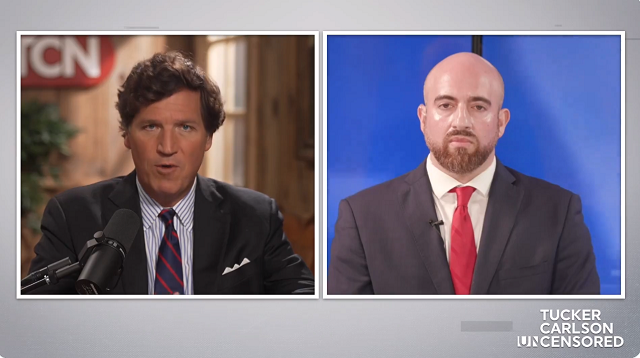
The Western defense and foreign policy establishment created, used, and then turned against the concept of free speech on the internet, during an interview with Tucker Carlson.
“Free speech on the internet was an instrument of statecraft almost from the privatization of the internet in 1991… Free speech was championed more than anybody by the Pentagon, the State Department, and the CIA cutout-NGO blob architecture as a way to support dissident groups around the world overthrow ‘authoritarian governments,’ as they were billed.”
“Essentially, internet free speech allowed insta-regime-change operations to be able to facilitate the foreign policy establishment’s State Department agenda,” Benz said. “Google is a great example of this, Google began as a DARPA grant by Larry Page and Sergey Brin when they were Stanford PhDs, and they got their funding as part of a joint CIA/NSA program to chart how ‘birds of a feather flock together’ online through search engine aggregation. And then one year later, they launched Google and became a military contractor quickly thereafter.”
“All of the internet free speech technology was initially created by our national security state. VPNs to hide your IP address, TOR and the dark web to be able to buy and sell goods anonymously, and encrypted chats. All these things were created as DARPA projects or joint CIA/NSA projects to be able to help intelligence-backed groups to overthrow governments that were causing problems to the Clinton administration, Bush administration, and Obama administration.”
“This plan worked magically from about 1991 to about 2014 when there began to be an about-face on internet freedom and its utility.”
“The highwater mark of the internet free speech movement was the Arab Spring in 2011-2012, when you had one by one all of the adversary governments of the Obama administration — Egypt, Tunisia — all began to be toppled in Facebook revolutions, Twitter revolutions. You had the State Department working very closely with the social media companies to be able to keep social media online during the periods.”
“In 2014, after the coup in Ukraine, there was an unexpected countercoup where Crimea and the Donbas broke away with essentially a military backstop that NATO was highly unprepared for at the time,” he said. “They had one last hail-mary chance that was the Crimea annexation vote in 2014, and when the hearts and minds of the people of Crimea voted to join the Russian Federation, that was the last straw for the concept of free speech on the internet in the eyes of NATO. They saw the fundamental nature of war change at that moment.”
“NATO, at that point, declared something called the Gerasimov Doctrine… that the fundamental nature of war has changed, you don’t need to win military skirmishes to take over Central and Eastern Europe, all you need to do is control the media and social media ecosystem because that is what controls elections. And if you get the right administration into power, they control the military. So it is infinitely cheaper than a military war to simply conduct an organized political influence operation over social media and legacy media,” he continued.
“An industry had been created spanning the Pentagon, the British MOD, and Brussels into an organized political warfare outfit infrastructure created initially in Germany and Central and Eastern Europe to create ‘psychological buffer zones,’” he said. “To create the ability to have the military work with social media companies to censor Russian propaganda or to censor domestic right-wing populist groups in Europe who were rising in political power at the time because of the migrant crisis.”
“When Brexit happened in 2016, it was this crisis moment where suddenly they didn’t just have to worry about Central and Eastern Europe anymore, it was coming West — this idea of Russian control over hearts and minds.”
“Brexit was June 2016, the very next month at the Warsaw Conference, NATO formally amended it charter to expressly commit to hybrid warfare as this new NATO capacity. They went from basically 70 years of tanks to this explicit capacity building for censoring tweets that they deemed to be Russian proxies. And again, it is not just Russian propaganda. These are not Brexit groups, groups like Matteo Salvini in Italy, Greece, Germany, or Spain with the Vox Party.”
“At the time, NATO was publishing white papers saying the biggest threat NATO faces is not an invasion from Russia, it is losing domestic elections across Europe to all these right-wing populist groups, who because they were mostly working-class movements, were campaigning for cheap Russian energy at a time when the U.S. was pressuring this energy diversification policy. They made the argument after Brexit that the entire ‘rules-based international order’ would collapse unless the military took control over the media.”
“So NATO would be killed without a single bullet being fired, and without NATO there i no enforcement arm for the International Monetary Fund or World Bank, so now the financial stakeholders who depend on the battering ram of the national security state would basically be helpless against governments around the world.”
“From their perspective, if the military did not begin to censor the internet, all of the democratic institutions and infrastructure that gave rise to the modern world after World War Two would collapse.”
THREAD: Mike Benz speaks with Tucker Carlson about the Department of Homeland Security-backed censorship consortium that censored millions of social media posts during the 2020 election and COVID-19.
The 2020 election and COVID-19 were the two most censored events in American history.
Mike Benz outlines how the government established a permanent domestic censorship office under the pretext of countering misinformation. and disinformation.
Initially considered for the State Department, CIA, and FBI, the censorship office found its home in the Department of Homeland Security (DHS), utilizing the Cybersecurity and Infrastructure Security Agency (CISA).
DHS classified elections as critical infrastructure and online misinformation, disinformation, and malinformation as cybersecurity attacks.
The original goal of countering Russian disinformation shifted to suppressing domestic dissent and the populist movement led by President Trump.
Examining the 2020 election’s censorship strategy, Benz details CISA’s collaboration with Stanford University, University of Washington, Graphika, and the Atlantic Council through the Election Integrity Partnership.
The censorship consortium employed coercive tactics, leveraging its deputized status to pressure tech companies through government threats.
A critical element was the seven-month pre-censorship campaign before the 2020 election. The consortium compelled social media companies to introduce a new “delegitimization” violation, targeting content challenging faith in mail-in ballots, early voting, and ballot drop boxes.
The overarching goal was narrative control, preventing doubts about a Biden victory and avoiding a crisis akin to the 2000 Bush-Gore election.
Anticipating Biden’s victory hinging on mail-in ballots, early voting, and ballot dropboxes, the consortium precensored any questioning of the election’s legitimacy, particularly if Trump appeared to win on election night but later lost due to late-arriving mail-in ballots.
3/ This Orwellian speech control consortium also flagged popular populist-right YouTube channels, including @scrowder, @BlazeTV, @JudicialWatch, and even the @GOP War Room, as “mis- and disinformation” spreaders.
10/ The EIP’s Starbird used advanced monitoring AI to map out entire networks of people who spread a narrative.
This allowed the EIP to stalk every chain in what they deemed a “false narrative” and to systematically censor entire belief systems at scale:@MikeBenzCyber… pic.twitter.com/bRjmycOLpD
12/ Kate Starbird heads CISA’s disinformation advisory panel with Vijaya Gadde, the former top lawyer at Twitter, who famously banned the former President and opposed @elonmusk proposal to roll back Twitter censorship policies. pic.twitter.com/H5SZ9VMu4G
17/ The EIP defined “delegitimization” as speech that “casts doubt” on the election process or outcome.
This accounted for 72% of the censorship tickets and targeted over 99% of the posts throttled by narrative, focusing on voting machines and vote-by-mail.@MikeBenzCyber… pic.twitter.com/D5ngNYPHdw
20/ The political establishment and the left used the COVID-19 crisis to push for nationwide mail-in voting, which increased the number of ballots cast by mail from 28.8 million in 2016 to 66.4 million in 2020, a massive 131% increase.
EDITORS NOTE: This Geller Report is republished with permission. All rights reserved.
https://libertyfirst.org/wp-content/uploads/logo_v6_225x110.png00DrRichSwier.comhttps://libertyfirst.org/wp-content/uploads/logo_v6_225x110.pngDrRichSwier.com2024-02-18 13:51:382024-02-18 13:51:38WATCH: How The U.S. Government Annihilated Free Speech, “The National Security State”
Let’s start out with a little humor. Remember this: Humor
What a week this was I hardly know where to start. One thing we should have learned is that when we call our legislators and conduct oversight it works. Because of our efforts the non-border border bill was killed. But fear not the RINOS and the Communists/Globalists in the Senate will twist enough arms, threaten enough people so that they will offer another bill with aid for Ukraine again. Think about how important Ukraine is to these criminals. Are they getting paid off? Do they need to give their lobbyist contractor friends money? Need to continue their human sex trafficking? Need to continue their drug pipeline? One thing is true they will never stop. We have to make sure that we never stop either. We have to continue our calls or emails to our legislators.
We can see clearly now that thugs/grifters are running this government and they will do anything to maintain control. But the people are smarter. We now see when we act we take back our power. The shift of power makes them crazy. We must make sure this election is overwhelmingly crushing against the globalist. We’re off to a good start. Nikki Haley lost to none of the above in Nevada. Trump won with an overwhelming majority and the US Virgin Islands . We have to see that in every state.
If you have not seen the report from Special Council Richard Hur on dementia Joe he proves what we already knew. Hur said even tough Joe committed multiple felonies, his is a “well-meaning, elderly man with a poor memory.” No, sorry if he is well enough to be President and destroy the county, he is well enough to be prosecuted. In the meanwhile Trump gets all the wrath because he is mean MAGA man who committed no crimes. seniors if you commit a crime or get in trouble remember you new defense “I am well-meaning, elderly man/woman with a poor memory.”
The government favors the globalists. Joe has dementia and is pathetic. So what do we do about it? We need to call the House and Senate oversight committees and tell them that Obiden is a compromised leader and if he is not well enough to be prosecuted for a felonies which he committed by taking classified material as a vice president when he had no right to classify material, then how can he be in charge of negotiation for anything good for Americans. Part of dementia is illusion and that’s what he is living under while forcing it upon us. Sadly the alternative will be Affirmative Action Graduate Kamala who maybe worse. But I think not because Joe was never really running the country anyway. The question is: Will the lying DNC take Joe out themselves or make him go through article 25? Or impeachment? Or leave him in office without ability to make any America killing policies. But regardless it is a disgrace to see what the leadership thinks of America. Remember Trump can not do this alone. We must vet candidates to get him support in both houses.
Another lie this week was the Bureau of Labor Statistics. BLS reported that we had the biggest job growth beating all expectations. Zero Hedge said it was the most ridiculous jobs report in recent history. Why would they say that? Was BLS lying? They weren’t really lying, they just manipulated the numbers. Does that count? Basically they changed the amount of hours they reported so it looked like more people had jobs and got higher wages.
This is the way the new economy works. The Feds print money out of thin air. The Feds give the money to the government, who gives the money to the UN, who gives the money to the NGO’s, who gives the money to illegals to invade our country, who then buy things to support the donors of the Globalists, who gives the money back to the Globalists. Then the lying media and globalist government reports that the economy is doing great as another trillion is added to the debt that the American people must pay. And the rich 1% get richer. That is modern day fascism aka slavery. If you want to see the theft in action see: The Great Taking
Globalists tell us it is our fault for eating too much meat, using to much fossil fuel, turning on the air conditioning. They dream up programs to force us to live in 15 minute cities so they can monitor our every move. And once again they get richer. Read what is going on in South Florida since DeSantis sold the state to his developer friends. Then you will know what to look for in your state. This is the Great Reset or the destruction of the American Dream.
Let’s tackle the greatest lie which we have been told over and over again. No it’s not China. No it’s not illegals. No it’s not Iran, or the Middle East. No it’s not Russia. Can you guess? It’s climate change. The farmers are rising up in Europe and the truckers are rising up in America as people all over the world reject world wide slavery and hunger. We must peacefully protest. They want civil war so they can declare a national emergency and stop the election. Too many western countries are having elections in 2024. Too many nationalists are running for office. This is the big threat. It’s numbers that count,. We must vote. Remember every time they tell you net zero, to get rid of CO2, to get rid of nitrogen, to stop farming or that agriculture is bad they want us dead. Globalists are putting in place a plan that will kill humanity. CO2 is one of the most necessary gases to sustain life. The biggest emitter of CO2 is water vapor. The Earth is 75% water. Humans have no control over the weather.
Everything is connected. Nothing is random, Everything has a plan. All plans are lies. All Globalists want is MONEY, POWER, CONTROL Don’t give them yours. Challenge them with the truth. Doing Nothing is affirmation.
Copyright 2024. Karen Schoen. All rights reserved.
https://libertyfirst.org/wp-content/uploads/logo_v6_225x110.png00DrRichSwier.comhttps://libertyfirst.org/wp-content/uploads/logo_v6_225x110.pngDrRichSwier.com2024-02-16 10:51:242024-02-16 10:51:24Kill Them All — O’Biden/Globalist Net Zero Agenda
In this latest program, host Gabriella Hoffman (who also serves as a CFACT senior policy analyst) journeys to Alaska to look into how mining operations are carried out in this beautiful, yet remote state.
As CFACT supporters know, Alaska is chock full of critical minerals needed to run our modern society. Gold, silver, copper, zinc, graphite, cobalt, lead, and rare earth elements are all found in abundance up there. That’s why domestic mining in the region is necessary for supplying America’s technological and electricity generation needs.
Sadly, our ability to get these minerals is being hampered by the Biden Administration and radical Greens. In fact, as the latest episode points out, the Biden administration is actively blocking new Alaska mining projects in the name of fighting climate change. One of these being targeted is known as Ambler Road –an infrastructure project supported by Alaskans to reach the Ambler Mining District.
If the Green radicals succeed in taking this project down it would be bad news for all of us.
Alaskan mining is a big positive. Viewers will learn that the Alaskan mining industry supports 10,800 total direct and indirect jobs, paying an average annual wage of $118,000—more than any other sector of the state’s economy.
And, of course, there’s also a little fun added in. You’ll get to see Gabby attempt to pan for a little gold and land a wild Alaska salmon.
Make sure you don’t miss this program.
EDITORS NOTE: This CFACT column is republished with permission. All rights reserved.
https://libertyfirst.org/wp-content/uploads/logo_v6_225x110.png00DrRichSwier.comhttps://libertyfirst.org/wp-content/uploads/logo_v6_225x110.pngDrRichSwier.com2024-02-16 09:51:192024-02-16 09:51:19CONSERVATION NATION VIDEO: The Biden Threat to Alaskan Mining
The absurdity of a requested 100% rate increase for some North Carolina property owners got my attention. (Note that insurance PR people knew that 100% might sound unreasonable, so they adjusted it to be 99.4%!). Let’s back up a bit to see what’s going on here…
Every one of us pays for insurance, one way or another. Some of the most common types of insurance related to property are: homeowners, flood, wind, earthquake, umbrella, tenant, etc. Since what we pay is supposedly related to such matters as actuarial calculations, most of us believe that there is little we can do to complain about our premiums — as what would be the business basis of our argument?
I’ll try to answer that key question…
Note: this issue can get very complicated quite quickly, so this is a layperson’s overview. (FYI: when discussing rates, obfuscation is often a tactic purposefully employed by the insurance industry.) For simplicity, I’ll primarily talk about flood insurance. For those readers who have joined recently, you may have missed an earlier commentary I published on the flood insurance fiasco. Please reread that. I’m writing this update to focus on one unappreciated major development.
A profoundly significant change has happened in the property insurance business over the last decade or so — and almost no one is discussing it! The most fundamental property insurance question is: how is future risk calculated?
Traditionally (i.e., for as long as property insurance has been offered), future risk has always been primarily calculated based on PRIOR HISTORY.
For example, if your property is located near the ocean, river, etc., the insurance company’s estimate of the likelihood of your property flooding in the next year, was based on the average prior history. In other words, if your property was flooded once in the last hundred years, the future estimate for flooding risk would be 1/100 (1%) per year going forward.
All things being equal, that not only makes logical sense, it was also the basis for almost all insurance companies being profitable. That, in turn, resulted in FEMA et al being careless regarding underwriting policy conditions, actuarial flood rates, etc.
So along came a perfect storm: climate alarmism (and their government enablers) plus Katrina. Insurance companies saw this motley pairing as an exceptional opportunity to increase their profits: they scrapped historical data as being the basis for our rates.
NOW, future risk is calculated based on a computer program. Worse, this program incorporates some undeclared, undocumented, and unproven assumptions!
This is a revolutionary change, that is ripe for self-serving manipulations by the insurance industry. For example, using the traditional methodology, a homeowner could always choose to research prior history. They would then know for certain whether it was accurately reflected in calculations of future projections.
With the current methodology of everything done by a computer (and operated by men behind the screen), no homeowner (or anyone else — including watchdogs) has even a remote chance of double-checking hardly anything.
Insurance regulators wouldn’t normally allow such a change simply to make insurance companies more profitable. So the insurance industry shed crocodile tears while using Katrina and Climate Change as a double-barreled shotgun, to blast away any semblance of actuarial sensibilityoraccountability.
Rather than fix the multiple serious deficiencies with the FEMA flood insurance program, it’s much easier just to charge everyone more. (Again, I’m just using flood insurance as an example.) Consider that NC homeowners are being targeted with an average of 42% rate increase, for homeowners insurance (NOT flood insurance).
It’s all traceable to the same issue: calculating rates based on historical results is old school. Now, an unaccountable computer program is used to project future risk.
Critical-thinking citizens should be strenuously objecting to their state and federal representatives about this greedy and unaccountable sleight-of-hand.
https://libertyfirst.org/wp-content/uploads/logo_v6_225x110.png00DrRichSwier.comhttps://libertyfirst.org/wp-content/uploads/logo_v6_225x110.pngDrRichSwier.com2024-02-15 20:51:322024-02-15 20:51:32An Insurance Scam that Affects Us All
Biden is bleeding black votes, especially those with small businesses who are trending towards voting for Trump with motivations like — “Well, we were broke with Biden. We weren’t with Trump.”
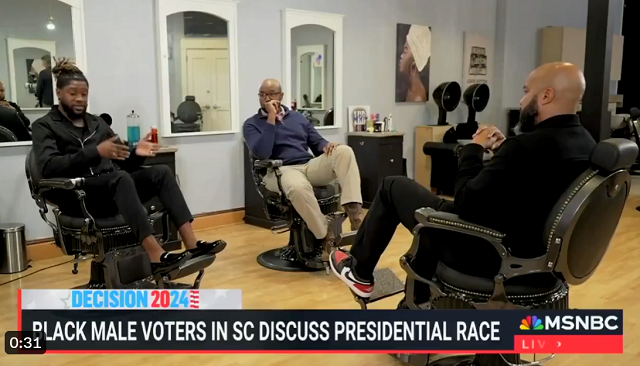
MSNBC’s decision this week to host a discussion about former President Donald Trump with several black male voters from Charleston, South Carolina did not go as planned.
As seen and heard below, a number of them wound up expressing support for the network’s arch-nemesis.
The discussion occurred at a barbershop where MSNBC correspondent Trymaine Lee asked barbers and customers alike what Trump’s “appeal” is among them.
“Money,” several responded.
“I mean, Donald Trump has a reputation of being the money man, so,” one man, Anthony Freeman, said.
Thomas Murray, another black man, added that he’s particularly impressed with Trump’s business acumen.
“I just think that Donald Trump, in spite of all the craziness he may have in his head, reading some of the things that he talks about with business, I can kind of agree with as far as business-wise, because I’m trying to grow my business,” he said.
“As far as Biden, I haven’t seen Biden really care about business like that. And my concern is having my business so that I can build generational wealth, so my kids can see and have something to take upon when I’m not here,” he added.
He made a terrific point about current President Joe Biden’s apathy — if not distaste — for small and large businesses alike. There’s a reason why the president’s approval rating among small business owners hit a new low late last year.
https://libertyfirst.org/wp-content/uploads/logo_v6_225x110.png00DrRichSwier.comhttps://libertyfirst.org/wp-content/uploads/logo_v6_225x110.pngDrRichSwier.com2024-02-04 01:51:472024-02-04 01:51:47Black Small Business Owners Favor President Donald J. Trump
The International Criminal Court should add “ecocide” to its brief alongside genocide, crimes against humanity, and war crimes to criminalise the side effects of farming, fishing and energy production, a green activist argued during the annual World Economic Forum meeting in Davos, Switzerland.
Greta Thunberg ally and CEO of Stop Ecocide International Jojo Mehta demanded during a WEF Davos panel dubbed “Where Nature Meets Conflict” on Tuesday that a new international criminal category of “ecocide” to prevent the “mass damage and destruction of nature”.
Mehta, who co-founded Stop Ecocide in 2017 alongside the late green legal activist Polly Higgins, said at the globalist World Economic Forum meeting: “What our organisation and other collaborators aim to do is to have this recognised legally as a serious crime because one of the issues that pervades this discussion is that we have a culturally engrained habit of not taking damage to nature as seriously as we take damage to people and property.”
While proponents of the legislation have often pointed to disasters such as oil spills and nuclear meltdowns, Mehta suggested that ecocide could be extended to include necessary functions of humanity such as agriculture and energy production.
“If you are campaigning for human rights, at least you know mass murder, torture all of these things are serious crimes, but there is no equivalent in environmental space. Unlike an international crime like genocide that involves a specific intent, with ecocide what we see is what people are trying to do is business, is to farm, is fish, is produce energy, but what is missing is the awareness and the conscience of the side effects, around the collateral damage that happens with that,” the green activist said.
Mehta argued that creating the criminal category of “ecocide” would “steer” individuals, businesses, and governments around the world in a “healthier direction”, presumably out of concern of facing prosecution at the International Criminal Court and potentially lengthy prison sentences.
The green activist has previously explained: “One can envisage, for example, once the law is in place, that a decision that leads to a new coal mine or a decision that leads to the opening of new fossil fuel projects will potentially have to be really seriously rethought.”
Jojo Mehta, founder of Stop Ecocide Now and an ally of Greta Thunberg, tells a WEF panel about her desire to criminalize the side effects of making money from farming, fishing, and creating energy.https://t.co/aJiaQfZlkbpic.twitter.com/4RQqTRUZsN
There is no crime of Ecocide, rather there is a war going on between those who want to “save the plant” by eliminating us humans. You see these humans see us humans as evil and worthy of punishment.
Punishments like:
Taking away all fossil fuels, including liquid hydrogen.
Taking away your food, like meat and poultry, and replacing them with eating bugs.
Taking away all of your freedoms to life, liberty and happiness.
Farmers can be classified as “war criminals” if Ecocide laws are enacted.
Finally, those who are pushing Ecocide are now pushing extending “personhood”, the rights of people, to plants, animals, trees, rivers, lakes and even robots and AI programs.
They want nothing other than total control of how you live, what you purchase, what you eat and what you drive.
Farmers could face criminal prosecution for doing their jobs.
Some might soon be labeled as guilty of “ecocide,” which was among the more controversial positions that came from the 2024 WEF conference in Davos. pic.twitter.com/8L0x1mk2Zw
.@monicalennon7 is consulting on a proposed Member’s Bill to protect the environment in Scotland and deter environmental damage by introducing the crime of ecocide into Scots law.
Already, there is a growing movement to grant human rights to plants, animals, rivers, and even artificial intelligence.
This is raising concerns over what it means for the value of human life if everything is treated on the same value as a human life.https://t.co/qRe7m01o9w
https://libertyfirst.org/wp-content/uploads/logo_v6_225x110.png00DrRichSwier.comhttps://libertyfirst.org/wp-content/uploads/logo_v6_225x110.pngDrRichSwier.com2024-02-03 13:51:252024-02-03 13:51:25What is ‘The Fifth Crime Ecocide?’ Is Ecocide coming to America or is it already here?
The Bureau of Alcohol, Tobacco, Firearms and Explosives (ATF) is working on a rule that could effectively ban the sale of firearms between private individuals, agency whistleblowers told a watchdog group.
Empower Oversight, a nonpartisan watchdog representing one of the Hunter Biden Internal Revenue Service whistleblowers, says that ATF whistleblowers informed it of a 1,300-page document being drafted by the agency that would require background checks for all firearm sales, including those between two private individuals. The new rule would “effectively ban private sales of firearms from one citizen to another,” according to a press release from Empower Oversight.
Empower Oversight submitted a records request to the Department of Justice seeking more information about the rule.
The rule would “violate the Second Amendment to the United States Constitution,” according to Empower Oversight President Tristan Leavitt. Leavitt also said the rule would “circumvent the separation of powers in the Constitution.”
Empower Oversight points out that the ATF’s rule could redefine individuals who occasionally sell guns as being “engaged in the business of dealing in firearms,” thus requiring them to acquire a Federal Firearms Licensee and run background checks on whoever they’re selling to.
In the Firearms Owners Protection Act of 1986, Congress established that the term “engaged in the business” of selling guns “shall not include a person who makes occasional sales, exchanges, or purchases of firearms for the enhancement of a personal collection or for a hobby.”
Leavitt pointed out that the courts would likely strike down the rule and argued that it is likely a ploy to fire up the Democratic base during an election year.
Private background checks are popular with voters, according to polling data.
A poll conducted by Morning Consult and Politico in 2022 found that 81% of registered voters supported background checks at gun shows and for private transfers.
Support for background checks is lower among Republicans than among Democrats. A 2021 Morning Consult and Politico poll found that 77% of Democrats supported background checks for all gun purchases, compared to just 53% of Republicans.
While Americans are open to background checks, banning certain kinds of firearms is unpopular among Americans.
Only 27% of Americans supported banning handgun ownership as of October 2023, according to Gallup. An April 2023 poll conducted by Monmouth University found that more Americans opposed an “assault weapons” ban than supported it.
The Biden administration has consistently pushed for stricter gun laws.
President Joe Biden pushed a rule that forced people who owned pistols with arm braces to register them as short-barreled rifles, Politico reported. Pistol braces remain legal as states and gun rights groups sue the ATF over the rule.
Registering a short-barreled rifle with the ATF carries a cost of $200. The National Firearms Act, the law requiring the registration of short-barreled rifles, was last updated in 1986.
Biden also banned the sale of firearm parts lacking serial numbers, which can be used to construct “ghost guns,” and has continuously pushed for a so-called assault weapons ban, according to Fox News Digital.
Some gun rights groups are ready to fight the ATF’s rule should it come to fruition.
“The records of these sales will eventually end up in the ATF’s firearm registry database,” director of federal affairs for Gun Owners of America (GOA) Aidan Johnston told the Daily Caller News Foundation. The ATF maintains a registry of firearms sales, the Washington Free Beacon reported.
Johnston said GOA is “actively preparing to take legal action if and when Joe Biden’s administration releases their rule change.”
Empower Oversight and the ATF did not immediately respond to the DCNF’s requests for comment.
All content created by the Daily Caller News Foundation, an independent and nonpartisan newswire service, is available without charge to any legitimate news publisher that can provide a large audience. All republished articles must include our logo, our reporter’s byline and their DCNF affiliation. For any questions about our guidelines or partnering with us, please contact licensing@dailycallernewsfoundation.org.
https://libertyfirst.org/wp-content/uploads/logo_v6_225x110.png00DrRichSwier.comhttps://libertyfirst.org/wp-content/uploads/logo_v6_225x110.pngDrRichSwier.com2024-02-01 23:51:262024-02-01 23:51:26Whistleblowers Allege ATF Is Drafting Rule That Could Effectively Ban Private Firearm Sales
On Thursday, the Biden administration announced it was invoking a hold on permitting processes for proposed new export projects for liquefied natural gas (LNG). It was a nakedly partisan act designed to appease the Democrat party’s climate alarmist funder base, one that will create ripple effects across the global economy and energy space. It will also create uncertainty and alarm among consumers of US LNG, especially among European nations who are supposedly America’s allies.
Reacting to the policy decision, Tom Pyle, President of the DC-based Institute for Energy Research, told me that, “With this decision, President Biden is continuing to place his environmental donors over the American people. A delay of a decision on [permitting] until after the November 5, 2024, U.S. presidential election could spare President Biden from criticism from environmentalists, but it will likely cause havoc to markets and the energy security of our allies who may question the reliability of the United States as a secure energy supplier.”
Fortunately for the United States and its LNG customers, an array of new export facilities already in the construction phase of development will add up to 12 billion cubic feet per day of new export capacity over the coming three years. These projects would be unmolested by this latest authoritarian move by the White House, absent efforts to expand it.
One of the biggest of these is the Rio Grande LNG project being constructed outside Brownsville, Texas near the mouth of the Rio Grande River. Operated by developer NextDecade, Rio Grande LNG will have the capacity to export 11.74 million tonnes of LNG per year once its three trains go into service in the coming years. That equates to enough energy to heat and cool 34 million households, more energy than all the Biden administration’s planned offshore wind projects combined.
Even better, Rio Grande LNG is being designed to produce LNG that will rank among the lowest carbon-intensive production in the world. That’s because NextDecade is simultaneously building out a massive carbon capture and storage project in conjunction with the export facility.
But, even though Rio Grande LNG and other planned facilities under construction appear to be untouched by the Biden delay, no one should think they are moving ahead unopposed. A pair of activist groups, the Private Equity Stakeholder Project (PESP) and the Oregon Investment Council (OIC), groups with no real connection to the community, have worked to drum up opposition to the project that is providing hundreds of jobs and ultimately billions of dollars in economic impact for the local area. Ironically, this PESP group is working in opposition to the development despite major investments being made into it by ESG-focused investor groups, potentially including Larry Fink’s BlackRock if a planned acquisition is completed.
Part of the opposition’s advocacy claims to be protecting the interests of the Carrizo Comecrudo Nation with a somewhat specious claim that the project is being sited on sacred lands. But this Carrizo nation is not a federally recognized tribe, likely because a review of its history indicates it is in fact native to Mexico rather than Texas. The claim of sacred lands appears to hold no merit and be purely motivated by politics, no different than the White House delay on permitting announced Thursday.
An email missive from PESP that landed in my email inbox this week also claims that “… the facilities would significantly degrade local fishing, shrimping and natural tourism industries putting communities’ livelihoods at risk.” But the only evidence offered in support of these claims is a “study” authored by a group of leftwing climate alarm groups like the Rainforest Action Network and the Sierra Club. If the claims had been truly quantified by any credible source, the Biden administration would have no doubt been eager to act on them to advance its Green New Deal-based agenda.
The world needs America’s LNG, and is likely to need more and more of it as time goes on. The White House’s action to delay the already-ridiculously slow permitting process in such an obvious political move is as reprehensible as it is, frankly, stupid.
The views and opinions expressed in this commentary are those of the author and do not reflect the official position of the Daily Caller News Foundation.
David Blackmon is an energy writer and consultant based in Texas. He spent 40 years in the oil and gas business, where he specialized in public policy and communications.
All content created by the Daily Caller News Foundation, an independent and nonpartisan newswire service, is available without charge to any legitimate news publisher that can provide a large audience. All republished articles must include our logo, our reporter’s byline and their DCNF affiliation. For any questions about our guidelines or partnering with us, please contact licensing@dailycallernewsfoundation.org.
https://libertyfirst.org/wp-content/uploads/logo_v6_225x110.png00DrRichSwier.comhttps://libertyfirst.org/wp-content/uploads/logo_v6_225x110.pngDrRichSwier.com2024-01-29 18:51:442024-01-29 18:51:44DAVID BLACKMON: The Biden Admin And Its Buddies Are Waging Foolish War Against Abundant Clean Energy
Once again the Florida State legislators are diminishing local authority regarding the housing make up of the county.
Considering the illegal problem we have in the state, and knowing that most agriculture is done with equipment, why do the Florida State legislators feel the need to change the makeup of the county without local input?
These bills should never pass. Soon there will be no reason the have local elected officials.
That is a Great Reset goal. Please share
In 2023 they passed CS/SB 102
Housing; Citing this act as the “Live Local Act”; deleting the authority of local governments to adopt or maintain laws, ordinances, rules, or other measures that would have the effect of imposing controls on rents; providing an exemption from ad valorem taxation for land that meets certain criteria; authorizing local governments to adopt ordinances to provide an ad valorem tax exemption for portions of property used to provide affordable housing meeting certain requirements; suspending, for a specified period, the General Revenue Fund service charge on documentary stamp tax collections; authorizing the Governor, under the Florida Job Growth Grant Fund, to approve state or local public infrastructure projects to facilitate the development or construction of affordable housing, etc.
APPROPRIATION: $711,000,000
In 2024 they are now attempting to pass HB 1051 and SB1082
HB 1051
HB 1051 General Bill by Agriculture, Conservation & Resiliency Subcommittee and Tuck and Alvarez (CO-SPONSORS) McClure
Housing for Agricultural Workers: Prohibits governmental entity from inhibiting construction of housing for agricultural workers on certain agricultural land; provides requirements for construction or installation of specified housing; requires local ordinances comply with certain regulations; authorizes adoption of local land use regulations that are less restrictive than certain state & federal regulations; provides requirements for record maintenance; provides for the suspension & removal of use of certain housing units; specifies applicability of certain permit allocation systems; authorizes continued use of certain housing sites constructed if certain conditions are met.
Effective Date: July 1, 2024
SB1082
General Bill by Agriculture, Conservation & Resiliency Subcommittee and Tuck and Alvarez (CO-SPONSORS) McClure
Housing for Agricultural Workers: Prohibits construction of housing for agricultural workers on certain agricultural land; provides requirements for governmental entity from inhibiting construction or installation of specified housing; requires local ordinances comply with certain regulations; authorizes adoption of local land use regulations that are less restrictive than certain state & federal regulations; provides requirements for record maintenance; provides for the suspension & removal of use of certain housing units; specifies applicability of certain permit allocation systems; authorizes continued use of certain housing sites constructed if certain conditions are met.
Rabbi Cary Kozberg has served as a pulpit rabbi, campus rabbi, and long-term care chaplain.
Rabbi Kozberg is a Certified Healthcare Chaplain with the National Association of Jewish Chaplains.
Rabbi Kozberg has been interested in personal self-defense for over four decades and has extensive training in the use of small firearms.
He recently completed the Ohio Peace Officers Training Academy’s handgun qualification test with a perfect score.
Please watch our wide ranging discussion with Rabbi Kozberg on why Jews and Americans must arm themselves, now more the ever, to protect our families, neighborhoods, community and Constitutional Republic.
https://libertyfirst.org/wp-content/uploads/logo_v6_225x110.png00DrRichSwier.comhttps://libertyfirst.org/wp-content/uploads/logo_v6_225x110.pngDrRichSwier.com2024-01-25 13:51:282024-01-25 13:51:28Personal Self-Defense with Rabbi Cary Kozberg on DISSENT Television
The distribution of this information is protected under the First Amendment to the Constitution of the United States of America. You have a First Amendment right to read and share this, or to not read it.
CODE 20 EXPLAINED
We are in troubling times that may be moving towards a violent conflict. President Trump was robbed of his 2020 re-election; the Communist Biden/Harris/Obama cabal are working to enslave us; both Islam (Islam is an ideology, not a race) and Communism are mortal existential threats along with the People’s Republic of China. The Deep State is real. They’re accountable to NOBODY and they’re hellbent on ERASING your rights and enslaving you.
We Americans have been so tolerant that we tolerate those who will not tolerate us! This must end.
OATH: At one time or another, most of us have sworn a sacred oath that included language to protect and defend our Constitution from all enemies both foreign and domestic. Protecting that Constitution is our main mission. The Democratic Communist Socialist Party (DCSP) government have forsaken that oath – have opted to be traitors. All traitors should face the harshest of mortal consequences for being turncoats.
CODE 20: A decorated former Marine Corps battle planner coined this idea. He fought in Vietnam where Marines successfully used special team tactics against the Communists. He coined CODE 20 as a modern movement to take on anti-Americans in government, in society, in our nation who hate you, your First Amendment guaranteed free speech rights, and the guarantor of free speech, the Second Amendment.
The “CODE 20” refers to a desired number of active patriotic activists in a Zip Code. A CODE 20 does not mean that a group must have exactly 20-members. A group can have as little as three or more than 50 members.
We are a secret society. Large secret societies are NOT secret because, in America, the haters of liberty and freedom will infiltrate such a secret society, plant agents’ provocateur to lure members into doing things that are unwise or illegal so that they (the FBI, DOJ, etc.) can jail them. That’s what happened on January 6, 2021.
CODE 20 are stand-alone operations, unattached to any entity.
The haters are determined to make our great America into a third world banana republic ruled by corrupt criminal racketeers and politicians and those who fund and support them. They pulled the rug out from under more than 75-million American voters in 2020. This cannot be tolerated. We know who our enemies are. [The 2020 election hijacking was perpetrated on we-the-American-people by criminals.]. [To quote Biden: “We have put together, I think, the most extensive and inclusive voter fraud organization.”] Of the more than 75,000,000 Trump voters are many Democrats and 40+% are minority voters (anti-Trump Republicans and RINOS voted for Biden).
CODE 20 does not have a traditional Command and Control structure. It would be too easy for our enemies, the freedom hating corrupt criminals (the swamp) in Washington, D.C. and elsewhere, and their instruments of terror to identify and take action against us. By being small independent groups focused on legitimate pro-American goals and objectives of our own choosing we can remain anonymous and be incredibly effective and influential.
From Maine to Hawaii, Alaska to Florida and in the territories, there are thousands of zip codes. Within a given zip code, teams of about twenty+- patriots (thus, CODE-20) can self-organize to form powerful independent cells or several cells in highly populated zip codes. Independent cells can act against evil and corrupt politicians, Communists, the lying information media (the Main Stream Pravda), social media oligarchs such as Facebook, Google, YouTube, corrupt civil servants, groups, companies, even so-called religious groups (such as Islam), unions, and much more.
CODE 20’s are powerful, determined, skilled, imaginative and capable activists of all stripes united to defeat the enemies of the American Republic. Strong, smart, tough men and women built this nation and strong, smart, tough women and men will preserve it. We are mostly very nice people – but we must be just as un-nice when necessary.
Our First Amendment (dreaded by tyrants) rights of free speech and assembly are under attack; and our rights to own and bear arms are under attack. Social media Haters are blocking us so that we cannot freely talk to one-another. We are overcoming this.
Action can take many forms such as attending public meetings and calling out corruption in venues such as school boards and teacher unions, neighborhoods, city (planning commission, city council), county, and even statewide entities. We can learn how to effectively approach and influence political leaders:
Here’s another one,
We absolutely must, take both conventional and unconventional steps to preserve and protect our fragile Republic. One very important thing is to get going now to be INFLUENCERS and activists. Become election poll workers and volunteers to make certain that vote tallying is not messed with. Get rid of tallying machines built and/or controlled by outsiders. We must participate as workers and observers to ensure that every legal ballot is counted – once; that no phony ballots sneak into the counting process in the dark of night; that vote counting machines are not doctored so as to cancel votes or switch votes. Ideally, all foreign made machines should be scrapped – tossed out. Use ballots that we certify and manually count or visible hard ballots, either paper or punch cards that can be verified by individual voters or truly non-partisan monitors throughout the process. Everything must be tabulated in an open, transparent process (no black boxes) that does not employ any computerized gadgetry vulnerable to hacking or manipulation.
Our voting/tabulating machines must be:
American made.
Transparent – Visible.
Stand alone with no external wires or power supply cords.
Battery powered.
Tempest protected.
Shielded from the full spectrum of RF interference.
Tamper proof.
Everybody with functioning brain cells must rain again and again on any and all officials involved in any way and every way to get the above done, to restore viability, integrity, efficiency, TRUST. This must be done before the next national elections take place.
Influencers gather contact information on officials and leaders in their community such as Chiefs of Police, Sheriffs, politicians, church and community leaders, etc., and send information that these officials may not otherwise receive; about crooked officials, about enemy ideologies such as the Marxists, the Communists, Moslem Brotherhood, Antifa, BLM, The Council on American-Islamic Relations, anarchists etc. Influencers can do it anonymously or put their name on what you send. Sending by postal mail is most effective. You can use latex gloves to keep your fingerprints from papers and envelopes that you don’t lick.
Public activism is good. Peaceful activism is good. There may be times where less peaceful means may be useful to protect ourselves, to get appropriate attention and action. Patriots stand up for America and do it in a way that commands respect, or even causes great fear among enemies; taken to disable or to cause physical damage, or even something more extreme. We cannot officially condone any deadly actions by a CODE 20 group, team, or individual. Neither will we condemn such actions if carried out in the spirit of protecting our Republic, our Constitution, our culture. This is why this is a self-managed but awesomely powerful movement that the haters of our country cannot use to identify other CODE 20 groups, etc.
CODE 20 will be the STORM!
Most of us may from time to time feel a need for a guideline or set of procedures to help us. Self-education or self-training is essential along with self-governance, and one such tool that has been used successfully by domestic terrorists is the book by Saul Alinsky titled: RULES FOR RADICALS. This is available by special order in bookstores like BARNES and NOBLE, etc., along with other guidelines that can actually be used to help and protect you as you destroy the haters. While it is a tool of the haters there is much valuable information that you can use in your CODE 20 groups.
Being a meaningful or effective political activist is not for the faint of heart: We are warriors, not necessarily combatants, but activists in bringing the haters down. Each CODE 20 group needs all types of people: writers, public speakers, researchers & investigators, fundraisers, computer geeks, logicians, attorneys, performers, everything, and, yes, militant people willing and capable of getting physical if or when necessary. Carrying out acts overtly as well as covertly need to be carefully managed to protect ourselves and team members. We make bad government quake in fear!
EXTREMISM IN DEFENCE OF THE AMERICAN REPUBLIC AND CONSTITUTION IS A VIRTUE!
Within days of BiDung being installed in your White House, some haters called for interning All Republicans/Conservatives (you and I) in camps. Some haterts have openly called for the extermination of Republicans, Conservatives, Christians, etc. One Main Stream Ptalking head suggested using killer drones to hunt us down and to kill us. They can get away with declaring or supporting such on TV, MSN outlets, social media, etc. if we let them. When they do, we can sit on our backsides, contact the FBI and file a whiny complaint about being threatened; or track them down and cause them to seriously regret threatening us. Some Patriots are reciprocating, calling for the extermination of liberals. All is fair in war. Disable their cars, fires, whatever! Scare their families like they are doing to us.
We have a moral and ethical right to discuss or even apply vigilantism when our government, our federal, state, county, city and local courts and law enforcement refuse or are unable to serve we-the-people. When our civil and legal rights are breached, we rightfully lose confidence in a system that is presently increasingly hostile to every day citizens. (example: The January 6 mistreatment of many innocent demonstrators at the U.S. capitol).
According to the dictionary, being a full fledged vigilante involves becoming armed and possibly using weapons to enforce laws and deal with criminals. For the purpose of the CODE 20 movement, we can consider being a vigilant MILITIA going after and working to influence, punish, or otherwise deal harshly with delinquent or hateful officials and authorities with letter writing campaigns, contacting news media and publishing stories, using phones, the internet, posters, and more, etc., including organizing uprisings.
Possible militia actions: demonstrations, boycotts, vandalize the haters’ property, damage Communist Chinese (mainland, not Taiwan) goods in stores (just damaged packages can cause a product to be gotten rid of). Don’t buy or consume anything from Islamist or Communist countries from hater supporters such as COSTCO, Starbucks, Amazon, Target, etc. Raise hell about your tax dollars being sent abroad to fund terrorists determined to eliminate us (Taliban, ISIS, Al-Qaeda, Communist China, etc.).
Finding good quality candidates that can run in local elections, where often the turnout is less than 10% isn’t hard . . . but it is vital. We need good guys on planning commissions, school boards, community boards, city councils, everywhere.
In the 2022 elections note that the Democratic movement had thousands of local and national Political Action Committees to raise billions of dollars to fund their operations and candidates. They did well.
Each CODE 20 group can/should establish one or more Political Action Committee/s (PACs) to raise funds both for operations and fund/support political and related programs in support of winning elections. Make up a list of targets and needs. List them in priority order, take action. Apply every tactic to the haters that they use against you. Do it! Attack everything they treasure. Discourage them. Frighten them. More.
We can start identifying haters, Communist/Marxist, and Sharia compliant Islamic Jihadi operatives and enterprises at the local level. Disrupt them in any and every way possible. Expose them for what they are in the local community. Nearly every city has one or more Democratic party headquarters. Ruin them, and when they repair, mess them up again. The same with Moslem Forward Operating Bases (FOB), i.e. Mosques, Madrassas, Islamic centers, etc. They’ve been doing it to us. Reciprocate…..
Political Islam (the Moslem Brotherhood, the Council on American-Islamic Relations, Moslem Student Unions, etc.) are mortal existential enemies of the American Republic, of moral, ethical civilization. Never forget this and know that they may come after you, I, and every decent citizen in our nation. Islamic entities are very subtle at times but they are a major part and parcel of our enemies. They have Mosques (Forward Operating Bases), Madrassas (Islamic schools), stores, and many other tools working against us. At every opportunity damage their signs, property, etc. When they have their month of fasting or other holidays, set up bar-b-q grills (with “CODE-20 MILITIA” signs and posters) nearby and cook pork. It will drive them nuts. On every 9/11 anniversary drive by their Mosques at prayer time and make noise using horns, sirens, fireworks, etc.
Note that just about every mosque has a secret armory (hidden) stocked with weapons, poisons, explosives, and chemicals, etc. The armory is often called a RABAT, and if not hidden in the Mosque itself, it is nearby and is where they plot and prepare against us and even commit honor murdering (no longer in the news because they took this practice underground to avoid unpleasant publicity) of their rebellious women and girls, and others who greatly displease them.
Moslems are active participants with the BLM movement, Antifa, and other anarchist movements. They are to be exposed, opposed, and obstructed at every opportunity. Work to get Moslem Student Unions expelled from high schools, colleges, universities.
Keep track of their local activities. Learn when they buy property and start planning to build a mosque or other facility. They lie to Planning Commissions. Go and call them (and their supporters and fellow travelers, such as Interfaith groups) out. Explain to decision makers that trash will accumulate in streets, sewage lines can become overwhelmed, traffic congestion will occur, that they will park illegally, that Mosques are places where criminal plans are formed, weapons are stashed; they will build minarets and blast out (at over 200db) their five-times daily calls to prayer, and more. We can make it work in our favor. I was a leader in a small city where we blocked/cancelled a proposed 44,000 square foot mega-mosque. I have advised others in how to mess successfully with mosque projects. Do all that you can to make their lives miserable.
Venturing into places like the Washington, D.C. metropolitan area is taking a step into ENEMY TERRITORY. Be careful.
Here is a place where one can find a Congressional friends and foes list: https://www.educationviews.org/keep-this-handy-america-sold-out-by-pontius-pilate-and-cowards/. From this you can identify your Communist, Moslem, Democrat, Socialist, RINO, and swamp dwelling haters and also decent leaders as regards who support liberty during contested elections. Find the names of enemy congress people and senators near you. Get their local office addresses and go there with a handful of fingerprint free notices to hang on car windows in their parking lots where you can hang something like: ATTENTION, personal vehicles in this area are subject to being damaged because you share parking spaces with (for example – Congressman Schiff). Do it a couple of times per year and that staff will find themselves harassed and even afraid – a successful militia/guerilla activity. This tactic can be used against enemies of the Republic at county, city, and other levels.
Use your many skills, talents, abilities, and imagination to devise whatever will work. Support that which is good.
Protect your identity. Use cryptonyms (pseudonyms) within your CODE 20 group so that you cannot be outed using your real name. Nobody should maintain a list of real names together with their cryptonyms. If the FBI/enemy captured it the whole group would be compromised. You could in some instances use a Democratic politician’s surname when going to public political meetings, etc. to challenge the haters.
Don’t trust DHS, the BATF, IRS, FBI or DOJ, etc. They are underhanded and badly compromised. As the world we once knew is increasingly hostile to citizens and patriots who care, be wary.
The Democrats, political Islam, Antifa, and BLM thugs and anarchists are the equivalent of Hitler’s Brown Shirt thugs and they may even get information fed to them by traitorous elements within the government. Remember always that the FBI, DOJ, and others are colluding with and protecting traitors such as Bill and Hillary Clinton, Barak Hussein Obama, John Kerry, Kamal-a Harris, the Joe Biden crime syndicate, Eric Swalwell, etc.
Use only cash or untraceable gift cards for purchases in connection with your CODE 20 activities.
Get armed up. Learn and apply gun safety. Learn how to stash your guns & ammo away from intrusive cops and ground penetrating radar (Obama put down looking radar in a chopper in every county). Check this out: Guns, Gun confiscation, Gun Control, Gun Politics and Ammo & Guns: Protect Them. Ghost guns are not illegal.
Make copies of this and hand distribute them in your community, within your zip code, in neighboring zip codes. Email this to others, post it on social media, make copies and mail them; blast it all over the country.
SECURITY: We have many enemies. Beware of imposters. Meet with your members in person, never repeating regularly at the same location. Do not communicate electronically (email, messenger, phone, zoom, etc. unless encrypted). Letter (snail) mail is an incredible tool. You can go to this site and download a PDF on Insurrection
“Good Germans” in Hitler’s Germany did nothing to offend the regime. Neither did they do anything to protect or to save decent, innocent people from extermination. Know where you stand.
A good read written by General Mike Flynn:
To gain an insight into what seems to be coming our (your) way (and to get some points on how to proceed as mayhem sets in): https://unconstrainedanalytics.org/insurrection-and-violence-a-citizens-guide.
Biden declares war on the so-called gig economy and countless companies that use freelancers. “(Biden) Admin proving it’s an equal-opportunity jobs killer.”
The labor market is cooling while more Americans are using side hustles like driving for Uber to cope with rising prices.
Yet now the Biden Administration is declaring war on the so-called gig economy and countless companies that utilize freelancers. (WSJ)
A recent regulatory change by the Biden administration is so poorly designed, there’s no telling exactly how many workers will be hurt.
But now, as many as 73 million Americans who are independent contractors could lose that freedom. So may every American who might have pursued this path in the future.
On January 10, President Biden’s Labor Department issued a new rule that will gut independent contracting nationwide. While the department and much of the media are framing the rule as a win for workers, it’s anything but.
The Biden administration, which claims the rule will make it easier for workers to get employment benefits, overtime pay, and minimum wage, is really looking out for the interests of labor unions, which have struggled to organize independent contractors and find it much easier to go after traditional employees. There’s nothing pro-worker about stifling workers in favor of special interests.
[ … ]
Over the past four years, I’ve spoken with workers around the country who depend on independent contracting. Shelby Givan told me she became a freelance online educator so she could continue teaching while caring for her infant son. Karen Anderson built a 25-year career as a writer, editor, and photographer, taking jobs she liked instead of working for a firm. Kim Kavin did the same thing, choosing independent writing after a ten-year career in the struggling yet demanding news-and-magazine business.
From actors and designers to truckers and construction workers, I’ve heard the same thing over and over. Independent contracting gives workers…
With a new Labor Dept rule that reclassifies independent contractors, the Biden Admin declares war on the so-called gig economy and countless companies that use freelancers. “(Biden) Admin proving it’s an equal-opportunity jobs killer.” https://t.co/OGZT4qeW5S via @WSJ
Argentinian President Javier Milei just DESTROYED socialism in front of room of globalist world leaders at the World Economic Forum:
“The problem is ‘social justice’ is not just… it’s an intrinsically unfair idea because it’s violent… The State is financed through coercion.”🔥 pic.twitter.com/XYhi2FYYzI
https://libertyfirst.org/wp-content/uploads/logo_v6_225x110.png00DrRichSwier.comhttps://libertyfirst.org/wp-content/uploads/logo_v6_225x110.pngDrRichSwier.com2024-01-18 17:51:542024-01-18 17:51:54New Labor Edict From Biden Regime Declares War On Independent Workers
The Federal Aviation Administration is actively recruiting workers who suffer “severe intellectual” disabilities, psychiatric problems and other mental and physical conditions under a diversity and inclusion hiring initiative spelled out on the agency’s website.
“Targeted disabilities are those disabilities that the Federal government, as a matter of policy, has identified for special emphasis in recruitment and hiring,” the FAA’s website states. “They include hearing, vision, missing extremities, partial paralysis, complete paralysis, epilepsy, severe intellectual disability, psychiatric disability and dwarfism.”
The initiative is part of the FAA’s “Diversity and Inclusion” hiring plan, which claims “diversity is integral to achieving FAA’s mission of ensuring safe and efficient travel across our nation and beyond.”
The FAA’s website shows the agency’s guidelines on diversity hiring were last updated on March 23, 2022.
The FAA, which is overseen by Secretary Pete Buttigieg’s Department of Transportation, is a government agency charged with regulating civil aviation and employs roughly 45,000 people.
All eyes have been on the FAA and airline industry in recent days, after a plug door on a Boeing 737 Max 9 blew out during an Alaska Airlines flight on Jan. 5.
The FAA grounded all 737 MAX 9 planes after the incident, and is carrying out an “extensive inspection” and maintenance work.
The FAA added it would increase its oversight of Boeing following the incident, including auditing Boeing’s 737 Max 9 jetliner production line and companies that supply parts to the airline manufacturer.
Following the incident, social media commenters and public figures have charged that airlines and airline manufacturers’ emphasis on diversity, equity, and inclusion initiatives has made flying less safe.
“Do you want to fly in an airplane where they prioritized DEI hiring over your safety?,” tech billionaire Elon Musk wrote on X last week. “That is actually happening.”
“The DEI Rot In The Airline Industry Is Way Worse Than You Think,” Daily Wire commentator Matt Walsh wrote in an op-ed last week.
https://libertyfirst.org/wp-content/uploads/logo_v6_225x110.png00DrRichSwier.comhttps://libertyfirst.org/wp-content/uploads/logo_v6_225x110.pngDrRichSwier.com2024-01-16 07:51:462024-01-16 07:51:46FAA’s Diversity Push Focusing on Hiring People With ‘Severe Intellectual’ and ‘Psychiatric’ Disabilities
This is the second installment of a five part series on the upcoming 2024 U.S. elections. See here for Part 1.
Those who dig into the election voting process will eventually come across the name: Edison Research. Who are they? Essentially what they do is act as a third-party, vote-reporting firm. Basically, they get ballot results from each state, and then pass these on to media sources like the NY Times, TV networks, etc.
Why are they in the loop? Consider the situation from the media’s perspective. On election night (etc.) to get Presidential election results (for example), they would have to be in almost constant contact with 50 states. Conversely, each of the election departments of 50 states would have to be in contact with numerous major media players. That would be a logistical nightmare, to say the least.
Edison steps in to be the middle man person to solve this problem. Now the NY Times, Fox, etc. get the election data for the entire country from just one source: Edison.
Fine, but what (if any) role does Edison play in any ballot shenanigans?
Generally speaking, to see Edison data, you have to be a paid subscriber — as they are a business, providing a service. They report (on Excel type documents), minute-by-minute ballot tallies, from each state. For example, for the 2020 Presidential election, there were some 21,000 line items (data points) that they passed onto customers.
One very suspicious matter is that some of these ballot tally line items are a negative number! For example, Edison might have reported at 11:30 PM on November 3rd, 2020, that there were -21,555 votes for Trump, in Nevada.
How can the number of new ballots at a certain time, from a state, for a specific candidate, be negative? Remember that this is not Edison’s number, but is rather what some particular state submitted to them for that time period and candidate. In other words, it is not likely that Edison has anything to do with the fact that there are negative ballot numbers. As the saying goes, don’t shoot the messenger.
So if we go back one step prior, to the submitting state, what is their explanation for giving Edison a negative number for a certain time period and candidate? Their stock answer is “a correction was being made.” (This could be legitimate, maybe due to something like a precinct’s tallies being mistakenly counted twice, earlier on.)
On the surface, this might seem plausible — but who is checking to see that no abuses are happening here? From what I know, almost no one.
Before we get excited about this, how many ballots are we talking about? If you carefully read this Report, two things jump out about the 2020 Presidential electionballot tabulations: a) there were over a thousand different reports of negative ballots, andb) the total number of negative ballots amounted to almost Four Million !!!
As bad as that is, the situation may be much worse. I say that because if bad actors were so bold to flag adjustments as negative numbers, then it is likely that some “corrections” are hidden in positive numbers. For example, if 50,000 ballots were about to be sent for Candidate A, they could subtract out a “correction” of 30,000, so that the reported amount is plus 20,000 — and no one would be the wiser.
In any case, these 4± MILLION “corrections” are not trivial amounts. That means that it’s all the more important that there is transparency here. Since Edison is simply a middle person, it is not reasonable to hold them accountable for these adjustments.
On the other hand, the submitting state should have accounting quality records — available for public inspection — that explain each and every correction and/or negative ballot that they submit to Edison (or otherwise report).
How can this be fixed? IMO this is a relatively rare situation where the Federal government should be involved. Even though the Constitution says that the States have primary responsibility for elections, this is an accounting issue (not an election matter). Further, it makes sense that all states abide by the same accounting standard.
The House Republicans have recently put forward a national election bill called the American Confidence in Elections (ACE) Act. IMO this is the type of provision that should be added to it.
Here are my suggested words: “Any time a State publicly reports a Federal ballot tally that includes a correction of over 100 ballots, the State must have a full accounting for such an adjustment. These records must be available for public inspection, and must be maintained for at least two (2) years from the time of origination.”
Note that I put in an arbitrary minimum (100) to trigger this requirement, as it does not seem reasonable for the State to have to maintain records for a 5-ballot error, etc. I’m sure that some legal experts can fine-tune my draft words.
How important is this? IMO very. Bad actors are carefully looking for weak links in our election process, to be able to take advantage of them. That there is no national requirement for transparent change records for some 4± MILLION ballots is totally unacceptable.
Note that this issue is separate from large, unexpected ballot spikes. See my team’s Report on that matter. The bottom line is that 2020 Presidential ballot spikes totaled over three million — all in favor of one candidate!… These may all be legit, but they are statistically improbable. Again, top-notch accounting documentation is needed to assure the public that everything is on the up and up.
Maintaining such records is a normal practice for a business adhering to high-quality accounting standards. That is a good way to look at what needs to be done regarding our election system: from real audits to accurate record keeping, it needs to be made more business-like. Right now it’s like we are running a billion-dollar enterprise and keeping records on index cards, hidden in an unlocked desk drawer.
https://libertyfirst.org/wp-content/uploads/logo_v6_225x110.png00DrRichSwier.comhttps://libertyfirst.org/wp-content/uploads/logo_v6_225x110.pngDrRichSwier.com2024-01-15 18:51:492024-01-15 18:51:49The Rhyme and Reason of Negative Ballots?
I think I am beginning to dislike the word “Sustainable” . I think it is the most overused words in the past 3 years. Everything we touch or do, all products, actions must be sustainable. Yet does anyone know what Sustainable ,means`. according to the dictionary sustainable means: able to be maintained at a certain rate or level. According to Gro Harlem Bruntland, author of Our Common Future, Globalist friend of Globalist Hillary Clinton, “Sustainable Developments means development of society that meets the needs of the present society without compromising the needs of future society to meet their own needs.”
In simple terms Sustainable means CONTROL!
In this controlled society there will be no growth, no innovation, no creation. You will do nothing without Government approval.
All activity will be regulated by a consensus of unelected Globalists who think they have the right to control you. They use the Precautionary Principal determining the worst case scenario on the computer and regulate as if it were true. They never take into consideration the genius of man in solving problems because they do not want problems solved. They lie and get the low information populace to believe they are taking action without scientific certainty to save future generations from scarcity of resources often screaming that without these restrictions, the planet will be destroyed by climate change. They restrict, catch shares, oil, water, coal, food, mobility Globalists lie so you will believe they must
NATIONALIZE EVERYTHING for the common good. In reality they are just a bunch of grifters determined to steal everything we own. We will own nothing and they will be happy.
As Globalists must change mindset of Americans into do more for less. They intend to accomplish this through the Implementation and monitoring using TECHNOLOGY by Digitalizing ID, Money, Surveillance Cameras, Vaccine Passports, Smart Meters while forcing people to live in SMART 15 minute cities.
Everything must be watched, shared, monitored for usage. You will be monitored for your consumption patterns and if you use too much you will be shut off. Smart Meters, Smart Grids, Red light Cameras, Social Credits, Vaccine Passport and Digital money will keep you in line with their program. S=Surveillance, M=Monitoring, A= Analysis, R=Reporting, T=Technology
This will never happen in America you say. Sorry wrong answer. It is already here. By lying and paying off elected officials, Globalist were able to get businesses to be their enforcer. They called fascism Public Private Partnerships (P3s). Gov Rick Scott brought P3s to Florida. How did that work?
The Globalists wanted to redistribute the wealth of the middle class to themselves and their friends. So they began to outlaw products that were perfectly fine but they didn’t control and were not making money from. All of a sudden the inexpensive incandescent made in America light bulb was not sustainable. It had to be replaced by the CFL (compact fluorescent light bulb) Never mind that the CFL was filled with mercury and harmful to the environment if broken and were 3 times as expensive. But they were made in China in companies owned by Globalists.
Globalists hate competition so only favored companies who followed Globalist regulations would get government contracts. PPPs began replacing small family owned American companies. Covid insured that many small companies went under while regulations are finishing the rest. Today it is almost impossible for a small business to make money. That is the idea.
None for thee and all for me should be the motto of the Globalists. Nothing is more in your face than the lies about beef. In Ireland ranchers were told to kill 1/3 of their herd because cows expel methane gas and that is harming the planet. All over the globe the cry is save the planet, kill the cows. What will happen if this is ever done? People will starve which is the idea. Less People, Less Problems. So what will the Globalists eat? Will they eat bugs? Don’t count on it. Today we learned that Mark Zuckerberg is raising a herd of “high quality beef” on his ranch in Hawaii. https://finance.yahoo.com/news/mark-zuckerberg-embarking-most-delicious-112603039.html?fr=yhssrp_catchall
All is not grim if we act. Globalists can not handle the truth. The world is waking up and all over populists are winning elections. Will it be easy? NO. It took Globalists a long time to get this much control. They will not go away without a fight. But the truth will win.
How do you spot a Globalist? They are in both parties. Its very easy. Just ask your candidate what MAGA means. Ask them what kind of government does America have? If they say a democracy, say next. If they say a Republic ask them what is the difference between a democracy and a republic. There is only one way to save America that is – with hard work. Are you up to it? Did you share? Contact your legislator? Did you get 5?
Florida: Stop Article V a.k.a. Con-Con CON: ACT NOW:Con-Con resolutions HCR 693 and HCR 703 have passed to next committee 1/11. Tell your legislator NO to Con-Con CON
https://libertyfirst.org/wp-content/uploads/logo_v6_225x110.png00DrRichSwier.comhttps://libertyfirst.org/wp-content/uploads/logo_v6_225x110.pngDrRichSwier.com2024-01-13 17:51:192024-01-13 17:51:19Name the Enemy: Globalists. What do they want? Everything
The second-largest foreign landowner in the U.S. is a Chinese billionaire who it has been determined is a member of the Chinese Communist Party (CCP), according to a Daily Caller News Foundation review of Chinese-language news reports.
Chen Tianqiao, the founder, chairman and CEO of global investment firm Shanda Group, owns approximately 200,000 acres of land in Oregon, according to Land Report. Chen also has extensive ties to the Chinese government, ranging from CCP membership to executive roles in CCP-affiliated organizations, according to a DCNF review of Chinese-language media reports.
In 2015, Chen acquired 198,000 acres in Oregon, according to Land Report. The $85 million purchase made the Chinese national the 82nd-largest property owner in the U.S. and the second-largest foreign U.S. land owner, Bloomberg reported, second only to a Canadian family who owns over 1 million acres of Maine.
Oregon’s Bull Springs Skyline Forest accounts for approximately 33,000 of Chen’s acreage, according to Land Report. The forest is located west of Bend, Oregon, and is home to springs, creeks, timberland and wildlife, according to the Bull Springs Skyline Forest website.
Oregon Republican Rep. Lori Chavez-DeRemer said she was “deeply concerned that individuals tied to the Chinese Communist Party are buying up timberland, which is one of our most precious and finite resources.”
“Foreign ownership of United States lands is a serious problem that has rightfully sparked unease among farmers, ranchers and foresters across the country,” Chavez-DeRemer told the DCNF.
Chinese ownership of U.S. land, in particular agricultural land, has come under increased scrutiny from GOP governors, who see it as a potential national security threat. Several states, including Florida, have taken legislative and executive action to ban Chinese ownership of U.S. farmland, the most recent being Missouri Gov. Mike Parson’s January 2024 executive order banning such purchases near military installations.
“One of the Chinese Communist Party’s goals is to undermine and weaken America,” Florida Republican Sen. Marco Rubio told the DCNF. “This includes instances where our greatest adversary continues to buy land — whether its farmland or near our installations.”
‘Despise All Our Enemies’
Born in 1973, Chen served as a student cadre from an early age, state-run media outlet China News Service reported.
“In 1990, Chen enrolled in Fudan University to major in economics, the following year he joined the Chinese Communist Party, and, in 1993, he won the title of ‘Shanghai Municipal Outstanding Model Cadre Student,’” according to a DCNF translation of an archived 2005 press release from Chen’s alma mater, Fudan University in Shanghai.
Chen was just 18 when he joined the Communist Party, according to a 2007 article from Communist Youth Daily, the official newspaper for the Communist Youth League.
Since joining the Party, Chinese media outlets and business filings have repeatedly identified Chen as a CCP member.
A 2016 Sohu.com article identified Chen and several other Chinese CEOs as CCP members. Likewise, Chen’s profile on the Chinese financial portal Sina, which was last updated in November 2023, identifies him as a CCP member.
The state-run Beijing Review describes Chen as an admirer of Mao Zedong, first chairman of the People’s Republic of China (PRC). Several Chinese-language outlets have also reported that Chen’s corporate office prominently displays Mao’s written works.
Chen even has a favorite Mao Zedong quote, according to state-run media outlet China News Service: “Strategically we should despise all our enemies, but tactically we should take them all seriously.”
Mao delivered the remarks in a speech denouncing American imperialism during a visit to Moscow in November 1957, according to the University of Dayton Review.
Above and beyond his CCP membership, Chinese government records show that Chen served as a representative to the 11th and 12th councils of the Chinese People’s Political Consultative Conference (CPPCC), which ran between 2008 and 2018.
The CPPCC is a Chinese government agency where “all the relevant united front actors inside and outside the party come together: party elders, intelligence officers, diplomats, propagandists, military officers and political commissars, united front workers, academics and businesspeople,” former CIA officer Peter Mattis testified to the House Permanent Select Committee on Intelligence in 2019.
“CPPCC delegates attend a high-profile annual meeting to receive direction from the CCP regarding the ways its policies should be characterized to both domestic and foreign audiences,” according to the U.S.-China Economic and Security Review Commission. “Delegates to the CPPCC serve as proxies for CCP interests by virtue of their participation in this forum, and they frequently act as interlocutors with foreign government officials, businesses, and academic institutions.”
Chinese media reports include photos of Chen attending CPPCC meetings while wearing the government agency’s distinctive red, clip-on delegate’s badge.
‘Growing Cause For Concern’
Chen has also held executive positions with the All-China Federation of Industry and Commerce (ACFIC), including with the group’s Shanghai branch, according to the Chinese-language news outlet Sohu.com.
ACFIC describes itself as an organization “led by the Communist Party of China” that “contributes greatly to the Party’s united front and economy related work as well as the cause of socialism with Chinese characteristics.”
John Dotson, deputy director of Global Taiwan Institute, told the DCNF that ACFIC is subordinate to the United Front Work Department (UFWD), which is a CCP agency whose operations are a “blend of engagement, influence activities and intelligence operations,” according to the House Select Committee on the CCP.
“In regards to the All-China Federation of Industry and Commerce, it’s definitely a subordinate agency of the UFWD — that’s not even a matter for analysis or interpretation,” Dotson told the DCNF. “In public Chinese sources, ACFIC is openly listed as a subordinate branch of the UFWD.”
ACFIC could not be reached for comment.
“The increase in PRC-affiliated U.S. land purchases in recent years is a growing cause for concern,” a House Select Committee on the CCP aide told the DCNF. “We can start with adding a presumption of denial for entities affiliated with the PRC when it comes to land acquisitions near national security sites such as military bases that the CCP could use for intelligence collection or worse.”
Chen and Shanda Group did not respond to multiple requests for comment.
All content created by the Daily Caller News Foundation, an independent and nonpartisan newswire service, is available without charge to any legitimate news publisher that can provide a large audience. All republished articles must include our logo, our reporter’s byline and their DCNF affiliation. For any questions about our guidelines or partnering with us, please contact licensing@dailycallernewsfoundation.org.
https://libertyfirst.org/wp-content/uploads/logo_v6_225x110.png00DrRichSwier.comhttps://libertyfirst.org/wp-content/uploads/logo_v6_225x110.pngDrRichSwier.com2024-01-12 16:51:142024-01-12 16:51:14Second-Largest Foreign Owner Of U.S. Land Is A Chinese Communist Party Member