Lessons From Brazil For America’s Younger Voters
By Neland Nobel
Written by Neland Nobel
Estimated Reading Time: 4 minutes
The world woke up on Monday to the somewhat surprising news that Brazil’s socialist Lula has won again. We say surprising because Bolsonaro’s forces had done so well in recent regional elections and led somewhat in the polls. In addition, controversial last-minute judicial rulings by Lula-appointed judges that left some polls closed while keeping some open two hours longer may have swung the election in favor of the socialists.
The election results will likely be contested, which could lead to extended political instability in Brazil.
While all of this interpretation is arguable and controversial, the results for Brazilian investors are not.
The markets plunged overnight, diving nearly 40%, an instant bear market of large magnitude. If the markets do not rebound soon, this will be a staggering loss of wealth.
This might be an instructive lesson for many American younger voters, who seem to be flirting with socialism.
For many, opportunities to participate in housing simply haven’t been there. They have been priced out of the market.
However, many younger investors are participating in the stock market. It is one of the few places, including cryptocurrencies and gold, where young people have been able to multiply their capital. This is true not only through their employer’s 401K, but also through the proliferation of low-cost computerized platforms like Robinhood, which have given low-wealth individuals easy and economical access to the markets.
The chart above shows that, as a percentage of total household wealth, the public has never been more heavily invested in the stock market than it is today.
As of Q2 2026, that figure reached 48.2%—the highest since the series began in 1945. It exceeds the prior peaks of roughly 38–39% around the 2000 dot-com bubble and about 41% in 2021.
Beyond direct investment in equities, young people benefit when older investors do well because they provide the capital for economic growth, which creates job opportunities for younger people. The old saying that you will never get hired by a poor person makes both logical and statistical sense.
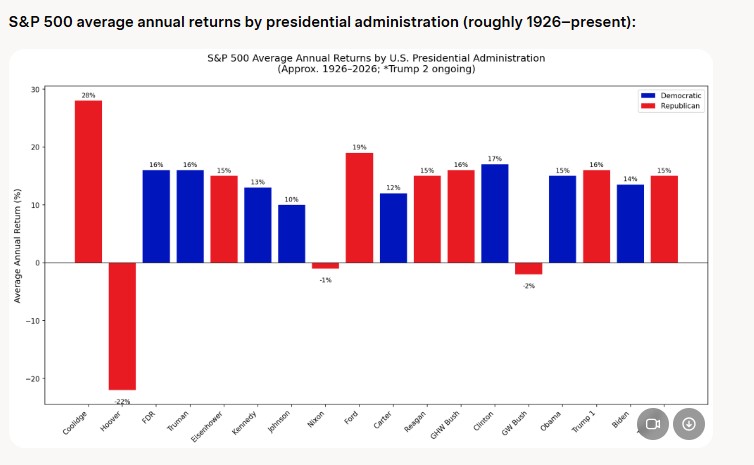
Many will suggest that market fears of a decline following a Democratic election victory are overblown. Over the past 100 years, stocks have performed marginally better under Democrats than Republicans.
Republicans will counter that this is because Republicans always have to clean up the financial mess left by Democrats, and that is why stocks don’t do quite as well on their watch.
In truth, if you throw out the aberration of the Great Depression, the returns are about the same, regardless of who has been in power.
However, it should be noted that caution may still be warranted because business cycles may carry into one administration that began in another, and charts like this don’t indicate which party controlled Congress, only which party controlled the White House.
And we would add one other caveat. The chart above was compiled when the Democratic Party was still a “mainstream” party that did call for a larger welfare state but did not advocate directly for socialism. Today’s Democratic Party is very different from what it was then, so historical comparisons may not work well.
We could be looking for something more like the Brazilian election, although, to be fair, Lula the socialist has been in power for years, and hence, it is nothing new. Having an American socialist party in charge would be something quite new. Hence, a Democratic sweep could be quite a shock to the markets.
The markets have been vulnerable for some time. Not only is margin debt high, but general debt levels are also high by historic standards, and financial leverage can exacerbate market moves. The market has also been overvalued, and both earnings and corporate cash have been highly concentrated in about 10 giant tech companies. Such overvaluation and high concentration historically have preceded bear markets.
As the election approaches in the US, markets have tightened up their trading ranges, and volatility has been declining. Some technical types suggest the market is “coiling”, like a snake, and that after the election a big move will result from this congestion.
If all that is true, the more important question is then: which way from the congestion does the market move, up or down?
One hint suggesting a better outcome is that the CNN Fear and Greed gauge has now moved towards deep market pessimism. On October 22, the gauge was as low as 19, in the extreme fear range, and has rebounded a bit since then.
Again, the “theory of contrary opinion” does not suggest such fears are unwarranted. They may well be. But it does show that such fear is already in the public mind and has likely already influenced investment decisions.
In short, much pessimism about the outcome of the coming US midterm elections is likely already priced in.
If the Democrats don’t win big, or don’t win at all, the market seems poised for a rebound.
However, the lesson we learn from Brazil is still important. Voters cannot vote to kill the “golden goose” of free enterprise capitalism and then expect their 401Ks to hold up or job opportunities to expand.
As Richard Weaver so aptly observed, “Ideas have consequences.”
*****
The author created the charts using GROK AI.
-Neland Nobel
Neland ‘Neil’ Nobel was born in Uniontown, Pennsylvania, and moved to Arizona in 1961. He attended ASU and earned a B.A. and an M.A. in history, with a specialty in economic and military history. He graduated Summa Cum Laude and received a Richard M. Weaver Fellowship from the Intercollegiate Studies Institute. He spent the next 45 years in the financial services industry, ending his career with a 25-year run with UBS as a portfolio manager and Certified Financial Planner. In retirement, he remains active, having founded the Prickly Pear in 2020 and continuing to contribute content. In his spare time, he is a certified firearms instructor and runs a hiking club and two shooting clubs. He is married with three children and three grandchildren.
The author’s views are their own and do not constitute financial, investment, or legal advice. Investing involves risk; please consult with a qualified professional before making any financial decisions.
Sourced from PRICKLY PEAR

This article is courtesy of ThePricklyPear.org, an online voice for citizen journalists to express the principles of limited government and personal liberty to the public, to policy makers, and to political activists. Please visit ThePricklyPear.org for more great content.