Whistleblower Videos Capture Pennsylvania Election Officials Destroying Evidence

By Margot Cleveland

A complaint alleges Pennslyvania election officials were tearing tapes ‘into pieces and placing … them into the trash stating they will have a campfire to burn the data.’

Several residents of Delaware County Pennsylvania filed a sprawling lawsuit Thursday against the former Secretary of State Kathy Boockvar, Delaware County, the Delaware County Board of Elections, and more than a dozen individual election officials. The lawsuit followed Wednesday’s night release of videotapes taken by a whistleblower capturing concerning behavior by several election officials in the Keystone state.

A source familiar with the lawsuit provided access to the tapes, noting the then-unnamed whistleblower had come forward with video evidence purporting to show Delaware County, Pennsylvania election officials destroying records from the November 2020 general election. The videos were also filed with the complaint and a bevy of exhibits the plaintiffs maintain support the allegations contained in their 91-page complaint.

The complaint, filed by Delaware County residents, Ruth Moton, Leah Hoopes, Gregory Stenstrom, as well as the Friends of Ruth Motion campaign, prevented both detailed alleged violations of state election law during the November 2020 election and claims of a conspiracy after the election to hide the numerous problems and illegalities that occurred during the last presidential election.

While the minutia of the election law recited in the complaint may escape the public’s notice, allegations that the defendants conspired to destroy or alter election data, materials, and equipment, “to prevent the discovery of the fraudulent results of the November 3, 2020 election, and the violation of various state and federal election laws,” when coupled with the videos, may finally awaken the sleeping masses to the cause of election integrity.

A May 21, 2021 request for 2020 election data and information submitted to Delaware County under Pennsylvania’s Right to Know Law served as an impetus for the alleged conspiracy and cover-up, as the complaint told the story.

A week later after the Right to Know request, a conversation is captured between two individuals, identified by those with knowledge of the lawsuit, as James Allen, the Director of Election Operations for Delaware County, and Jim Savage, identified by Delaware County’s directory as the Chief Custodian/Voting Machine Warehouse Supervisor.

In that video provided to The Federalist, Allen is heard telling Savage, “Then get rid of the pads and the second scanners.”

“We can’t talk about it anymore,” Savage replies, with Allen questioning, “Why?” “It’s a felony,” Allen countered.

The complaint added more texture to this video, alleging that Savage then “encouraged a private conversation to continue the conversation of the removal of the pads and scanners due to other Delaware County employees and [contract employee] Regina Miller,” being present.

The following month the whistleblower filmed a conversation she had with another Delaware County official, James Ziegelhoffer, according to a source with knowledge of the lawsuit. Ziegelhoffer, also known as Ziggy, held the position of “Judge of Election” for the Western Precinct in the Media Borough.

This tape purports to capture Ziggy saying, “What we have here . . . is evidence. Right? Let them figure that out.”

The whistleblower interjects, “Yes, but what I don’t understand and this makes — honestly this makes me nervous. Is why tapes were being thrown away?”

Ziggy begins to deny the claim, “No, no tapes were,” when the Whistleblower cuts him off:

“No, you guys have been throwing away tapes … so what tapes are you throwing away? Like why?”

“They’re all unidentifiable,” he counters before the whistleblower interrupts again:

“But it’s been that way since the November elections, so why would you throw anything away. Because you have to save it for 22 months,” the unnamed source is heard saying in the video, a reference to federal retention mandates.

“Yes there are tapes that are being tossed,” Ziggy finally acknowledges, but adds, “but they are of no audit value.”

A third video appears filmed in the same large room and captures a man identified by individuals with knowledge of the lawsuit as a Delaware County lawyer, Tom Gallager. As Gallager tears the tapes from the voting machines and discards them, the whistleblower can be heard asking: “Tom, why do you have to rip it up? Makes you feel better?”

“At this point,” Gallager replies, “I don’t want anybody to pick it up, and thinking we threw stuff away.”

“We’re gonna have a little campfire going,” Ziggy adds.

Several allegations in the complaint mesh with this video as well, with the plaintiffs alleging Delaware County layer, Tom Gallagher, and Ziegelhofer “set up a long table full of November 3, 2020, election data, and selectively destroyed the machines/proof tapes along with other November 3, 2020 records by tearing it into pieces and placing [it] into the trash stating they will have a campfire to burn the data.”

“Regina Miller became nervous” the complaint continues, alleging that Miller “informed the pair that they were violating numerous state and federal laws.” According to the complaint, Ziegelhoffer justified his actions by claiming “there was no audit value” to the November 3, 2020, election data.

Miller, who was a contract employee with Monarch Staffing, also claimed that in July of 2021, Allen threatened to consider a complaint taken to anyone else but him, as a “second and final violation of chain of command.” The complaint further alleged that Savage “told Regina Miller that he would have someone killed if he was ever betrayed by someone at work and described a story that he heard regarding someone from the county that someone “ratted on.”

Attempts to speak with Allen proved unsuccessful, with an administrative assistant stating he was in a meeting, but agreeing to convey my media request to him. Allen did not return my call. A call to Savage went unanswered and the County also ignored requests for comments from the gentlemen along with Gallager and Ziegelhoffer.

After detailing the purported violations of election law and the alleged destruction of election records and the claimed conspiracy, the complaint presented five legal theories for recovery, with Count I for common law fraud, Count II for fraudulent misrepresentation, Count III for negligent misrepresentation, Count IV for a claim for common law quo warranto, which apparently is a Pennsylvania claim for fraud related to elections and Count V for Mandamus and Equitable Relief.

While, if true, the allegations seem to scream of violations of the law, none of the claims alleged seem a close fit to the facts proffered to the court in the complaint. Also troubling is grasping the remedy the plaintiffs seek.

Typically money damages are awarded for fraud, but how do you monetize the harm to a voter when he is disenfranchised by election officials who counted illegal or fraudulent votes? Similarly, what court order (or mandamus) or other injunction could make the plaintiffs whole again.

The litigation, however, may have served another purpose: To highlight what the plaintiffs believe were widespread violations of state and federal election law and to expose the alleged conspiracy to cover up those problems, and thereby prevent a repeat in future elections.

Still, the videos may not be enough for those so blinded by their distaste for Trump that they cannot see the real threat to our democracy: elections without integrity and an electorate unable to trust the official outcome.

*****

This article was published on November 19, 2021, and is reproduced with permission from The Federalist.

The Bush Family Affair With China

By John Meroney

From H.W. sitting down with Mao in 1975 to Neil Bush shipping off millions of masks to China last year.

This decision has not come easily. Those were the foreboding words of Mayor Sylvester Turner of Houston, Texas, as he gathered with other city officials before TV cameras on March 11, 2020. Local stations broke into daytime programming with the news everyone was dreading.

Turner coughed and announced that he was signing a public health emergency declaration. “In the best interest of the health and safety of the people, the Houston Livestock Show and Rodeo, which we all deeply love, is canceled.” The annual event had come to symbolize Texas culture as much as Mardi Gras defines New Orleans. The reason for closing it was the outbreak of Covid-19, Turner said.

News accounts said the virus that originated in China had arrived in the Lone Star State. A few hours after Turner’s declaration, the Houston metro area of more than seven million people ground to a halt, along with the rest of the country.

Watching the shutdown was 65-year-old Houstonian Neil M. Bush, scion of a family with deep roots in Texas. Son and brother to two U.S. presidents, Neil chairs the George H.W. Bush Foundation for U.S.-China Relations, a 501c3 organization named for his late father, the 41st president, who was, in Neil’s words, “a huge believer in the importance of the bilateral relationship between China and the U.S.”

The purpose of the foundation, Neil said, was “to get Americans to change their negative views” of China and recognize the country’s “natural kindness and gift giving.”

As the group’s leader, Neil had inside information on what was happening in China. During the last four decades, he had traveled to the country more than 150 times. Before most Americans ever heard the words “Covid-19,” Neil received reports that people in China were dying from a mysterious virus. To try to control it, the Chinese government ordered its citizens to wear medical face masks when they went outside.

There were few places in the U.S. that still made masks and other protective gear. China produced 20 million masks each day.

In early February 2020, the Bush Foundation found two million masks close to home, in Mexico. They persuaded Chubb and Walmart to pay for the masks, and FedEx flew them without charge to China, even though the bulk of the world’s masks were already made there.

As Houston and the rest of the country locked down in mid-March, Neil was acutely aware of something that made him, and the Bush family, unique: a decades-long devotion to work in China.

Following Turner’s address, doctors interviewed on TV said the virus would kill millions across the planet.

Spindly and resembling his father in his awkward mannerisms, Neil Bush introduces himself in speeches, “I’m Neil Bush, the favorite son of George and Barbara Bush,” a quip that usually generates uncomfortable laughter. Both his parents died seven months apart in 2018 and their deaths left him raw. When talking about them, he often tears up.

For three years before their deaths, Neil and the rest of the Bushes anguished over the family legacy. After President George H.W. Bush’s reelection loss in 1992 and President George W. Bush’s disastrous decision to go to war in Iraq, the family’s political reputation was shattered. Even Barbara Bush seemed eager to call it quits. “There are other people out there that are very qualified,” she said on Today in 2013. “We’ve had enough Bushes.”

Neil’s brother, the former governor Jeb Bush of Florida, tried to resurrect the family business by launching a campaign for the GOP presidential nomination in 2015. His placards read “JEB!” but any enthusiasm that may have existed died on June 15 of that year with a buzzsaw aimed right at the Bushes and the policies they championed.

Donald Trump lambasted military interventionism and “free trade” with China in his campaign for president. He also did something unthinkable to other Republican candidates: held former President George W. Bush to account for the terrorist attacks of September 11, 2001.

“When you talk about George Bush, I mean, say what you want, the World Trade Center came down during his time,” Trump said in an interview he gave to Bloomberg TV in 2015.

He also assailed decades of rotten trade deals, culminating with China’s entry into the World Trade Organization in 2001, a watershed move that was encouraged by Bush 43. The result was that thousands of factories in the U.S. closed. Many of them moved to China.

On a campaign stop in New Hampshire, Jeb said his father grew so angry watching Trump’s critiques that he threw his shoes at the TV set.

Maureen Dowd always said the Bushes suffered from daddy issues. Maybe what made them so angry about Trump was that he sounded a lot like their patriarch, Prescott Sheldon Bush, the Republican U.S. senator from Connecticut from 1952 until 1963. “I was never a free trader,” the old man said in an oral history in 1966. “I never felt that we could abolish tariffs and do away with all protective devices, because we would have been flooded with imports which would have hurt our economy, hurt our defense posture, and I felt that these things had to be done gradually, selectively.”

The most important theme in Trump’s campaign and later presidency was China, how it was set on dominating and controlling the United States. For years, Trump had called China “our biggest long-term challenge.” He charged that Democrats and Republicans, and especially the Bushes, had disregarded China’s bad behavior so they could gain access to Chinese markets.

Trump also said, “Obama bowed to China and allowed them to steal our future.” He emphasized China’s currency manipulation and its theft of intellectual property. “Those who pretend China is our friend are either naïve, incompetent or both. The Chinese can be reined in easily—we are their biggest customer. All we need is a president willing to stand up, not bow down to China.”

In June 2020, William P. Barr, who had served as attorney general for H.W. from 1991 to 1993 and was now Trump’s attorney general, delivered a speech where he declared that the U.S.’s response to the global ambitions of the Chinese Communist Party was “the most important issue for our nation and the world in the 21st century.” Barr also accused China of engaging in industrial espionage, cyberattacks, and extortion.

“As the pandemic spread around the world, the PRC hoarded the masks for itself, blocking producers, including American companies, from exporting them to other countries that needed them,” Barr said. “It then attempted to exploit the shortage for propaganda purposes, shipping limited quantities of often defective equipment and requiring foreign leaders to publicly thank Beijing for these shipments.”

It was a remarkable address coming from someone who had been an integral part of an administration that made trade and cooperation with China a centerpiece. The attorney general’s warnings were echoed in major speeches by Secretary of State Mike Pompeo, National Security Advisor Robert O’Brien, and even FBI Director Christopher Wray.

Maybe the biggest thing Trump did as president was apply tariffs on imported goods from China, measures President Joe Biden has kept in place. Because these transformations were such a departure from Bush family policies, they made a future for them in national politics difficult.

In December 2019, Neil’s 33-year-old son, Pierce Mallon Bush, announced a surprise run for U.S. Congress from Texas’s 22nd District. He decided to eschew his family’s policies and instead campaign on Trump’s, including tightening the border.

Pierce Bush lost the GOP primary. Republicans chose Sheriff Troy Nehls of Fort Bend County, who also campaigned on Trump’s issues—“Standing with President Trump” read a banner on his website. Two days after winning, the sheriff removed the pro-Trump banner. He still went on to beat the Democrat in the general by almost 29,000 votes.

* * *

Neil Bush struggled for decades to find his footing. The media took note of him when he was just 26, but only because he happened to be friends with Scott Hinckley, brother of the man who tried to assassinate President Ronald Reagan. Neil and Scott had planned to have dinner together in Denver on March 31, 1981, the day John Hinckley shot Reagan and three others in Washington. During ABC TV’s live coverage of the assassination attempt, correspondent Steven Greer reported glibly, “Their plans have been canceled.”

By the early 1990s, Neil’s image had grown even more dubious. Democrats and the media made him the face of the savings and loan meltdown. His story was featured on the cover of Playboy in June 1991: “HOW NEIL BUSH WENT ASTRAY.” The tagline: “Running with the biggest rats of the S&L mess, the president’s son became the poster boy of bunko banking.”

“I was never accused of anything illegal, and yet I would be confronted by people, ‘You should be thrown in jail.’ I remember going to Washington and there were ‘Jail Neil Bush’ signs pasted on the telephone poles. It hurt me business-wise for a long time,” he said.

Neil found his destiny with China, a country integral to the Bush family since President Richard M. Nixon appointed ex-congressman George H.W. Bush as ambassador to the United Nations in 1971. (Nixon told his aide Bob Haldeman, “Bush will do anything for the cause.”)

On October 25, 1971, the U.N. voted to admit the People’s Republic of China and expel Taiwan. U.N. Secretary General U Thant asked all members to “endorse the tremendous step forward” and “set aside suspicion and bitterness.” Neil, then 16, was in New York visiting his parents.

“The first thing [dad] did when the Chinese delegation arrived was invite them to a lunch at my grandmother’s home in Connecticut to show kind of American hospitality, to welcome them with open arms,” Neil said, choking up. “From that point on, his first real contact with Chinese leaders, my dad has had an affection for the Chinese people and has high aspirations for how our two great countries should be working together.”

After Watergate, President Gerald Ford huddled with Secretary of State Henry Kissinger about prospects for H.W. They thought he would make a good ambassador because he was easy to control. Ford offered the embassy in London or Paris. Bush didn’t want to pay what it would cost a diplomat to entertain in those cities, so he counteroffered with China instead, where the U.S. didn’t have an embassy but needed an “envoy.” Ford accepted and appointed Bush as head of the United States Liaison Office in Peking (now Beijing). Bush concluded that the experts on China knew just about as much as he did, so he did little to prepare for the job.

The post made H.W. into Washington’s chief representative in China. He held the job for 15 months, and the tenure appears to have had the largest role in forming his view of diplomacy.

Bush pedaled around Peking on a bicycle. He also kept a diary on a tape recorder. Much of it is about his dog, C. Fred; eating Chinese food (“They must have put something stimulating in the food, I couldn’t sleep all night”); and trying to “win over” the Chinese people and officials. Kissinger told him that goal was pointless. Still, Bush tried to organize cocktails, dinners, sightseeing. “My hyper-adrenaline, political instincts tell me that the fun of this job is going to be to try to do more, make more contacts… it will be fun trying,” he recorded.

When Kissinger visited in 1975, he took Bush and another diplomat, Winston Lord, with him to pay their respects to 81-year-old Mao Zedong. Mao seemed ancient and was surrounded by medical devices. He grunted a few formalities. When they tried to broach an issue of Sino-American relations, the old commie waved it away. “Fang go pi,” he muttered. Translation: “dog fart.” Toward the end of the meeting, Mao managed to get out a few words. “God blesses you, not us,” he said. “God does not like us because I am a militant warlord, also a communist. No, he doesn’t like me… He likes you three.”

Bush still didn’t get the communist machinations swirling around him, nor did he understand the general upheaval under way in the country. “I wish I could tell what China’s real interest is,” he said into his recorder. He also never seemed to grasp that it was dangerous for the Chinese if they socialized with him, that the government would penalize them for befriending an American.

To keep control, Kissinger cut H.W. out of the foreign service loop, a strategy that became obvious to Bush. Rather than learning about the surrender of the Vietnamese countryside through the State Department, Bush overheard chatter at an embassy drinking party.

“I clearly feel we are not fully clued in by Washington,” Bush said into his tape recorder. “I am just not going to worry about Kissinger’s peculiar style of operation, where he holds all the cards up against his chest and refuses to clue people in on what is really happening.”

Most of the time, Bush just seemed bewildered. “It’s difficult to define our function here,” he said on the tape.

After relocating to Houston, Neil Bush found there were investments to be made, enterprises to start. China seemed a good fit. Government officials there also wanted prominent Americans, and they fêted this son and brother to presidents when he visited.

Neil immersed himself in Asian business enterprises. SingHaiyi Group Ltd., a property development and management company based in Singapore, made Neil chairman. Executives wanted to invest in the U.S., and through what Neil calls “a networking of mine,” they found projects.

One was the Tri-County Mall in Cincinnati, Ohio. Wives of Neil’s friends recommended he purchase and redevelop it. “I said, ‘It must be in a good neighborhood if my friends are coming here,’” he told WCPO-TV in 2013.

Neil did well. He moved into a house across from his parents in Tanglewood, a Houston neighborhood where they’d lived since the 1960s.

Neil described his approach to life when he appeared on All the Best, a podcast hosted by George H.W. Bush’s grandson, Sam LeBlond, who is also Neil’s nephew. In a November 2019 episode, “The Meaning of Service,” Sam asked, “Can you give me more insight into your professional roles? How do you find time to do it all?”

Neil said, “I’ve found that the busier that you are, the more fun you have and the more you get done.” Neil went on to say that his real passion is leading the “Bush legacy movements.”

This must be quite a job because there are more than half a dozen such organizations. The George W. Bush Presidential Center’s motto is “World changers shaped here.” The George W. Bush Institute goes by “Shaping global leadership for future generations.” Points of Light is about “creating a global culture of volunteering” with a “global network” in 38 countries. (At a rally in Montana in 2018, Trump mocked Peggy Noonan’s famous phrase. “Thousand points of light, I never quite got that one. What the hell is that? Has anyone ever figured that one out? And it was put out by a Republican, wasn’t it? I know one thing, ‘Make America Great Again’ we understand. ‘Putting America First’ we understand.”)

The boards of directors for the “Bush legacy movements” are peppered with executives from Google, Bank of America, Goldman Sachs, Starbucks, General Motors, Disney Parks, MoneyGram, and other major corporations.

As the initial strains of the novel coronavirus were swirling around Wuhan, unknown to the rest of the world, Neil said on Sam’s podcast: “I’m the chairman of the George H.W. Bush Foundation for China relations, which is kind of a controversial situation right now given the hostility that Americans have towards China. Dad believed strongly that China should be an ally, dealing with our world’s biggest global challenges.”

When I lived in Washington, columnist Bob Novak schooled me on where George H.W. Bush stood when he announced he was running for president in 1980. Bob covered the campaign and said Bush hadn’t been elected to anything except two terms as a congressman from Houston more than a decade earlier. Nor had he run for anything since losing his second Senate race nine years earlier. Bob said any future Bush had in politics depended on an appointment by a Republican president.

That appointment came at the GOP convention in Detroit. After Ronald Reagan’s nomination was assured, he considered selecting former President Ford as his running mate. But when Ford gave an interview to Walter Cronkite in the CBS convention booth and said that if Reagan chose him, they would go to Washington as co-presidents, Reagan went in a different direction and named Bush as his V.P.

When I worked as an intern in former President Reagan’s personal office in Century City in 1991, it was rare to hear a mention of Bush, including by Reagan himself. An exception came in an interview Reagan gave to a former assistant, Martin Anderson, who asked about his vice president. “Would it be fair to say, given the extraordinary number of meetings, private one-on-ones with the vice president, that looking back on it he was probably your main advisor?”

Reagan answered, “I think he recognized his position as such that he didn’t attempt to volunteer something and say, ‘You ought to be doing…’ No, he wouldn’t do that at all.”

“But if you asked for his advice, he certainly would have.”

“Yes. But I always noticed—did you ever notice?—that in the cabinet meetings, in there with everyone else there, he never, never spoke up? He’d answer a question directly if I asked him.”

I recall stories about the weekly lunches Bush had with Reagan in the White House. Reagan loved practical jokes, especially when the vice president was the butt. On one such occasion, Reagan announced to Bush, “We really must isolate the things that America makes in the world and what we do best.” Bush nodded agreement. Reagan said, “For instance, condoms. Condoms are the thing that America makes that are best.” Bush said, “I didn’t know that.” Reagan said, “Yeah, that’s why at the end of each condom it has this huge ‘MADE IN THE USA’ printed on it.” Bush said, “I didn’t know that.” Reagan replied, “Well, George, you have to unroll them all the way to see it.”

When Bush ran for president again in 1988, he listened to his longtime friend and advisor James A. Baker III, who realized that the path to victory was campaigning on the idea of a continuation of a successful two-term Reagan presidency. “We wanted it to be about the same issues that the Reagan-Bush administration had been pursuing,” Baker said in an oral history. “We wanted it to be about lower taxes. We wanted it to be about strong defense.”

But over the course of George H.W. Bush’s presidential term, he sent us to war in the Persian Gulf, raised taxes, and pushed for “free trade,” including with China. He said that “the more economic contact we have with China, the more they are going to see the fruits of market economies.” That philosophy didn’t seem to work very well when, after the massacre of students in Tiananmen Square, Bush called his “old friend” Deng Xiaoping to lodge a protest. Deng refused to take his call.

Still, in 1990, Bush said, “The whole fact that we’ve had economic involvement with China has moved China more toward reform than if we hadn’t had it.”

In July 1991, the National Victory Celebration Parade was held in Washington. Some 800,000 people turned out to cheer for the troops returning from Desert Storm. President Bush appeared to salute them and celebrate. According to polls, almost 89 percent of the American people approved of the job Bush was doing.

By the time he traveled to Los Angeles for the opening of the Reagan Library in November 1991, the country had grown weary. Factories were closing. There was a recession. A few weeks later, Pat Buchanan went to New Hampshire to challenge Bush for the Republican nomination.

“He is yesterday, and we are tomorrow,” Buchanan said. “He is a globalist, and we are nationalists. He believes in some Pax Universalis; we believe in the Old Republic. He would put Americans’ wealth and power at the service of some vague New World Order; we will put America first.”

In the presidential debate on October 11, 1992, Bill Clinton accused Bush of coddling tyrants. “I think it is a mistake for us to do what this [Bush] administration did when all those kids went out there carrying the Statue of Liberty in Tiananmen Square.” It was still fresh in the public’s mind.

Clinton continued: “Mr. Bush sent two people in secret to toast the Chinese leaders and basically tell them not to worry about it. They rewarded him by opening negotiations with Iran to transfer nuclear technology. That was their response to that sort of action… I would be firm. I would say, ‘If you want to continue Most Favored Nations status for your government-owned industries as well as your private ones, observe human rights in the future. Open your society. Recognize the legitimacy of those kids that were carrying the Statue of Liberty.’”

Bush gave a garbled reply, “Governor Clinton’s philosophy is to isolate China. He says don’t do it, but the policies he’s expounding of putting conditions on MFN and kind of humiliating them is now the way you make the kind of progress we are getting… We are the ones that have lowered the barrier to products with [U.S. Trade Representative] Carla Hill’s negotiation.”

You can see why Bush lost.

A decade later, H.W.’s national security advisor, Brent Scowcroft, who delivered that infamous toast to the Chinese, admitted, “I do have a regret about the trip to China in December of 1989, where I was, in effect, sandbagged by the Chinese. That’s a personal regret… It certainly didn’t help the view of the Bush administration and the way we were treating China.”

By the time of the election, just 37 percent of the country approved of Bush. A spectacular fall, the lowest number for an incumbent president since William Howard Taft in 1912.

About 20 years ago, I became friends with a man who helped run the Communist Party on the West Coast, a very successful screenwriter named Richard Collins. He lived in Brentwood, used Brooks Brothers diaries, and produced the TV series Remington Steele, but at one time he oversaw one of the most ambitious communist operations in the world. He showed me how the communist business model hasn’t changed for a century. The party uses whatever is the technology of the day, Collins said, but the basic plan for expansion is the same as it was in the time of Lenin, Stalin, and Mao.

In 2015, Chinese President Xi Jinping, who sees himself as Stalin’s successor, delivered a speech in which he talked about the importance of influencing and shaping the world. All the Chinese Communist functionaries were present for Xi’s address: the Central Commission for Discipline Inspection, the Propaganda Department, the Political-Legal Commission, the People’s Liberation Army, the Organization Department, and—essential to Xi’s overarching goal—the United Front Work Department, which is tasked with “managing relations with non-CCP elites and organizations with social, commercial, or academic influence inside and outside China.”

Collins told me how he and other party officials would establish a “front,” an organization whose membership is made up of non-communists (with a few exceptions) and their goal would be to pursue an objective which, on the surface, has no obvious relationship to communism itself.

The members become convinced they are serving U.S. interests by advocating “harmony” and “cooperation” between the U.S. and the communist country. In the case of the Chinese Communist Party, these apparent purposes help with its networking. They create “linkages” which can then be exploited by targeting individuals for grooming. Collins said the party leaders loved deploying psychological methods. They’d reassure the people in the front group that they were working for the “greater good,” praise their work as brilliant when it was hackery, and give them promotions and money. The front group would help advance the real communist objective, without the supporters aware they were spreading the communist party’s messages and extending its influence.

For the Chinese Communists, sympathizers are vital. These people are non-communists who are opposed to certain features of communism but believe it’s permissible to associate with them to advance “causes.” Collins said that the sympathizers are always naïve dreamers: If I’m tolerant and understanding, the communists will abandon their brutality, dictatorship, and deception. They think the Communist Party will become a benign, worthy movement. No more murdering Nobel Peace Prize laureates. They think involvement in a communist country’s markets will do magical things.

For decades, people at the Council on Foreign Relations, the U.S. Chamber of Commerce, the Club for Growth, Heritage Foundation, and Cato Institute believed this about China. In some ways, that belief was understandable, because their dreams came true in Korea and Taiwan. Both countries were run by dictators, then they “democratized” and became free and peaceful. But if you looked at China and understood its history, it was obvious it was going to be different.

“The FBI was all over the catastrophe. They busted in on a meeting. They were up the ass of the whole thing.” I’m listening to Joshua Eisenman, a professor of U.S.-China relations at Notre Dame who used to teach at the University of Texas at Austin. He’s telling me a fantastic story about the time the Chinese Communist Party tried to take over part of the LBJ School of Public Affairs. His first indication that something was up came when he and other scholars went to China for a conference in 2017.

The group’s host was a former U.S. foreign service employee, David J. Firestein. For several years beginning in the late 1990s, Firestein, who is fluent in Chinese and Russian, worked various positions in embassies in Beijing and Moscow. He also taught a course on political consulting at Moscow State University. Now Firestein was working for the EastWest Institute, a think tank, and promising to bring millions to UT to underwrite a new China Public Policy Center at the LBJ School.

During meetings in China, Eisenman says he detected a “lickspittle nature” to the events. Critiques of the Chinese government were always vague and never unpacked. He asked Firestein, “Why are we pulling punches? Why are we not engaging?”

“I was used to working at the American Foreign Policy Council, where exchanges were robust,” he recalls. “We were honest. We were bringing important people together and letting them speak forthrightly. The lack of this during the UT trip made me ask Firestein, what is going on?”

Firestein told him. His benefactor was something called the China-United States Exchange Foundation (CUSEF). Eisenman recognized it as a Chinese Communist Party front that operates in the U.S. It is led by Tung Chee-haw, vice chairman of the Chinese People’s Political Consultative Conference, a self-described United Front Organization. In fact, CUSEF is registered in the U.S. as an “agent of a foreign principal.”

The Chinese government didn’t want disagreements; in fact, the goal was to build more entities at UT focused on U.S.-China “cooperation.” Lectures about what China may be doing wrong aren’t on the agenda, Firestein said.

That’s when Eisenman realized that Firestein’s project at UT wouldn’t permit anyone to ever go off script because the Chinese communists were paying for it, as part of Xi’s influence operation. The center had to be in the interests of China.

“We have an obligation to the truth,” Eisenman said. “Things shouldn’t be sugarcoated. The goal should be to introduce China as it is, not China as China would like for us to see them. That’s our obligation. I was clear with Firestein that I wasn’t going to stand by and allow him to use these Communist Party funds at this public university. I have to teach my students in an objective fashion.”

Eisenman alerted then-dean Angela Evans and other senior faculty by email and then in person when he returned to campus in the fall. Soon Firestein attracted the attention of the Texas congressional delegation in Washington. FBI agents came to campus to question professors, Evans, and UT president Gregory L. Fenves.

Fenves canceled Firestein’s plan. “The University will not accept programmatic funding from CUSEF,” he wrote in January 2018. “Neither will we accept any funds for travel, student exchanges, or other initiatives from the organization… We must ensure that the receipt of outside funding does not create potential conflicts of interest or place limits on academic freedom and the robust exchange of ideas. I am concerned about this if we were to accept funding from CUSEF.”

It wasn’t a total loss for Firestein, though. He’d already hooked up with Neil Bush.

In the wake of President Trump’s meeting with Xi at the G20 summit in Japan in June 2019, Neil Bush appeared at what he called a “deeply urgent and important gathering” at the Auberge Discovery Bay Hotel in Hong Kong. It was a conference co-sponsored by CUSEF, the same group that tried to embed itself at UT, and another front operation, the China Center for International Economic Exchanges. Among the other Americans participating were chairman of the Asian Studies Center at the Heritage Foundation, Ed Feulner; former White House chief of staff in the Obama administration, William Daley; and president of the China Center at the U.S. Chamber, Jeremie Waterman.

The lectern wobbled as Neil stood behind it, and music continued over him as he started to deliver his keynote. Neil said that his foundation was “gearing up to do great work” and that it was “run so ably by a real China expert, David Firestein.” From the audience, Firestein nodded with approval.

For the most part, Neil’s speech was his usual patter—“Dad often stated that the U.S.-China relationship was the most important bilateral relationship in the world… China has benefited consumers with lower cost, high-quality goods”—but about five minutes in, Neil’s speech took a bizarre turn. He said he had just returned from a family trip to Croatia where he’d been “in full vacation mode.” One evening, his “quite astute” son-in-law asked about China. “Fueled by some wine,” Neil said, the discussion during the family trip turned heated.

Hard as it may be to believe, Neil then proceeded to describe the most damning criticisms of China, in the voice of his son-in-law. The treatment of ethnic minorities. Use of facial recognition techniques that keep tabs on citizens. The plan for big data to give individuals a social credit rating designed to control behavior. Use of intrusive Big Brother tactics, including monitoring social media to crack down on government critics.

Neil said his son-in-law called China “nefarious” and “aggressive” and said the country sought to dominate the world. “I still love the boy,” Neil remarked, “but he even compared authoritarian rule of China to that of Saddam Hussein in Iraq and Hitler in Nazi Germany. I almost flew out of my seat at this point.”

We don’t know what Neil said to his son-in-law that night on the family vacation. But his words about him at the communist-funded conference aren’t in doubt. He then proceeded to throw his son-in-law under the proverbial bus in front of the comrades.

“Clearly the wine was speaking,” Neil said. “My son-in-law has never been to China. His facts and assumptions are clearly flawed and based on half-truths or all-out fake news. His views show just how hysterical and challenging the times are. My son-in-law and many Americans only know what they hear.”

He closed his speech by imploring, “Those who believe the U.S. and China ought to work together need to find our voices… I advise my American friends not to meddle too much in the internal affairs of China.” He urged the U.S. and China to “collaborate.” He also said the U.S. and China “must set parameters to address the proliferation of fake news and to control other aspects of the cloud and internet and many others.”

In the most devastating time of the pandemic, when the U.S. and the rest of the world became desperate for medical face masks, Neil Bush realized that his sending two million masks to China in early February 2020 might be too much of a tell. In April, the Bush Foundation contacted Houston’s Mayor Turner with the news that it was going to donate 35,000 masks to the city. On April 27, 2020, Turner called a press conference for “a special, appreciative announcement.” From behind the same lectern where he announced the shutdown, Turner, who this time appeared masked, informed the public of the “generous donation from the Bush Foundation and our friends in China.”

Turner then introduced Neil Bush, who was also wearing a mask. “My father advocated for closer ties between China and the U.S. for years,” he said. “When China was going through the peak of the coronavirus, the Bush-China Foundation found sponsors and sent desperately needed supplies from Mexico to China. This is what Americans do.” Bush concluded, “China continues to be a reliable trading partner for our country during this time of need.”

For months, I asked Neil Bush if he would meet or talk on the phone. I wanted to ask him how he thought Covid-19 would impact U.S.-China relations. I was curious what he had to say about the role the Chinese Communist Party played in the way the virus was handled in China. About the Xinjiang internment camps where an estimated million Uyghurs are being “reeducated.” What can be done about the Chinese communists harvesting the organs of religious minorities? I wondered what blame he thinks the Communist Party deserves. When Neil refused to meet or talk, I even sent him my questions, hopeful I’d get written replies. His assistant said in the end he just didn’t have time.

I also tried to get Firestein on the phone, to no avail. He emailed: “Many thanks for reaching out; much appreciated. Alas, the timing is problematic for me; I’m in the midst of a heavy travel period and don’t really have any additional bandwidth over the next couple of weeks… this is probably the busiest time of year for us. I do greatly appreciate your contacting me; thank you again and all the best with this article.”

I tried former president George W. Bush to see what he has to say about the work of the Bush-China Foundation but he, too, was busy.

With all the flash and pizzazz one would expect of a high-school A.V. club circa 1995, the video begins with a woman speaking too closely into a microphone. She introduces the man who is sitting in the spartan studio, Dr. Wang Huiyao, president of the Center for China and Globalization. “Live from Beijing,” the program (now posted to YouTube) is part of the center’s “Global Dialogue Series.”

Appearing through videoconferencing are Neil Bush, “a very distinguished guest,” and David Firestein, “a very old friend of China and a senior China hand.” Their faces are often too close to the screen. It’s not unlike zooming with your grandparent. “You do such wonderful work bringing ideas and helping inform the public,” Dr. Huiyao says to them.

For close to two hours, with some 200,000 viewers watching live, according to Dr. Huiyao, Bush and Firestein hit all the usual talking points. Firestein attacks Trump for “racially charged and racist rhetoric.” He says, “The language matters, the communication matters, and boy, what I wouldn’t give to have a way of thinking about communication and thinking about bringing people together of the type we saw under the presidency of George H.W. Bush. To his credit, Joe Biden has banned [racist] language in the White House… I think we’re getting back to norms that were established under many presidents.”

Firestein also urges the U.S. to reopen the Chinese consulate in Houston, desist from efforts to shut down Confucius Institutes, and pursue trade and investment with China.

About an hour into the program, Neil launches into a monologue on the origin of Covid-19. “Who cares where it originated?” he says. “Whether it originated in a lab, or from a bat, or from the United States—wherever it originated, who cares?… Throw away the crazy conspiracy theories and just assume that there was an origin of some kind. It doesn’t matter where it originated. Let’s deal with it together.”

Still curious about the masks the Bush Foundation sent to China and where they fit in with the whole scheme, I called Peter Navarro, who at the time the masks were sent was assistant to the president and director of trade and manufacturing policy in the White House. He is also tough as nails on the China issue.

Do you know anything about Neil Bush sending two million masks to China when we needed them? I asked.

“No, I don’t,” Navarro said. “But what I do know is that the Bush family, and that person, should be registered foreign agents for the Chinese Communist Party. He’s the Republican equivalent of Hunter Biden who basically sold out the country and traded off their famous fathers’ names. This happened because it’s part of the Chinese Communist Party game plan, their strategy. It’s either money pots or honey pots. With honey pots, it’s like Eric Swalwell—he’s sleeping with a Chinese spy and she gets information from him. With Neil Bush and Hunter Biden, it’s the money pot. The Chinese Communist Party, that’s what they do. They co-opt our politicians.”

U.S. President George W. Bush and Chinese President Hu Jintao meet with the press after their bilateral meeting at the Great Hall of the People November 20, 2005 in Beijing, China. (Photo by Adrian Bradshaw-Pool/Getty Images)

Nobody wants to air the family laundry if they don’t have to. Given that, it’s easy to see why George W. Bush feels more comfortable talking about his hobby of painting portraits of immigrants, as he did last summer on C-SPAN when he was interviewed by his daughter Barbara. Or why, on the 20th anniversary of the 9/11 attacks, he stood up at Shanksville where one of the hijacked planes crashed and compared the terrorists who killed 2,977 Americans to Trump supporters. It’s important for the Bushes to change the subject.

Reflecting on the four decades of Bushes in China and what it has wrought, and the $5 million or so the Bush-China Foundation gets from a Chinese Communist Party front, I was reminded of the remark W. made after he listened to Donald Trump’s inaugural address in 2017. In the speech where Trump said, “Washington flourished but the people did not share its wealth. Politicians prospered but the jobs left and the factories closed. The establishment protected itself but not the citizens of our country.” In the words of W., “That was some weird shit.” 

*****

This article was published on November 1, 2021, and is reproduced with permission from The American Conservative.

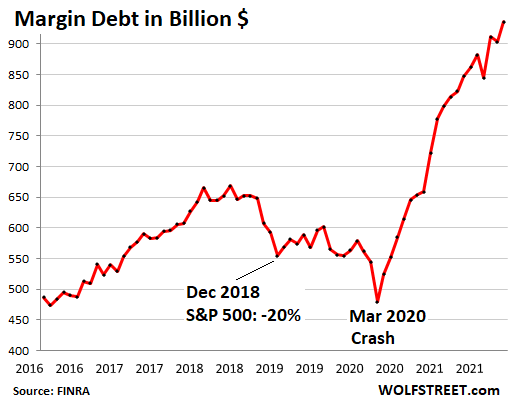
Stock Market Leverage Spikes, Margin Debt Up 42% YoY. Fed Warns about High Leverage Ratio of “Younger Retail Investors”

By Wolf Richter

“Potentially Destabilizing Outcome could emerge if elevated risk appetite among retail investors retreats rapidly.” But what the heck.

Only part of the leverage in the stock market is tracked and disclosed on a monthly basis. Much of the leverage happens in the shadows, including Securities Based Lending (SBA) that banks may or may not disclose on a quarterly or annual basis; leverage at the institutional level such as with hedge funds, an $8.5 trillion industry; and leverage associated with options and other equities-based derivatives.

It’s only when something blows up that we can see tidbits of this leverage emerge in all its splendor, such as when Archegos imploded earlier this year.

The only leverage data we do get on a monthly basis is margin debt at brokers, reported by FINRA. And we got another doozie: Stock market margin debt spiked by $33 billion in October from September to another all-time high of $936 billion, up by $277 billion, or by 42%, from a year ago, and up by 67% from October 2019

The increase in margin debt has become a huge outlier, compared to prior years, with margin debt ballooning by 42% year-over-year and by 66% in two years, summarized by this chart of year-over-year changes, with the period since March 2020 in red:

This type of stock market leverage doesn’t predict when the market will crater. What it does predict is that when this market is going down hard enough, it will trigger massive bouts of forced selling as margin calls are going out, and leveraged investors have to sell stocks to pay down their margin debt, which then pushes down prices further, which then triggers more forced selling, and more fears of forced selling, as portfolios are being liquidated, thereby accelerating the swoon.

This is why leverage is a risk to financial stability. And why the Fed keeps talking about leverage in its Financial Stability Reports.

But apparently no one at the top of the Fed – least of all Powell and the other members of the FOMC – ever reads these Financial Stability Reports because the FOMC, out of the other side of its mouth keeps encouraging ever more leverage with its interest rate repression and money printing.

Margin debt is the big accelerator on the way up, as borrowed money enters the market and creates new buying pressure.

And margin debt is the big accelerator on the way down, as this borrowed money gets drawn out of the market and vanishes by paying off debts, thereby creating selling pressure.

High levels of stock market leverage are one of the preconditions for a massive sell-off. It’s hard to have a massive sell-off without a lot of leverage.

In its Financial Stability Report, released this month, the Fed is particularly warning about high leverage among young stock market investors.

“The median leverage ratios of younger retail investors are more than double those of all investors, leaving these investors potentially more vulnerable to large swings in stock prices, as they have a larger debt service burden,” the Fed said in the report.

“Moreover, this vulnerability is amplified, as investors are now increasingly using options, which can often boost leverage and amplify losses,” it said.

High leverage is a sign of high and growing “risk appetite,” as the Fed calls it. And concerning the risk appetite of these investors, and their reliance on social media, the report warns:

“A potentially destabilizing outcome could emerge if elevated risk appetite among retail investors retreats rapidly to more moderate levels,” the Fed said…..

*****

Continue reading this article, published November 18, 2021 at Wolf Street.

Western Companies Must Stop Helping China Become A Military Powerhouse

By Helen Raleigh

Since U.S. companies prioritize profit over national security, stopping their assistance to the Chinese military requires market-oriented solutions in addition to legislation. 

The U.S. Department of Defense recently released its annual report on China’s military power, which shows that China’s military has made astounding advancements to “modernize its capabilities and improve its proficiencies across all warfare domains” in a relatively short period. The report also made it clear that one of the main objectives of the Chinese military’s modernization is to fight and win wars “against a strong enemy,” a not-so-subtle reference to the United States.

The most significant advancement of the Chinese military is its navy, which was almost non-existent four decades ago and now is the largest in the world, “with an overall battle force of approximately 355 ships and submarines, including approximately more than 145 major surface combatants.” By contrast, the U.S. Navy has a battle force of 293 ships as of early 2020. The DOD report also highlights that the Chinese People’s Liberation Army (PLA) has heavily invested in advanced technologies such as artificial intelligence (AI).

The PLA’s goal is to “make weapons systems and military operations more networked and autonomous” and change “the future of warfare faster than expected.” Some military experts believe China is already surging ahead of the United States in the arms race for AI.

How did the PLA manage to modernize at such an astonishing speed? Besides heavy investment from the Chinese government, western companies have played a crucial role. Here are three examples.

German Engines Powered the Chinese Navy

German media recently disclosed that several types of Chinese navy warships are “powered by engines that were either developed or built by German manufacturers.” MTU, one of the German manufacturers, “was a regular supplier of engines for Luyang III class missile destroyers through a licensed production plant in China.” Luyang-class destroyers are equipped with state-of-art weapons systems and can launch land-attack cruise missiles, long-range surface-to-air missiles, and anti-submarine missiles.

Additionally, MTU supplied “engines that were used in China’s Song-class submarines.” A strong navy has enabled China to expand its territorial claim in the South China Sea, intimidate neighboring countries, disrupt standard commercial and exploration activities, and strengthen its ability to invade Taiwan.

MTU insists it didn’t directly supply the Chinese navy with its engines. It simply engaged in commercial transactions with Chinese companies that are supposedly purchasing its engines for civilian usage. However, MTU engines are so-called dual-use technologies that don’t require either export licenses or government scrutiny. Knowing these legal loopholes, the Chinese government has pursued a military-civil fusion development strategy, which “integrates and leverages science and technology innovations across military and civilian sectors” and “blends military and civilian expertise and knowledge.”

In practice, the Chinese military relies on Chinese civilian companies to acquire advanced dual-use equipment and technologies for military development, while evading both the European Union’s and U.S. exports controls. That approach has significantly helped the Chinese military’s development in AI and semiconductors, often with eager cooperation from western firms.

Americans Help Speed Up the Chinese Military’s AI

A team of researchers at the Center for Security and Emerging Technology at Georgetown University released a report last month that highlights the crucial role U.S. companies play in supplying China with data, software, and funding for the nation’s AI development. The report finds that western firms have provided various Chinese military PLA units with commercial, off-the-shelf autonomous drones and AI-enabled surveillance software — AI tools that are ready for use.

The report also reveals that most of the advanced computer chips at the heart of China’s military AI systems are designed by U.S. firms such as Intel, Nvidia, and Xilinx. Furthermore, U.S.-based venture capital companies are financing Chinese companies that supply the Chinese military with AI-based battle management and cybersecurity software.

The most troubling aspect is that since most Chinese military suppliers also sell equipment and technologies to civilian companies, many are not blacklisted by either the U.S. Treasury Department or the Defense Department. These companies have practically had free rein to acquire sensitive technologies and equipment with little to no restrictions.

U.S. Companies Help China Develop Chips

Like AI, the semiconductor industry is another area where western companies have lent China’s military a helping hand. Semiconductor chips are essential components of almost all electronic devices, from computing to health care to the military and more. According to the Chinese government’s Made in China 2025 initiative, the semiconductor sector is one of the top ten industries that the government has heavily subsidized, hoping to make China self-sufficient in chip manufacturing and dominant in global high-tech manufacturing.

Out of concern for national security, the Trump administration imposed strict restrictions on exporting American semiconductor chip technology to Chinese companies that supply the Chinese military. China’s Semiconductor Manufacturing International Corporation (SIMC) is one such Chinese company on the U.S. export control list.

SIMC is a national champion identified by Beijing to lead China’s semiconductor chip development. It has received large government subsidies and is backed by several Chinese state-owned enterprises that also are suppliers of the PLA. The Biden administration expanded the export control list, banning Americans from investing in 59 Chinese companies with alleged ties to defense or surveillance technology sectors.

U.S. Companies Invested Despite China’s Atrocities

Despite these restrictions, the Wall Street Journal reports that Silicon Valley venture-capital firms such as Sequoia and chipmakers such as Intel and their Chinese affiliates have been helping build China’s semiconductor industry by exporting sensitive technological know-how, investing in Chinese chip-making firms, and raising money from foreign investors to fund Chinese chip making start-ups.

Companies such as Intel have been very vocal in their home countries, taking a stand against what they claim is systemic racism and racial injustice. Yet, at the same time, they have shown little concern as they assist Beijing with its military development, even though Beijing has committed gross human rights violations against its own people, poses a threat to liberal democracy, and has the ambition to spread authoritarianism around the world.

Thanks to these American companies, Chinese firms have made significant progress in key technologies and are quickly narrowing the gap with western chip makers in technology and manufacturing. These technological advancements have helped make the Chinese military a powerhouse and give the Chinese Communist Party powerful tools to advance its geopolitical ambitions and disrupt the liberal world order.

Passing Laws May Come Too Late

In a statement, Sen. Bob Casey (D-Pa.) criticized these American companies for prioritizing “their bottom lines without regard to the broader American economy or our national security.” He and Sen. John Cornyn (R-Texas) are working on legislation that would “screen outbound U.S. investments and the offshoring of critical supply chains and tech-industry resources to adversaries like China and Russia.”

While such legislation is a welcome move, it may not be the most effective and timely solution because a bill takes months of deliberation. By the time it becomes a law and actually goes into effect, it may be too late because technological advancement takes place daily, and China may have already acquired all it needs to be technically self-sufficient before the bill becomes law.

Since western companies are more interested in fattening their bottom line than national security, stopping their continuing assistance to the Chinese military requires market-oriented solutions, in addition to legislation.

For example, Microsoft’s LinkedIn recently pulled out of China because it finally realized that it could not straddle between two opposing political and value systems and be successful. The increasing censorship Beijing demands has threatened the company’s reputation and subjected it to enormous legal risks back home, eventually hurting its profit worldwide. Patriotic shareholders of western companies should point to LinkedIn as an example to demand management to be accountable for subjecting their company to the risks of assisting the Chinese military’s modernization.

Another way to get the attention of western companies is for some of their most essential domestic customers, such as the Department of Defense, to put their foot down and demand companies pick a lane between liberal democracy and China’s authoritarian regime. A company that engages in helping the Chinese military at the expense of America’s national security doesn’t deserve to have millions or even billions of dollars worth of contracts with the U.S. government. Such a company shouldn’t be allowed to profit from U.S. taxpayers. Hopefully, western companies will finally change their behavior when management realizes they are hurting their bottom line if they continue business as usual.

*****

This article was published on November 17, 2021, and is reproduced with permission from The Federalist.

Western Sheriffs Association Declares ‘no confidence’ in DHS Secretary Mayorkas

By Bethany Blankley

The Western States Sheriffs’ Association has issued a declaration of “no confidence” in Department of Homeland Security Secretary Alejandro Mayorkas over his handling of the border crisis.

The association, which represents 17 states west of the Mississippi River, argues that illegal immigration is “not a new phenomenon” and has been occurring for decades. But what is new, they argue, is “a complete and total breakdown of efforts of the past several years.”

The letter is signed by Sheriff Leo Dutton of Lewis and Clark County, Montana, president of the association, and retired Sheriff James Pond, executive director of the association.

Of particular concern are the hundreds of thousands of people who entered the U.S. illegally from over 160 countries, some of whom are from special interest countries with terrorist ties, they argue, and that the director of Homeland Security tasked with protecting Americans isn’t fulfilling his oath to do so.

Mayorkas “was sworn into his position to follow the rule of law in securing our nation,” they said. But since his appointment “we have seen his policies enacted that are personal and political ideologies that continue to dismantle the security of our country and the enforcement efforts of the hardworking federal officers assigned to an extremely difficult task.

“America’s sheriffs have watched in disbelief as the southern border has turned into an invisible line in the sand,” they add. “Border patrol agents have been relegated to daycare supervisors at housing units and when they do attempt to act, they are scrutinized, placed on administrative leave, and investigated for political gain.”

They also point to “the impact of massive amounts of drugs being moved across interstate highways and small rural roads contributing to an historic fentanyl crisis in the U.S.”

More people have died in the U.S. from fentanyl overdoses than from COVID-19 in the last 20 months, they argue, because the drug being produced in Mexico is being brought across the southern border “at alarming and unacceptable levels.”

In his testimony before the U.S. Senate last week, Mayorkas gave himself an A grade “for effort” and insisted the southern border was under control, despite local law enforcement and Border Patrol agents being overrun by an unprecedented number of people pouring through after Mayorkas’ new policy directives made clear most foreign nationals entering illegally wouldn’t be deported or arrested for breaking the law or even for being in the country illegally.

“I put 100% into my work, and I’m incredibly proud to do so,” he said.

The association disagrees, arguing its membership “must emphatically state our position of having NO confidence in the ability of Secretary Mayorkas, and his leadership within the Department of Homeland Security, to affect any positive outcome ion this matter.”

The association has called on the Biden administration to “take appropriate steps to remove Secretary Mayorkas from his leadership position” and appoint a new leader to head the agency who “recognizes, respects and will enforce the rule of law for the safety and security of our nation.

“We demand a new leader who will work with our federal enforcement partners and the administration to restore security and safety on our nation’s southern border,” they write.

The Association has partnered with the Southwest Border Sheriffs Coalition and the Texas Border Sheriffs coalition to address crime resulting from illegal immigration. The association represents sheriffs from Arizona, California, Colorado, Idaho, Kansas, Montana, Nebraska, Nevada, New Mexico, North Dakota, Oklahoma, Oregon, South Dakota, Texas, Utah, Washington, and Wyoming.

Neither the Biden administration nor DHS has issued a statement in response to the declaration.

Their vote of no confidence comes after the National Sheriff’s Association and the Arizona Sheriff’s Association publicly opposed Biden’s nominee for commissioner of U.S. Customs and Border Protection, Tucson Police Chief Chris Magnus.

*****

This article was published on November 20, 2021, and is reproduced with permission from The Center Square.

A Home-Schooled High Schooler Debates the Woke Children.

By Ellie Fromm

Editors’ Note: The following is an essay by a 16-year-old home schooled young lady. The essay speaks for itself but we feel it important to emphasize that when young Americans are taught the foundational principles of our Republic without the leftist, ‘woke’ indoctrination so pervasive in our public school system, a responsible and educated young adult enters society ready to defend truth and reality. The Prickly Pear recently published a study from Harvard University examining the profiles of home schooled students. Ms. Fromm clearly reflects the findings in this study and we hope that many more like her follow into the dialogue of this nation and the battle to combat the woke assault on American society aided by the media, the educational system, our government, and our corporate leaders.

I attend a local university in Phoenix, Arizona as a homeschooled, dual enrollment high school student. Two weeks ago, my professor initiated a fiery discussion in Government class. My professor is conservative but encourages debate in the class and does not push his beliefs upon others. My class consists of 90 students if everyone is there, but usually there are only about 60. On that day we were discussing how certain demographics of people tend to vote. I say ‘tend’ because not every person in a certain demographic votes the same way.

I was the first person called upon. I was asked to explain why I thought Black/Latino Americans tend to vote liberal. However, I mostly focused on black Americans, explaining “I think black Americans tend to vote liberal because, statistically, over 70% of black children grow up in homes without a father present and as we just discussed, you tend to vote as your father does. Because fathers are frequently not present in the black home, mothers are working extremely long hours and are often out of the home. Therefore, many of these children are mostly raised by the education system and their programs. Because the education system is liberal, they tend to grow up and then vote liberal”. Nothing radical, just a 16-year old’s ideas expressed for discussion.

Apparently, many of the students thought what I said was radical. Two young black women and a young white woman disagreed with me and became extremely frustrated because I was not going along with their ideologies. One of the young black women claimed that I had a better chance of getting into college and getting a job solely because I am white. However, when I brought up Affirmative Action, she had nothing to say about it. Also, keep in mind she says I have a better chance of getting into college while we are sitting in the same class at the same university. Another claim she made was that “they” were oppressing black people and the black community needs “something”. When I asked her who “they” were or what the “something” is, she had no idea and could not answer my questions. With each question I asked she became more frustrated. I was calm and respectful throughout this heated exchange.

After my questions, which received no adequate responses, the young white woman said that until recently black people had been discriminated against through redlining and such. My professor then stopped her, asking her if, by saying recently, she meant about 60 years ago. She said “of course” – as if she hadn’t been trying to trick me. The word recently implies within 2-3 years ago, not 60! To her point, I said I understood and acknowledged that there was racism. I was about to go on when about 20-25 of the students in the class yelled at me, saying “THERE STILL IS!”.

This is the same type of thinking currently happening in university administrations country-wide. Over 75% of universities have already implemented black-only dorms and over 75 universities offer black-only graduation ceremonies. Excuse me? This is segregation! Yet, students at these schools think this is perfectly normal. They think this is good. These social justice warriors are missing the racism and segregation in front of their own eyes! In fact, they’re embracing it! Also, on many streaming services they have black power sections filled with movies featuring black actors. For some reason, promoting certain movies based upon the color of the leading actor’s skin, instead of the content of the movie itself, is great. This is racism, but it must be okay because it is for black people, not against them. Remember, racism can go both for and against white people. Sesame Street explicitly announced in one of their episodes that your skin tone defines you and makes you who you are. This is completely and utterly wrong. As an eloquent African-American father stated in August at a Colorado Springs school board meeting rejecting the teaching of Critical Race Theory, “Let racism die the death it deserves.”

White people and the American nation are not inherently racist. I do not care what color your skin is, I care whether you are a good person. The amount of melanin someone has in their skin means absolutely nothing to the vast majority of Americans. Yet, today’s media is purposely trying to paint white Americans as evil. The issues of race and racism are centerstage in the media, but look around. America is a melting pot of people from all corners of the world looking past their differences to celebrate liberty and make better lives for themselves and their families. The media and elite want people to think white people are evil as a way to divide the nation. If they have us aiming at each other, we will never notice them taking over our God-given natural rights.

How does one 16-year-old make 25 liberals angry enough to yell at her? Destroy their ideologies. Logical questions to their statements made them angry enough to yell at me. When a simple question is asked the answer is obvious, but they do not want to acknowledge the answer because they do not agree with it. They had absolutely no examples of racist white people and the so-called oppressive system. Yet, examples such as Affirmative Action highlight a system that promotes minorities. Not knowing who “they” are or what “something” is challenges liberal ideologies. Remember, precise language is extremely important when writing and debating if you want to get your point across.

As I was leaving class one of my classmates, a young black woman, stopped to talk to me. She informed me she agreed with my statements and thanked me for standing up for her community. Although I had left class frustrated as to how the discussion had ended, this young woman encouraged me. She helped show me that, even though I was frustrated, these types of discussions are not a lost cause.

The moral of the story is that liberals cannot handle someone simply asking why they believe a certain way. White people are not inherently racist. Yes, I’m sure there are racist people, but they come from all different races and are a minority. And for those who say white people are racist, what race freed the slaves over 150 years ago, and what nation was one of the earliest in the world to abolish slavery? White American men fought, were drafted, and put their lives on the line to free men and women of another race because they knew slavery was inherently evil. They had never met the people they were fighting for, yet 360,000 union soldiers died to free them. These men and their families paid the ultimate price to free their brothers and sisters of another race. We are equal.

A Home Schooled High Schooler Debates the Woke Children

By Ellie Fromm

Editors’ Note: The following is an essay by a 16-year-old home schooled young lady. The essay speaks for itself but we feel it important to emphasize that when young Americans are taught the foundational principles of our Republic without the leftist, ‘woke’ indoctrination so pervasive in our public school system, a responsible and educated young adult enters society ready to defend truth and reality. The Prickly Pear recently published a study from Harvard University examining the profiles of home schooled students. Ms. Fromm clearly reflects the findings in this study and we hope that many more like her follow into the dialogue of this nation and the battle to combat the woke assault on American society aided by the media, the educational system, our government, and our corporate leaders.

I attend a local university in Phoenix, Arizona as a homeschooled, dual enrollment high school student. Two weeks ago, my professor initiated a fiery discussion in Government class. My professor is conservative but encourages debate in the class and does not push his beliefs upon others. My class consists of 90 students if everyone is there, but usually there are only about 60. On that day we were discussing how certain demographics of people tend to vote. I say ‘tend’ because not every person in a certain demographic votes the same way.

I was the first person called upon. I was asked to explain why I thought Black/Latino Americans tend to vote liberal. However, I mostly focused on black Americans, explaining “I think black Americans tend to vote liberal because, statistically, over 70% of black children grow up in homes without a father present and as we just discussed, you tend to vote as your father does. Because fathers are frequently not present in the black home, mothers are working extremely long hours and are often out of the home. Therefore, many of these children are mostly raised by the education system and their programs. Because the education system is liberal, they tend to grow up and then vote liberal”. Nothing radical, just a 16-year old’s ideas expressed for discussion.

Apparently, many of the students thought what I said was radical. Two young black women and a young white woman disagreed with me and became extremely frustrated because I was not going along with their ideologies. One of the young black women claimed that I had a better chance of getting into college and getting a job solely because I am white. However, when I brought up Affirmative Action, she had nothing to say about it. Also, keep in mind she says I have a better chance of getting into college while we are sitting in the same class at the same university. Another claim she made was that “they” were oppressing black people and the black community needs “something”. When I asked her who “they” were or what the “something” is, she had no idea and could not answer my questions. With each question I asked she became more frustrated. I was calm and respectful throughout this heated exchange.

After my questions, which received no adequate responses, the young white woman said that until recently black people had been discriminated against through redlining and such. My professor then stopped her, asking her if, by saying recently, she meant about 60 years ago. She said “of course” – as if she hadn’t been trying to trick me. The word recently implies within 2-3 years ago, not 60! To her point, I said I understood and acknowledged that there was racism. I was about to go on when about 20-25 of the students in the class yelled at me, saying “THERE STILL IS!”.

This is the same type of thinking currently happening in university administrations country-wide. Over 75% of universities have already implemented black-only dorms and over 75 universities offer black-only graduation ceremonies. Excuse me? This is segregation! Yet, students at these schools think this is perfectly normal. They think this is good. These social justice warriors are missing the racism and segregation in front of their own eyes! In fact, they’re embracing it! Also, on many streaming services they have black power sections filled with movies featuring black actors. For some reason, promoting certain movies based upon the color of the leading actor’s skin, instead of the content of the movie itself, is great. This is racism, but it must be okay because it is for black people, not against them. Remember, racism can go both for and against white people. Sesame Street explicitly announced in one of their episodes that your skin tone defines you and makes you who you are. This is completely and utterly wrong. As an eloquent African-American father stated in August at a Colorado Springs school board meeting rejecting the teaching of Critical Race Theory, “Let racism die the death it deserves.”

White people and the American nation are not inherently racist. I do not care what color your skin is, I care whether you are a good person. The amount of melanin someone has in their skin means absolutely nothing to the vast majority of Americans. Yet, today’s media is purposely trying to paint white Americans as evil. The issues of race and racism are centerstage in the media, but look around. America is a melting pot of people from all corners of the world looking past their differences to celebrate liberty and make better lives for themselves and their families. The media and elite want people to think white people are evil as a way to divide the nation. If they have us aiming at each other, we will never notice them taking over our God-given natural rights.

How does one 16-year-old make 25 liberals angry enough to yell at her? Destroy their ideologies. Logical questions to their statements made them angry enough to yell at me. When a simple question is asked the answer is obvious, but they do not want to acknowledge the answer because they do not agree with it. They had absolutely no examples of racist white people and the so-called oppressive system. Yet, examples such as Affirmative Action highlight a system that promotes minorities. Not knowing who “they” are or what “something” is challenges liberal ideologies. Remember, precise language is extremely important when writing and debating if you want to get your point across.

As I was leaving class one of my classmates, a young black woman, stopped to talk to me. She informed me she agreed with my statements and thanked me for standing up for her community. Although I had left class frustrated as to how the discussion had ended, this young woman encouraged me. She helped show me that, even though I was frustrated, these types of discussions are not a lost cause.

The moral of the story is that liberals cannot handle someone simply asking why they believe a certain way. White people are not inherently racist. Yes, I’m sure there are racist people, but they come from all different races and are a minority. And for those who say white people are racist, what race freed the slaves over 150 years ago, and what nation was one of the earliest in the world to abolish slavery? White American men fought, were drafted, and put their lives on the line to free men and women of another race because they knew slavery was inherently evil. They had never met the people they were fighting for, yet 360,000 union soldiers died to free them. These men and their families paid the ultimate price to free their brothers and sisters of another race. We are equal.

Georgia Governor Orders Probe Into ‘sloppy’ November 2020 Vote Counts in Fulton County

By John Solomon

Brian Kemp says some audited results from state’s largest county are “inconsistent” and erroneous. One count of 950 votes for Biden actually appears to be just 92.

In a rare act for a state chief executive, Georgia Gov. Brian Kemp has referred the audited November 2020 election results in the state’s largest voting metropolis to the State Election Board after multiple reviews found significant problems with absentee ballot counting that included duplicate tallies, math errors and transposed data.

Kemp referred Fulton County’s risk-limiting audit results this week to election regulators, saying he was not asking for any changes to the declaration that Joe Biden beat Donald Trump but was alarmed by the level of sloppy vote counting in the county that includes the city of Atlanta.

The errors could have skewed the audit totals reported to the state by several thousand votes, according to a 36-item summary Kemp included with his letter. Biden was declared the state’s winner by about 12,000 votes.

“The data that exists in public view on the Secretary of State’s website of the RLA Report does not inspire confidence,” he wrote in his referral letter. “It is sloppy, inconsistent, and presents questions about what processes were used by Fulton County to arrive at the result.”

Kemp’s referral comes several months after a Just the News investigative report first raised questions about the audited election tallies Fulton County reported to Secretary of State Brad Raffensperger’s office after conducting a hand count known a risk-limiting audit.

Just the News reported the tally sheets Fulton County used for the audit/recount absentee ballots did not match totals from ballot images, in some cases appeared to include duplicate counts, and used batch numbers that did not correspond to existing ballot stacks.

A separate review conducted by Georgia lawyer Bob Cheeley, likewise, found irregularities this summer.

The referral to the State Elections Board is likely to add fuel to Secretary of State Brad Raffensperger’s push to place Fulton County elections into state receivership, meaning state officials and not county workers would supervise the next few elections.                   

Kemp wrote he first learned of the problems when a Georgia citizen named Joseph Rossi compared the audit tally sheets to ballot images, and found similar problems as those enumerated in the Just the News article.

Rossi recently referred his concerns to Kemp’s office, which did a similar analysis and confirmed there appeared to be serious errors in the final audited tallies Fulton County reported to the state.

Kemp’s referral letter identified numerous instances in which batches of absentee ballots appeared to have been counted twice.

For instance, one batch of ballots that awarded 93 votes to Biden and just four for Trump “appears to be duplicated” on the final report to the state, the letter said….

*****

Continuer reading this article, published November 19, 2021, at Just the News.

The Vampire Economy: Italy, Germany, and the US

By Jeffrey M. Herbener

Editors’ Note: Socialists have a habit of making everything a war. A war on poverty, a war on Covid, or the “existential risk of climate change.” In each case, it is an excuse to command more and more elements of the economy. It is not socialism per se as the ownership of the means of production stays largely in private hands. However, owners of “the favored businesses” get cheap loans, direct investment, protection from competition, tax breaks, and in many cases, the investors in such companies are members of, or cronies of, the political power brokers. It technically is more like the fascist model described below in some detail. Both the Chinese and US economies are to a greater or lesser degree, showing these characteristics. Clearly, environmental policy and healthcare concerns are pushing the US increasingly towards this model. Readers need to know this essential history and its conclusion. It doesn’t end well.

What is the link between fascism and socialism? They are stages on a continuum of economic control, one that begins in intervention in the free market, moves toward regimentation and greater rigidity, marches toward socialism as failures increase, and ends in a dictatorship.

The fascist system wrote Mises, “clung first to the same principles of economic policies which all, not outright socialist governments have adopted in our day, interventionism. Then later it turned step by step toward the German system of socialism, i.e., all-round state control of economic activities.”(1)

What distinguished the fascist variety of interventionism was its reliance on the idea of stability to justify extending state power. Big business and labor eagerly allied with the state to obtain stability against what Murray Rothbard called business fluctuations, the ups, and downs of particular markets that result from shifting consumer demands. They naïvely thought that state power could supplant consumer sovereignty with their own producer sovereignty over their industries while maintaining the greater productivity of the division of labor.

At first, the fascists used state spending, mainly for war, to eliminate business fluctuations. Only after they became dependent on the state did the leaders of big business and labor realize that they had merely traded consumer sovereignty for state sovereignty. Soon after they learned which one was the more exacting taskmaster.

To extend their control, the fascists bolstered fiscal expenditures with debt and monetary inflation. Not only did they hope thereby to dominate more and more industries with their expenditures, but also to boost public support for their regimes by generating economic prosperity. Instead, their reckless spending and inflating set in motion the boom-bust cycle. They took the depression as an opportunity to extend their power further by socializing investment with regulations while claiming that such measures would stabilize the business cycle.

The fascists found a readymade theoretical justification for stabilization policies in the work of John Maynard Keynes.(2) Keynes claimed that the instability of capitalism emanated from the free play the system gave to the “animal spirits” of investors. Driven by bouts of over-optimism and over-pessimism, investors alternate between bullish spending and bearish hoarding sending the economy into fits of boom and bust.

Keynes proposed to eliminate this instability with state control over both sides of the capital markets. A central bank with the power to inflate the money supply through credit expansion would determine the supply of capital funding and fiscal and regulatory policy would socialize the investment of capital.

In an open letter to President Roosevelt published in the New York Times on December 31, 1933, Keynes counseled this plan:

In a field of domestic policy, I put in the forefront, a large volume of loan expenditure under government auspices. I put in the second place the maintenance of cheap and abundant credit. . . . With these . . . I should expect a successful outcome with great confidence. How much that would mean, not only to the material prosperity of the United States and the whole world, but in comfort to men’s minds through a restoration of their faith in the wisdom and the power of government.(3)

Keynes was even more enthusiastic about the spread of his faith in Germany. In the preface to the German edition of the General Theory, published in 1936, Keynes wrote:

The theory of aggregate production, which is the point of the following book, nevertheless can be much easier adapted to the conditions of a totalitarian state than the theory of production and distribution of a given production put forth under conditions of free competition and a large degree of laissez-faire.(4)

State control of money, credit, banking, and investment became the blueprint for fascist stabilization policy. Thus, the expansion of state control under fascism followed a predictable pattern. Debt and monetary inflation paid for state spending. The resulting expansion of credit led to the boom-bust cycle. The financial collapse of the bust resulted in stricter regulation of banking and socialization of investment, which permitted more monetary inflation, credit expansion, debt, and spending. The consequent decline in the purchasing power of money justified price and wage controls, which became the focal point of all-around state control. In some cases more slowly and in other cases more rapidly, fascism followed this path toward central planning.

Italian Fascism

The Italian Fascists began spending and inflating to co-opt big business soon after the March on Rome in 1922. Industrial profits and production jumped during the consequent boom which lasted until 1926. Protectionist measures were also enacted during the boom to give an added benefit to steel, iron, automobiles, and shipbuilding. Under pressure on the lire to devalue in 1926, the Bank of Italy reversed course and the boom collapsed. By 1927, prices and wages were falling but not sufficiently to prevent widespread bankruptcy and depression. Businesses failed by the thousands in the 1930s.

From 1928–1932 production was cut by one-fourth and national income by one-third, and by the end of 1934 one-third of capital capacity sat idle and over one million workers were unemployed. The state progressively intervened to stave off the ill effects of its monetary inflation and extend its control. It bailed out big businesses and banks, fostered mergers and acquisitions, cartelized the remaining, now larger enterprises, and renewed spending, mainly for war.

Annual state expenditures in the early 1930s were double their levels of the early years of Fascism. As tax revenues failed to keep pace, deficits ballooned. Banks also combined and associated more closely with big industrial concerns under the supervision of the state. To rescue the big banks, which had accumulated significant holdings of industrial securities during the boom, the state nationalized their holdings in 1931 and issued new securities, backed by the state, to provide a source of new credit for the banks.

The state also created new and invigorated old credit institutions outside the banking system to provide added channels for credit. It appointed a majority of the boards of these new credit institutions and provided them with their funds by direct subsidies and by guaranteeing their industrial investments with state bonds. Private parties would invest in the state-guaranteed bonds of these new institutions that would then invest the funds in favored businesses.

Although the domestic purchasing power of the lire was rising in the early 1930s, the Italian state still overvalued it in foreign exchange. The resulting trade deficit and gold outflows led the state to limit imports and impose foreign exchange controls. When even the highest tariff rates in the world failed to close the trade deficit the Fascists adopted an import quota system enforced by licensing importers.

The burgeoning state control of business swelled the state bureaucracy and led to widespread centralization and corruption. Small businesses were left to fail and have their assets swallowed up by big businesses and big banks. Nearly 100,000 businesses failed from 1926–1935 in Italy, almost fourfold the number that failed in the previous ten years. By 1935, Mussolini boasted that fully three-fourths of Italian businesses rested on the shoulders of the state.(5)

The Ethiopian war in 1935 demonstrated the extent of Fascist control.(6) Annual war expenditures were fourteen times larger during the war years than previously. To meet these extraordinary expenditures, the Fascists resorted to monetary inflation and capital confiscation. Beginning in July, the gold reserve against the Bank of Italy’s notes was progressively relaxed. Even as the gold reserve sagged, from 5.25 billion lire in June of 1935 to 3.93 billion lire in October, the money stock rose to 15.27 billion lire. In the next few years, monetary inflation accelerated as the Fascists monetized the national debt which stood at 1.8 trillion lire by 1938. To curb the decline in the purchasing power of the lire, the Fascists resorted to price and wage controls which paved the way for all-around planning.

Confiscation of capital began in May of 1935, when banks, businesses, and individuals were required to turn all their foreign-issued stocks and bonds over to the Bank of Italy. By September, the state had compelled renters in cities and towns over a certain size to buy state bonds in amounts proportionate to their rents, all Italians to exchange their foreign credits for state bonds, businesses to invest all profits in excess of 6% in state securities, and investors holding heavily depreciated state bonds to exchange them plus liquid capital for a new issue of bonds at par value.

Carl Schmidt, in 1939, summarized Italian Fascism with these words:

Fascism rose to power as a preventive reaction, defending the pecuniary and sentimental interests of the propertied and quasi-propertied groups of towns and country from the spectre [sic] of revolution. . . . It not only sought to safeguard existing property rights, but also fostered further industrialization and concentration of business enterprise. . . . Yet, Fascism could not solve the basic difficulties of Italian capitalism. The deepening economic crisis in later years forced business enterprise to rest more and more on the support of the State. As the economic role of the State grew, a subtle shift of spirit and purposes took place. Governmental support of the going economic order called for an increasing army of intruding officials, for a bureaucratic formalization of business affairs. And the bureaucracy developed ends of its own, associated with holding and enlarging its security and power. . . . Thus, despite all formal pronouncements . . . Fascism seemed to be evolving into a tyranny over all but a very few of the Italian people.(7)

The Original Vampire Economy

Fascist Italy defined the fascist style of interventionism: state control of the economy by fiscal and monetary policy and regulation. Nazi Germany, in contrast, illustrates not so much the fascist style, but how the fascist episode culminates in all-around state control of the economy.

Concerning the socialization of investment under Nazi Germany, Günter Reimann wrote in 1939:

Backed by the General Staff of the army, Nazi bureaucrats have been able to embark upon schemes which compel the most powerful leaders of business and finance to undertake projects which they consider both risky and unprofitable. The building-up of the German war economy takes precedence over everything, including the opinions of private capitalists and their scientific research staffs. . . . The viewpoint of private investors and industrialists who think of the ultimate safety and soundness of investments has been disregarded.

This is particularly true of the big industrialists who earned huge profits from the armament boom and who have large amounts of capital to invest. Their liquid funds do not escape the attention of State commissars, who are searching for means to finance new State-sponsored plants.(8)

Lured by enormous profits in war production, big businessmen in one industry after another came under state control. Neither political connections nor social status protected industrialists from state predation. The Nazis coerced them into investing war profits to build factories for unprofitable projects such as synthetic rubber, low grade iron ore, and other ersatz production. State and Army commissars insisted on the rapid expansion of plant capacity, ancillary investments related to war production, and the use of obsolete, discarded machinery.(9)

Along with directing investment at the point of the bayonet, the Nazis confiscated the profits of industrialists and directed them to new construction. In addition to malinvesting capital, these policies retarded the maintenance of existing capital capacity. The state even forbade private investment to increase or replace existing profitable capital capacity. Prohibitions against new entry were enacted as well as closing down existing plants. And in the shrinking realm of private investment, the capriciousness of state bureaucrats could throw investment plans into disarray. The myopia of state planners led to the neglect of investment to maintain and improve what would become important wartime industries like the railroads.(10)

Reimann summarizes the situation with these words:

The flow of capital is no longer regulated by a capital market which directs it into industries that are particularly profitable. The State has supplanted the capital market. It compels private capitalists to make investments in a future wartime economy and creates economic conditions which cause old investments to decline in value.(11)

Faced with the dearth of profitable opportunities in the shrinking market economy, investors turned to what they thought would be safe-havens from state power such as real estate and precious metals and gems. Thus, even the capital not consumed by the state was directed away from the capital structure.(12)

As part of the drive to bring capital markets under their control, the Nazis made bankers mere functionaries. Like their counterparts in industry, big bankers eagerly entangled themselves in the web of state power by accepting bailouts to avoid bankruptcy during the banking crisis in 1931. By the time the Nazis came to power, the state-owned a majority of the shares of the big banks.

State power was extended to the entire economy in the form of price and wage controls. Wage controls were imposed in 1933 with the purpose of holding down labor costs to boost profits during the depression and comprehensive price controls were added in 1936 to hide the effects of monetary inflation.In 1933 the state declared its “control of all credit institutions” and began to license banks, collect information on debtors, and scrutinize banking operations. The state dictated to them what investments they were permitted to recommend to investors, namely government bonds and bonds of the enterprises subsidized by the state. Bankers were forbidden to express less than optimistic assessments of the state’s financial condition. For investors who refused such advice and withdrew their capital from banks to invest on their own initiative, bankers were obligated to report their activity to the state. A large bureaucracy was formed to oversee banking, centered in the Reichsbank. By 1935, state spending had ballooned to the point that private investment decisions had been supplanted and banking was under the full sway of the state.(13)

Hans Sennholz reports that by 1945, the Reichsbank’s note issue was sixteen times larger than it was in 1933. And bank credit increased nearly sevenfold from July of 1936 to September 1944. By 1939 state debt had risen to 16 billion marks and the deficit had come to exceed the entire funds available in the capital markets. By 1935, war expenditures were more than half the total budget and by 1939 they exceeded 75% of the total. The price and wage controls enacted in response to the decline in the purchasing power of the mark formed an integral part of the Nazi system of total command over the economy.(14)

When debt and monetary inflation proved insufficient to feed its spending, the state freed itself from financial limitations by decree. It refused to make payment on its debt, confiscated funds from individuals and groups, canceled private debts and reduced interest rates on private loans and transferred the resulting funds to the state.

As financial pressures from war expenditures mounted during 1938 and investors fled from banks to invest with other financial intermediaries, the state compelled all credit intermediaries, banks, insurance companies, and savings banks as well as municipalities to buy its debt. The stock market, too, was controlled by the state through the dominant position that banks came to hold in it after its collapse during the depression. Reimann estimated that by 1938, 80–90% of new capital was absorbed by the state. Thus, the Nazis built their war economy by consuming the capital stock constructed by preceding generations of German savers and investors.(15)

The New Vampire Economy

The fascist form of interventionism in America was built on the rump of state corporatism that emerged during the Progressive Era and the experience of state planning during the First World War.(16) The former culminated in the establishment of the Federal Reserve System to fully centralize state control of banks and monetary inflation and the latter set precedents for New Deal programs.

With the Fed in full swing, the Italian pattern during the Great Depression was seen in America, also.(17) Monetary inflation and credit expansion during the 1920s led to the bust which was used to justify greater state control of investment, through fiscal expenditures and regulation. Like Mussolini, Hoover used protectionism to favor certain producers, increased funding for public works programs, and bailed out key businesses. Federal spending more than doubled from 1929 through 1934 and nearly tripled for the decade between 1929 and 1939. From a modest surplus in 1930, the federal budget was in deficit in every one of the next fifteen years. In 1932 the deficit was 142% of tax revenue and in 1933 it was 130%. In four of the five years between 1932 and 1936, the budget deficit was more than 100% of tax revenues.(18)

After the stock market crash in October 1929, the Fed tried unsuccessfully to re-inflate and to bolster the credit markets. When its effort failed, Hoover strong-armed big banks into establishing the National Credit Corporation to bailout banks. Capitalized with $500 million from the banks and the power to borrow up to $1 billion with Fed assistance, the NCC operated as a stopgap measure until the rebirth of the War Finance Corporation from the First World War as the Reconstruction Finance Corporation.

Born in January of 1932, the RFC was chartered to issue $1.5 billion in debt and to lend to distressed businesses. The first $1 billion was dispensed by June and 80% of it went to banks and railroads. In July the RFC was authorized by the Emergency Relief and Construction Act to extend its credit to $3.8 billion and it dispensed $2.3 billion for the year, $300 million of which was lent to the states for their relief programs.

Hoover also induced insurance companies to put off foreclosing mortgages by subsidizing them through the Federal Farm Loan Banks. Authorized by the first Glass-Steagall Act in February of 1932, the Fed stepped up its purchases of Treasury securities in what proved to be another vain attempt to re-inflate the economy. Despite a 35% rise in bank reserves during 1932, the money stock fell by $3.5 billion. In July of 1932, Hoover added the Federal Home Loan Bank with $125 million of capital for mortgage loans.(19)

At least Hoover did not embrace the Swope Plan, which called for the forced cartelization of the economy under the direction of the federal government; that would have to wait for his successor.(20) While accelerating expansionary fiscal and monetary policy, Roosevelt conducted a regulatory blitz. The Emergency Banking Act of 1933 further cartelized banks, brought them under stricter federal regulation and provided bailouts. The state eliminated competition among banks and from non-bank institutions by reserving to banks a uniform set of practices. The Banking Act of 1935 insulated the banking cartel by closing entry to unapproved competitors.

The Federal Deposit Insurance Corporation slowed the liquidation process of the depression and froze malinvestments in banking and the capital structure. To pave the way for more monetary inflation, Roosevelt abandoned the gold standard, abrogated gold contracts, and confiscated gold holdings. The Civilian Conservation Corps, the Emergency Relief Act, and the Works Progress Administration subsidized unemployment and misallocation of labor and distorted private charitable efforts.

The Agricultural Adjustment Acts put crop planting decisions in the hands of the state and subsidized disinvestment and malinvestment in agricultural production. The Tennessee Valley Authority malinvested capital, destroyed natural resources, and distorted energy markets. The Federal Securities Act put stock markets, the pinnacle of capital allocation in the market, under the regulatory arm of the federal government.

The National Industrial Recovery Act cartelized and bureaucratized the economy under federal control. The Home Owners Loan Act, the National Housing Act, and the Rural Electrification Administration malinvested capital in housing and electricity. The National Labor Relations Act and the Fair Labor Standards Act distorted labor costs leading to malinvestments and fostered unemployment. The Social Security Act forced people to “invest” in federal trust-fund bonds. As the Fascists had done, Roosevelt built public support for state intervention as necessary for stability and made war preparation the main outlet for the state’s stabilizing expenditures.

The Office of Price Administration was charged with setting price and wage controls in the wake of the Fed’s massive monetary inflation. Its General Maximum Price Regulation, issued in April of 1942, resulted in widespread shortages and rationing. Not content with the unsystematic application of controls, Roosevelt pushed through the Economic Stabilization Act in October of 1942. The Office of Economic Stabilization was charged to develop a “comprehensive national economic policy relating to control of civilian purchasing power, prices, rents, wages, profits, rationing, subsidies, and all related matters.” While New Deal agencies owed much to First World War predecessors both in form and in personnel it took the Second World War to bring all-around state planning.(21) The Selective Training and Service Act of 1940 empowered Roosevelt to conscript labor and confiscate goods and factors for the war effort. In mid-1940, the Reconstruction Finance Corporation was authorized to issue debt and use it to purchase and operate production facilities, invest in equipment and machinery, and buy land for war production. The First and Second War Powers Acts in 1941 vested broad powers in the President to seize production facilities, regulate industries, purchase goods and factors, stipulate terms of contracts, allocate resources and expanded Fed inflationary potential by authorizing it to purchase debt directly from the Treasury.

From 1940 to 1945 federal expenditures increased nearly tenfold and tax revenue rose nearly sevenfold. By 1942, the budget deficit was more than double all federal expenditures in 1940. In 1943, the deficit was two and a half times the deficit in 1942 and double the amount of 1943 tax revenues. The federal debt rose fivefold during the war and the Fed nearly doubled the money stock.(22)

State power was rolled back after the war, federal expenditures were cut in half and many of the agencies were disbanded and some of their functions ceased while others were transferred to remaining agencies, but the state assumed the role of stabilizing the economy. The Employment Act of 1946 pledged the federal government to “use all practicable means . . . to promote maximum employment, production, and purchasing power” in other words, to prevent downturns.(23) To stabilize the economy, the state has been working to restore the power it exercised during the war.

Let’s recount how far down the fascist path we have traveled. The Fascists used state spending and regulation to direct investment into state-approved lines of production, war being chief among them. The federal government has 165 primary agencies, 141 of which have a significant affect on investment in the economy. Sixty-six impact investment by fiscal expenditures.

The departments of agriculture, commerce, defense, education, energy, health and human services, homeland security, housing and urban development, transportation, and interior are among the major sources of such federal control.

In 2005, the federal government spent approximately $1.3 trillion in these areas. And from 1945 to 2005, the federal government has spent $9.5 trillion on defense, $6.5 trillion on health care, $1.4 trillion on education, $1.2 trillion on transportation, $0.8 trillion on energy and natural resources, $0.6 trillion on agriculture, $0.5 trillion on science, space, and technology, $0.33 trillion on community and regional development, and $0.3 trillion on commerce and housing.(24) These expenditures have malinvested entire sections of the capital structure.

The other 75 federal agencies that affect investment do so by regulation. Examples here include the departments of labor, justice, and treasury, the environmental protection agency, the federal trade commission, the federal communication commission, the federal deposit insurance corporation, and the federal reserve system.

The cost of compliance with federal regulation has been estimated at $1 trillion a year without the Patriot Act and Sarbanes-Oxley.(25) The impact of the federal government’s fiscal and regulatory policies is $2.3 trillion this year. This is nearly 20% of Gross Domestic Product and over 40% of Private Product Remaining.

The Fascists used a central bank and cartelized the banking system under its regulation for the purpose of monetizing their debt and expanding the supply of credit. The Fed owns $736 billion of the federal debt and depository institutions own another $1.4 trillion. Together they hold 27% of the $7.9 trillion federal debt. Of the $4.6 trillion of the federal debt owned by the public, depository institutions hold 30%. The fiduciary component of checkable deposits issued by depository institutions is approximately $582 billion, which is 8% of the total credit of $7 trillion intermediated by depository institutions.(26) As Joe Salerno has pointed out, monetary inflation and credit expansion cloak the capital consumption of state intervention and thus quell public outcry against it.(27)

The Fascists closed the windows of opportunity for investors to escape state control. As restrictions on banking mounted in the 1960s and 1970s, investors sought alternatives and entrepreneurs provided them. From 1950 to 1980, the share of total assets of all financial intermediaries held by banks fell from 52% to 36%. And the share of the short-term credit market held by banks fell from 91% to 71%.(28) In response to the financial services revolution, the federal government moved to consolidate its control over financial intermediaries.

The Monetary Control Act of 1980 brought all financial institutions that offer checkable deposits under the regulatory authority of the Fed and imposed on them the uniform practices of all member banks. All depository institutions in America are regulated by three federal agencies, the Fed, the FDIC, and the Comptroller of the Currency. Combined they enforce more than 150 categories of regulations.

The Fascists used banks to collect information on clients’ financial activity. Since the Bank Secrecy Act of 1970, the federal government has enacted eight additional anti-money laundering laws expanding its power to collect financial information on Americans. Banks must now form financial profiles of their customers and file suspicious activities reports to the state when they deviate from these patterns.

The Fascists dictated acceptable lines of investment. The federal government compels banks to make certain types of loans, as with the Community Reinvestment Act, and businesses to make certain types of investments, as with the Americans with Disabilities Act, environmental laws, and Sarbanes-Oxley. In other cases, the federal government coercively changes incentives banks have to lend into certain lines of production, as with the Fannie Mae and Freddie Mac.

The Fascists confiscated capital when fiscal pressures mounted. The confiscatory power of the federal government has been directed at drug war and RICO cases. The Patriot Act increased asset confiscation to abate money laundering and made anti-money laundering measures uniform across financial institutions.

Faced with a fiscal crisis and price inflation from their fiscal and monetary policies, the Fascists stepped up dictatorial and confiscatory powers and resorted to price and wage controls. Extraordinary federal expenditures for the Vietnam War and Great Society programs coupled with monetary inflation led to our last imposition of price and wage controls in the early 1970s. Certainly, the federal government will resort to greater dictatorial and confiscatory powers and stricter price and wage controls in the wake of the next fiscal and monetary crisis.

A political class that is willing to throw $250 billion into rebuilding a single city in the face of massive federal deficits is oblivious to the looming fiscal danger. As always, however, war spending is the biggest threat to the fiscal integrity of the state. If these fascist trends in America are not checked, they will lead to net capital consumption and the end of economic progress in America not to mention curtailing what remains of our liberties.

*****

This article was published on November 13, 2021, and is reproduced with permission from the Ludwig von Mises Institute.

References ( ) follow the article linked directly above (This article).

The Chinese Communist Who Understands America

By Habi Zang

There is a book about America whose author’s identity is as important to Washington, DC as the insights contained in its pages: America Against America, written by Wang Huning in 1989.

Few American intellectuals or politicians know of Wang Huning, notwithstanding that Wang is in charge of China’s propaganda and education, sitting on the fifth seat in the 19th Politburo Standing Committee of the Chinese Communist Party. Few, therefore, know that Wang has been the center of conversation among overseas Chinese dissidents who colloquially refer to Xi Jinping’s second term as the “Xi-Wang regime”; or that Wang is the brain behind Xi Jinping (2012-) and perhaps also his predecessors Jiang Zemin (1989–2002) and Hu Jintao (2002–12).

Right after Xi assumed office, I noticed something out of the ordinary in China’s political landscape. Almost overnight, the catchy phrase “Chinese Dream,” a rip-off of the term “American Dream,” flooded television, newspapers, the internet, and campuses. Though I cringed to see Xi fumbling through his first formal speech on the Chinese Dream, the way the propaganda apparatus marketed the insipid and seemingly exotic concept made me suspect that some people within that opaque power center must understand Western democracy in general and America in particular.

It is worth noting that though it is Wang’s most famous book, copies are no longer available on Amazon or China’s counterparts such as Taobao, JD.com, or Dangdang. No official English translation is offered. Indeed, the book is as mysterious as its author. One can, however, find an electronic scanned pdf version online.

Democracy in America

In August 1988, Wang—then a professor of international politics at Fudan University, one of the top ten universities in China—embarked on a six-month visit to the U.S. under the auspices of the American Political Science Association. Wang visited 30-plus cities, some 20 universities, and dozens of governmental organizations. He conversed with numerous Americans and foreigners alike. In substantive ways, Wang’s 1988 visit is reminiscent of Tocqueville’s travels in America a century and a half earlier.

Like Tocqueville, Wang’s trip culminated in a book that offers a panoramic view of America, as “a history, a culture, a nation, and a set of systems.” The America Wang depicted is meant to be nothing like the “dogmatic stereotypes” that its partisan antagonists or adherents in China used to peddle. To better understand socialism, we ought to better understand capitalism, notes Wang. America is his case study that allows him to explore “China’s path to power and prosperity.” But Wang also understands that the American polity is a unique product of what he calls “historical-socio-cultural” dynamics.

America fascinated—but did not tempt or intimidate—the young professor (then 33 years old) who spent his teenage years reading foreign literary classics while others (such as Xi) were “sent down to the countryside” during the Cultural Revolution. Wang had been an immensely prolific writer whose work ranged from political theory to political economy and political culture.

America Against America is a very apt title, as it conveys Wang’s overarching impression of a country that he calls “the America phenomenon.” As with “the China phenomenon,” it stands out in the 20th century. To the dispassionate and perceptive academic, America is a paradox, defined by its conflicts and contradictions.

One revealing example that piques Wang’s interest is the eternal tension—or even conflict—between freedom and equality, the two pillars of the American creed. Wang notes freedom is an “elastic” concept, subject to “various interpretations and usages,” driven by “different interests,” whereas equality is “more bounded.” Equality of conditions, when intertwined with freedom, will essentially lead to inequality in outcomes. What the Western (democratic) system guarantees can only be political equality, not economic or social.

The mainstream value, Wang concluded, was freedom. Wang writes, “in an age when individualism prevails, the value of equality can hardly dominate.” This statement runs contrary to the real 21st-century America where advocacy of equality has transmogrified over the past two decades into the demand for equity. This transformation happened in a society where atomized individuals were aggressively severing their bonds to traditions, cultural inheritance, family, and now even biology.

Though Wang did not fully grasp the relations among individualism, liberalism, freedom, and equality, his worry about individualism, which reached a climax in the last chapter entitled The Undercurrents of Crisis, was prescient in another way.

Imprinted with Confucian filial piety, Wang completely objects to the American familial mode which in his view is too individualistic, too contractual, too loose, and extremely lacking in “ren qing wei” (I find it almost impossible to fully translate this Chinese phrase which indicates a personal touch that transcends, or ought to transcend, private boundary).  Consequently, Wang notes, family is no longer the cell of American society, “the real cell is the individual.” This means that the American family has lost its societal function of educating the youth, supporting the elder, and ameliorating interpersonal conflicts. The government, therefore, had to take on the role of the nanny.

Wang sees perverted nihilistic individualism as the biggest threat to America because it dissolves the traditional Western value system, and when the value system collapses, Western democracy inevitably dies as well, says Wang.

An erudite academic, Wang’s field trip in America was accompanied and complemented by his broad reading of Western political thinkers from antiquity to modernity such as Aristotle, Augustine, Rousseau, Montesquieu, Hobbes, Locke, Tocqueville, Hegel, Marx, and contemporary writers such as Herbert Marcuse, Henry S. Commager, Samuel P. Huntington, Allan Bloom, Sidney Verba, Theodore Lowi, Robert Dahl, and many others. Little wonder why he was able to penetrate through superficial manifestations and into the essence of the American mind.

American political theorists, political scientists, and policymakers ought to read the book and then ask themselves this question—does anybody in Washington D.C. understand China as deeply and comprehensively?

American Traditions

Freshly off the plane, Wang wrote, “There are two kinds of visitors to America. One is concerned with how to enjoy America, and the other wonders what has made America.”

Wang is obviously among the latter. He interviewed many people for that question. Among many diverse answers such as abundant resources, encouragement of competition, innovative spirit, the Puritan work ethic, and others, Wang found one answer “most abstract and yet most valuable:” “tradition.” Wang thinks it is the time-honored cultural bequest that is fundamental to the development and stability of a society.

In Belmont Massachusetts, Wang observed approvingly what he called America’s “political DNA”—the township self-rule. For Wang, this institution was not only the origin of American governance but still was vibrant when he visited the United States. However, one can argue that Wang failed to recognize that state centralization had by then usurped the rule of the towns.

American localism is exceptional, notes Wang, who says “for any polity to function well, local government must be grounded in its particular history and ideas, and meet the local needs.” By contrast, “uniformity leads to minute adaptability.” Wang continues to note that Belmont township preserves America’s political DNA because what we now call the American experiment is built upon such townships. And the American War of Independence was precisely to preserve its self-rule.

Wang concludes, “political customs” and “political traditions” sometimes are more powerful than laws because “laws are written on paper whereas the former are engraved in hearts and minds.” Hence, Wang argues that it is Americans’ sacralization, as he calls it, of the Constitution that makes it transcend those pieces of yellowed papers to be vibrant and everlasting.

Sacralization is a unique feature that Wang identifies in America’s “colorful national character.” Wang writes, “The American nation does not have a disposition for mystification or deification, but it has a special nature that I call ‘sacralization.’” Wang noticed that Americans tended to sacralize certain qualities or phenomena they saw in politicians, athletes, businessmen, film stars, singers, technology innovators, as well as football games, national ceremonies, the military, and the space shuttle.

“It is of a cultic nature, but it is not a religious cult,” Wang writes, “pragmatic Americans find it hard to worship abstract, legendary, and invisible objects, but they can worship success, bravery, adventure, and wisdom in their own surroundings.” This sacralization of a spirit for Wang is what Rousseau means by “civil religion.” Wang’s following words are particularly illuminating: “The process of sacralization has a fundamental social function, which is to maintain and transmit the core values of society . . . It is here that people’s sentiments, ideas, beliefs, pursuits come into some kind of agreement . . . In such an individualistic, self-centered society, sacralization is the best mechanism for spreading core values.”

Wang did not overlook the religious side of the American mind, though. In a section called God on Earth, Wang discussed another paradox about America. Varied religious organizations and vivacious religious activities play a cohesive role in public life. They are what he called “Soft Administration.” Wang noticed that religion both maintained social order and promoted freedom of society. He concluded that what made religion work in America was its secularization, separation from politics, and non-superstitious nature.

For Wang, core values are fundamental to political stability and social cohesion. Little wonder why the 24-word “Core Socialist Values” have been at the forefront of Chinese propaganda since the 18th National Congress of the CCP (2012).

It seems that stability and cohesion preoccupy the mind of the then political theorist and now politician. That is why he attentively observed and meticulously documented America from the American creed to the gap between ideas and institutions; from neo-conservatism to modern liberalism; from market economy to all-encompassing commodification; from party politics to grass-roots movements; from religion to philanthropy; from political science to public policy and administration; from crime to alienation.

America Against America is a rare candid book about America because Wang wanted to understand the rival of socialism. It is almost impossible to speculate how Wang Huning, the “Emperor’s Teacher,” would advise Xi on how to deal with America, especially given the extreme opaqueness of the CCP regime. But it is alarming that at the center of the regime, a communist understands both America’s strengths and weaknesses. As the author of The Art of War Sun Tzu (544–496 BC) famously says, “If you know both the enemy and yourself, you will fight a hundred battles without danger of defeat.”

American political theorists, political scientists, and policymakers ought to read the book and then ask themselves this question—does anybody in Washington D.C. understand China as deeply and comprehensively?

*****

This article was published on November 15, 2021, and is reproduced with permission at Law & Liberty, a part of the Liberty Fund Network.

Study: Arizona School-Choice Measures Saved Taxpayers $1.2B

By Cole Lauterbach

Arizona’s Empowerment Scholarship Account program has saved taxpayers more than $1 billion and as much as $3.2 billion, according to a national study on school-choice programs.

EdChoice, a nonprofit that advocates for parental choice in where they send their kids to be students, estimated in its new study that educational choice programs have generated between $12.4 billion and $27.7 billion in taxpayer savings from 2011 up to the fiscal year 2018. That averages to $7,500 for each student who participated in such a program.

Arizona is a pioneer of school-choice programs. It is home to the nation’s first educational savings account, a program allowing parents to redirect a portion of funding meant for a public school district and use it to send their child to a school of their preference. Originally passed in 2011, Arizona’s Empowerment Scholarship Account initially was directed toward students with special needs but was expanded to make nearly a quarter of the state’s K-12 students eligible.

“Arizona has one of the richest K-12 choice ecosystems in the country,” said Marty Lueken, director of the Fiscal Research and Education Center at EdChoice. “Funding for the state’s tax-credit scholarship programs represent just one-third the funds which districts would receive to educate the same students. These large funding gaps are indicative of benefits accruing to taxpayers.

“Arizona’s school choice programs have provided taxpayers with at least $1.2 billion in cumulative net fiscal benefits, likely more. These fiscal benefits are bonus, however. Bottom line is that they have helped countless families and children make their lives better by enabling them to find and access the best educational setting that works for them.”

Critics of Arizona’s ESA program and others like it say they siphon taxpayer funds from public school systems by not only removing parental contributions to the districts but state and federal disbursements that are often calculated by total enrollment.

Nationally, EdChoice estimates similar programs have saved taxpayers up to $7,500 for each student that participated. The report estimates school choice programs enroll 2% of the nation’s K-12 students but receive only 1% of public K-12 funding.

*****

This article was published on November 17, 2021, and is reproduced with permission from The Center Square.

Why a Red Star Is Just as Offensive as a Swastika

By Craig J. Cantoni

The reasons can be found in the book Gulag and in the book Tunnel 29. 

Gulag, by Anne Applebaum, Anchor Books, New York, paperback edition, 2004, 677 pages

Tunnel 29, by Helena Merriman, Public Affairs, New York, hardback edition, 2021, 318 pages

Reviews by Craig J. Cantoni

Bernie Sanders is an avowed socialist and is alleged to have communist sympathies. Yet when he speaks on college campuses, he isn’t vilified, shunned, canceled, and called a dangerous extremist. No doubt, that would be true even if he were to wear a communist red star or a hammer and sickle. But if he were to wear a swastika, he’d be booed off the stage or worse.

The author of Gulag, a Pulitzer Prize-winning book, mentions in the Introduction about experiencing a similar double standard in the treatment of the evils of communism and the evils of Nazism. Hardly a fascist or supremacist, she is a graduate of Yale and, at the time of the book’s publication, was a columnist and member of the editorial board of the Washington Post.

She had walked along a bridge in Prague where vendors were selling Soviet and communist memorabilia. People were eagerly examining and buying the items, like faithful Catholics treasuring artifacts from the early Church. Fascist memorabilia were not on display, evidently because of a prevailing belief that Nazism was evil but communism was not.

The book continues from that point to explain the reasons for the double standard and to detail the atrocities committed in the name of communism in the Soviet Gulag.

I recently reread the book because of the madness occurring on American college campuses and throughout society in the name of social justice—a madness that has led to an affection for socialism among American youth and to leftist apologists once again rewriting history about communism. My review of the book follows in the next section.

A more recent book on the evils of communism is Tunnel 29. If you prefer a history that reads like a suspense novel, it doesn’t get more thrilling than the book’s harrowing non-fiction account of East Germans risking their lives to escape to West Germany by climbing over or tunneling under the Berlin Wall. The author lives in England and has been a producer and reporter for the BBC.

The Berlin Wall could be a metaphor for the growing ideological divide in America. On the east side of the wall was everything that today’s progressive left-wing wants: free medical care, free child care, free education, subsidized housing, economic security, no class distinctions, and no income inequality. On the west side of the wall was a classical liberal democracy and a free-market economy, where there was hard work, economic insecurity, and unequal outcomes.

The wall was built by East Germany to keep its citizens from fleeing their progressive paradise for West Germany. There’s a lesson in this for America, but it’s not a lesson that is taught in K-16 classrooms.

Let’s take a closer look at Gulag and then Tunnel 29.

Gulag

Surveys say that about 36% of millennials have favorable views of socialism. This is from a generation that can’t do without a Peloton, iPhone, Starbucks, Subaru, Grub Hub, Trader Joe’s, and Nike shoes.

The survey results show how easy it is to convince people, including college-educated ones—or especially college-educated ones—to embrace injustice if the injustice is framed as social justice, equality, and equity. The Introduction of Gulag says that such framing is one of the reasons why the repression, terror, mass murder, and mass starvation of communism are seen as lesser evils than the evils of fascism.

Another reason is the culpability of past and present leftist intellectuals, academics, and reporters in ignoring the evils of communism, due to being in sync with the underlying tenets of Marxism. Their feeble excuse for looking the other way was, and continues to be, that Stalinism was an aberration and not a reflection of the true nature of communism. Actually, from the very start of the Bolshevik Revolution, before Stalin came to power, Lenin was a proponent of concentration camps. Also, of course, Stalin was not the dictator of other communist countries where mass incarceration and murder also took place, such as China under Mao, Cambodia under Pol Pot, and North Korea under the Kim dynasty.

Still, another reason for communism being seen as less evil than the National Socialism of the Third Reich is the belief that communism’s travesties were committed for reasons of class and economics, not for reasons of race or ethnicity—as if being imprisoned, tortured, and killed for the former reasons is somehow better than being imprisoned, tortured and killed for the latter reasons. In any event, it’s a myth that disfavored races/ethnicities weren’t subjected to mass arrests in the Soviet Union. In fact, Poles, Balts, Chechens, Tartars, and eventually Jews were targeted for arrest.

It’s true that Soviet concentration camps were different from Nazi concentration camps because they were not established as death camps per se. But regardless, widespread and gruesome deaths were the outcome in the Soviet camps, as detailed in Gulag. You need a strong stomach to read about the ways in which inmates were tortured and killed.

Fascism deserves to be hated. But in their hatred of fascism, today’s socialists conveniently forget that National Socialism was a mix of nationalism and socialism, not a mix of nationalism and capitalism. The Third Reich didn’t own the means of production, but as Hitler explained, it didn’t need to, because he controlled the industrialists. A debate for another day is whether the United States has free-market capitalism, or crony capitalism, or mercantilism, or fascism, or some combination of these.

A common thread weaves through fascism, communism, slavery, colonialism, and other forms of subjugation throughout history and the world: The victims were dehumanized, categorized, stereotyped, and blamed for socioeconomic problems that weren’t their doing. Such rhetoric in the Soviet Union was a precursor to the evils that followed. To quote from Gulag:

From the late 1930s, as the wave of arrests began to expand, Stalin took this rhetoric to greater extremes, denouncing the “enemies of the people” as vermin, like pollution, as “poisonous weeds.” He also spoke of his opponents as “filth” which had to be “subjected to ongoing purification—just as Nazi propaganda would associate Jews with images of vermin, of parasites, of infectious disease.

The “woke” movement in the United States has shades of such demonization. Those placed in the ill-defined and elastic category of “white” are seen as the product of privilege and the beneficiaries of institutional racism. They’re also seen as stumbling blocks to the woke utopia of social justice, diversity, and inclusion—just as aristocrats, industrialists and the bourgeoisie were seen as stumbling blocks to the attainment of a proletariat paradise of Bolshevism. Likewise, wokes see themselves as morally superior to non-wokes.

Perceived enemies of wokes aren’t sent to concentration camps, as were enemies of the state under communism; but they can be canceled, vilified, ostracized, and have their careers ended for not adhering to the party line. Also, they and their children often have to endure reeducation in the form of critical race theory, which is taught in corporate and government seminars and in K-12 classrooms.

Such humiliation was common but much more severe in the Soviet Union. To quote again from the book:   “Before their actual arrest in Stalin’s Soviet Union, ‘enemies’ were also routinely humiliated in public meetings, fired from their jobs, expelled from the Communist Party, divorced by their disgusted spouses, and denounced by their angry children.”

China’s Cultural Revolution employed the same tactics.

Communists also “ate” their own, which should serve as a warning to today’s wokes. After the Bolshevik Revolution, the winning faction of Marxists proceeded to exile, imprison or shoot their former comrades in the losing faction for having a different interpretation of Marxism. A similar dogmatic mindset can be seen in the way that Bernie Sanders and Alexandria Ocasio-Cortez attack their fellow progressives for not being radical enough.

Incidentally, speaking of AOC, she recently said that a woman of color like herself can’t depend on being protected by her peers in Congress. This was in reaction to Arizona Congressman Paul Gosar’s juvenile and unacceptable animation of himself as a cartoon character using a sword to attack a cartoon image of her.

Woman of color? AOC is whiter than this Italian writer and has immensely greater political power and privilege. She and others of her ilk want Americans to see themselves through their actual or imagined epidermis and then are surprised by the backlash.

As another warning to wokes, George Orwell experienced firsthand how communists turn on each other. His book, Homage to Catalonia, describes his disillusionment in fighting with the communists against fascist Franco in the Spanish Civil War. The communists had split into two opposing factions:  those dedicated to the Soviet Union’s worldwide communism movement and those just interested in defeating Franco. The Communist International undermined the locals. 

Gulag concludes with estimates of the number of prisoners and deaths in the Soviet Union. There were an estimated 28 million prisoners between 1930 and 1948, in a country that had a population of 170 million in 1939. Some historians have tried to calculate how many of them died, but archival data are not reliable. It’s also difficult to calculate how many Russians died in total as a result of the Red Terror, the Civil War, the famines stemming from collectivization, the mass deportations, the mass executions, the concentration camps and mass murders of Stalin’s reign, the camps of the 1920s, and the camps of the 1960s through the 1980s. The Black Book of Communism gives a figure of 20 million.

Whatever the number, communism, like fascism, is not something to be celebrated or endorsed, especially by those who espouse social justice.

Tunnel 91

This book is a much easier read than Gulag but is also an indictment of communism. It is largely based on interviews with an 80-year-old German who ended up East Berlin as a kid after his family became refugees at the end of World War II. He would go on to escape to West Berlin, where in 1961, he would watch the construction of the Berlin Wall, which would separate him from his family in East Berlin. Later, he would lead two efforts to dig a tunnel from West Berlin to East Berlin so that his family and friends, as well as the family and friends of the other diggers, could escape to the West.

It is a thrilling story of grit, determination, and courage.

Not only was it dangerous work, but if the diggers were discovered by the East German police, they could be imprisoned, tortured, or shot. The same for their families in East Germany. There was a high probability of being discovered, because the East German Stasi had thousands of spies in both East and West Berlin, including in government agencies in West Berlin.

In fact, hundreds of East Germans were caught trying to escape over the wall, under the wall, or, using forged papers, through checkpoints between the East and West. It speaks to their desire for freedom that they were willing to risk being shot or spending years in solitary confinement in a dreadful East German prison.

Stasi files, which were opened after the fall of the Soviet Union, document the surveillance, repression, and brutalities employed to keep East Germans from attempting to escape. There was a thick file on virtually every family. 

A takeaway from the book is the same as the takeaway from Gulag: Communism, like fascism, is not something to be celebrated or endorsed, especially by those who espouse social justice.

A Concluding Personal Note

Many decades ago, when I was in eighth grade, the nuns at my parochial school showed a film of the Nazi death camps being liberated, complete with footage of the stacks of bodies, the piles of hair and eyeglasses, the half-burned corpses in the ovens, and the emaciated prisoners with blank stares who had somehow stayed alive.

Wondering how humans could be so cruel to other humans, I bought the 900-page book, The Rise and Fall of the Third Reich, when it came out in paperwork. That led me to a lifetime of reading history, literature, and moral philosophy in trying to find the answer.

For the first two decades of my intellectual journey, I almost never ran across a book (or movie) that told the story of the evils of communism. That’s because popular books and movies on the Third Reich and the Final Solution far outnumbered those on communism’s mass murders and concentration camps. Among the first books that I read on the subject was Alexander Solzhenitsyn’s The Gulag Archipelago.

Books and movies on Joe McCarthy alone seemed to outnumber books like Solzhenitsyn’s. McCarthy has been so vilified by history for his witch hunts for communists in the State Department and Hollywood that “McCarthyism” has become a pejorative to denote right-wing extremism. But it took me a long time to realize that if the bullying drunkard had gone after Nazis instead of communists with the same zeal and unethical methods, he’d probably be lionized by history and Hollywood.

The double standard continues today, not only with the likes of Bernie Sanders being cheered on college campuses but in the difference in usage of the adjectives “right-wing” and “left-wing.” The former, which conjures images of jackboots and stiff-armed salutes, is used by reporters, commentators, academics, and authors as a pejorative about eight times more than the latter.

It’s no wonder that 36% of millennials have favorable views of socialism.

How Government Finally Made Americans Dependent

By Bruce Bialosky

This used to be a self-reliant country. When people suffered either through physical maladies or economic challenges, they turned to their neighbors, community, or religion-based organizations to help them through. The onset of COVID has collapsed the mores of most Americans. Now accepting government help has not only lost its stigma, but it has also become acceptable no matter your economic status.

As you know, initially we were told our economy would shut down for fifteen days. That was a fallacy. Then when the federal government canceled mandates, many Governors stepped in and elongated the period which put millions of Americans out of work. We were told these rules were saving lives, but the infection spread and will continue to spread and will never go away. It has become endemic. The shutdowns forestalled the inevitable medically but redefined our lives economically.

Governments from the federal level on down determined that, since they were disrupting so many people’s lives and cutting off their self-supporting resources, they had to give us handouts. They came in many forms – direct deposits, tax credits, PPP loans, enhanced unemployment benefits, and more. There were definitively people in need for a period, but that largely ended a long time ago. Many of the handouts did not.

What we have seen is that people who neither have the need nor in the past would not have taken government handouts have been dipping their toes (some their entire body) into the freebie trough.

To give people the benefit of the doubt, there was a period of uncertainty in the beginning but did not last for most people. That is because we only had two months of an economic downturn. That is not even close to being an official “recession,” defined as two consecutive quarters of an economic downturn, not two months. There are vocations, like performers and actors, who were completely shut down and only recently able to perform with many still hampered. Most of them are not financially stable enough to endure such a blow to their incomes.

We are not just addressing the people who stayed out of work because of excessive, prolonged unemployment benefits and rental eviction moratoriums. Many of these people took the opportunity to pay off their credit card balances while not meeting their other obligations like their landlords.

We are talking about people who took unemployment benefits when they had spouses still earning significant money. Even if they did not have spouses making money, they had adequate resources to continue their lifestyles without impediment. The government expanded unemployment benefits to self-employed individuals even though they were not part of the insurance system and did not pay into the fund. Otherwise, pure welfare.

There are people who had an excellent year in 2020 due to their PPP loans who went back to the trough and got a second PPP loan or Employment Retention Credits (ERC) in 2021. They took the benefits because there is an attitude today that others are taking the benefits; if I do not, I will be paying for their benefits and losing out. And why not? “Why not” used to be because there was a societal agreement these benefits were only for people in real need. Now it seems most everyone is feeding at the trough.

The state of California decided to add additional freebies instead of using a surplus to pay down debt or keep the money for an inevitable downturn or God forbid return the excess funds to the people who paid the excess taxes. Instead, they decided to provide breakfast and lunch for all students without income limitations in public schools. That concept alone warrants a full analysis, but we will only address a NYT commentary.

The New York Times has a daily column called California Today. On Friday October 1, 2021, it was written by Soumya Karlamangla. When addressing the reason for making every student at public schools eligible for free breakfast and lunch she wrote: “Families also felt stigma. Some had been reluctant to fill out the needed paperwork because they didn’t want to rely on government benefits.” Stigma? What about, “we don’t need help from the government so why take it?” Now every child in a public school has become a ward of the state. Why not keep them around and give them dinner also?

Many of the proposed programs that the Leftists want to add in the $2.0 trillion (or is it $4.0 trillion?) are not income-limited like most programs have been in the past. Many of the existing benefit programs have been stripped of work requirements.

The Leftists want to make us dependent on government benefits. It seems virtually everyone is playing along. It has become every person for themselves and damn the country.

When did we become such a selfish, non-self-reliant country?

*****

This article was published on November 14, 2021, in FlashReport, and is reproduced with the permission of the author.

Biden Treasury Nominee Saule Omarova Wants to “Bankrupt” Energy Companies

By Adam Houser

President Joe Biden has nominated Saule Omarova to lead the Office of the Comptroller of the Currency in the Department of the Treasury. That move is making headlines thanks to Omarova’s prior comments on bankrupting energy companies.

“For example for certain troubled industries and firms that are in transitioning,” Omarova said, “here, what I’m thinking about is primarily the coal industry and oil and gas industry. A lot of the smaller players in that industry are going to probably go bankrupt in short order, at least we want them to go bankrupt if we want to tackle climate change.”

In a statement to Fox News, AAF founder Tom Jones said: “Calling to bankrupt the fossil fuel industry that drives nearly our entire economy is dangerously misinformed. Yet the Biden administration is nominating zealots like Saule Omarova to serve in our government as they attempt to destroy American energy jobs and stifle innovation.”

Omarova was also a member of a Marxist Facebook group as late as 2019. According to the Washington Times, in a tweet in 2019, Omarova offered praise for the former Soviet Union, saying: “Until I came to the US, I couldn’t imagine that things like gender pay gap still existed in today’s world. Say what you will about old USSR, there was no gender pay gap there. Market doesn’t always ‘know best.’”

The Fox News article can be read here, while the Washington Times article can be accessed here.

*****

This article was published in November 15, 2021, and is reproduced with permission from CFACT, Committee for A Constructive Tomorrow.

Poll: Independent Arizonans Shifting Toward GOP Side on COVID-19 Issues

By Cole Lauterbach

Monthly polling of Arizonans shows Independents have shifted to align more with Republicans in terms of handling the COVID-19 pandemic.

Since the pandemic-related mitigations began in early 2020, registered Independent voters in Arizona have treaded evenly between Republican opinions on how to mitigate the spread of the virus and those of Democrats.

That began to change in July, according to OH Predictive’s Arizona Public Opinion Pulse.

Since mid-summer, Independent voters polled in OHPI’s monthly survey have inched closer to the sentiments of GOP-aligned residents.

In its latest poll, released Tuesday, more than one-quarter of Independents said they are unwilling to take the COVID-19 vaccine; seven percentage points behind Republicans. Thirty-four percent of GOP-registered voters had the same opinion, while only 10% of Democrats said they weren’t ready to be vaccinated.

Independents also have moved away from Democrats in terms of mitigation strategies.

Mask and vaccination mandates are opposed by 59% of Republicans, and now 28% of Independents agree. Only 6% of Democrats oppose the mandates.

“Independents in Arizona have always been a curious group to pin down, and it can be challenging to paint a clear picture of overarching Independent values and priorities,” OHPI Chief of Research Mike Noble said. “But, when Independent trends begin to shift, watching the direction they came from and where they go helps us understand what might be driving Independent sentiment.”

Comprising approximately one-third of the state’s electorate and increasing, registered Independents often are the target of Democrats and Republicans hoping to swing the large contingency their way. Former Arizona U.S. Sen. John McCain’s centrist attitude toward politics and tendency to buck his Republican Party voting line made him a favorite among Independents.

The poll was conducted from Nov. 1-8 and questioned 713 registered Arizona voters. Its margin of error is 3.7%

*****

This article was published on November 16, 2021, and is reproduced with permission from The Center Square.

Is The AR-15 on Trial or a Defendant?

By Charles M. Strauss

OK, I want to write this before the jury reaches a verdict.

From the closing arguments, I conclude:

  • The prosecutors are complete idiots.
  • The defenders are no prizes. They may have snatched defeat from the jaws of certain victory.

Here are the biggest errors that I thought the defenders made. (Keep in mind that I am not a criminal defense lawyer and I have never tried a case in court.)

  • They based the self-defense case re Rosenbaum on the premise that Rosenbaum “might have” taken Rittenhouse’s gun and used it against him. That should have been their secondary, backup argument. Their primary argument should have been “It is a myth that you cannot shoot an unarmed man.”  The prosecutors made a huge deal about that, going on and on about how Rittenhouse brought a gun to a fistfight, and he was too cowardly to duke it out like a man, and even saying “you cannot shoot an unarmed man like that.” Right after the closing arguments ended, Katie Pavlich, on Fox News, pointed out that “more people are killed with hands and feet than with AR15s.” She was right, and the prosecutor was wrong, but the jury doesn’t know that, because the defenders didn’t tell them. The defenders should have had an expert witness telling the jury, “More people are killed with hands and feet than with AR15s.” 

They should have emphasized that there is a difference between “deadly force” and a “deadly weapon.” The law says you can shoot somebody to protect yourself against “deadly force”; it says nothing about a “deadly weapon.” Defense lawyer: “Can an unarmed man kill you?” Expert witness: “Hell yes. Here are the stats.” That would also have neutralized the prosecutor’s assertion that Huber’s skateboard was not a deadly weapon because parents buying their children skateboards for Christmas are not buying them deadly weapons. We can hope that the jurors are smart enough to figure out that parents buy their children baseball bats (and many other things), which can be used as deadly weapons. The defenders should also have asked the jurors if they would be OK with being hit in the head with a skateboard swung full force. (And asked the prosecutors if they would like to demonstrate to the jury how harmless a skateboard is, by volunteering to be hit in the head with one.) However, “deadly weapon” is beside the point; the issue is “deadly force,” not “deadly weapon.” The defenders should have said that over and over. Rosenbaum and Huber were both quite capable of inflicting deadly force on Rittenhouse without taking his gun away.

Also, the definition of “deadly force” includes not only death but “serious bodily injury.”  The defense needed to emphasize that. The expert witness should have told the jurors that people who get beaten with hands and fists sometimes die, but more often they get fractured skulls, permanent brain damage, loss of vision (or loss of an eye), broken jaws, crushed testicles, broken backs, lacerated livers, collapsed lungs, and occasionally they end up confined to wheelchairs as quadriplegics, being fed with a spoon for the rest of their lives. Let the jurors imagine themselves like that. That would have neutralized the prosecutor’s stupid “duke it out like a man” argument.

  • The defenders, in their closing argument, should have said the words “beyond a reasonable doubt” over and over. “Ladies and gentlemen of the jury, the defense does not need to prove that Rittenhouse acted in self-defense; the prosecution needs to prove that Rittenhouse did not act in self-defense. And they need to prove that ‘beyond a reasonable doubt.’ Of course, if you think Rittenhouse acted in self-defense, then your verdict is Not Guilty. But if you think there is at least a reasonable possibility that Rittenhouse acted in self-defense, then your verdict is also Not Guilty. The only way to arrive at a verdict of Guilty is if you think that it’s ‘beyond a reasonable doubt,’ preposterous, outlandish, unreasonable to even think that Rittenhouse might have acted in self-defense; that no reasonable person could see anything that looked like self-defense.”
  • They could have done a better job addressing the “provocation” instruction that the prosecutors sneaked in at the last minute. “Imagine somebody who holds up a liquor store at gunpoint. A customer pulls a gun, but the robber shoots him first. Can the robber claim self-defense, because he only intended to rob, not shoot, and he was forced to defend himself against the customer? Of course not. That would be absurd. The provocation law was designed to avoid such absurd results. It certainly does not apply to Rittenhouse. And if Rittenhouse’s only “provocation” was having a gun, then why did all the many, many other people carrying guns not provoke many, many other attacks? You saw the videos. Did you see Rittenhouse provoke anybody? No, you didn’t. Did you see him provoke anybody beyond a reasonable doubt? No, you didn’t. This provocation business is a desperate, last-minute Hail Mary tactic by the prosecution. Not Guilty.”
  • When your enemy is destroying himself, don’t interfere. The prosecutor acted like a jerk, and surely alienated the jurors. But then the defenders came along and also acted like jerks. They got personal, for no good reason. Just point out that the prosecutor said the video would show Rittenhouse chasing Rosenbaum, but the video shows Rosenbaum chasing Rittenhouse. Leave it there. There is no reason to say “The prosecutor is a liar.” Let the jury figure that out for themselves.

You watched the trial; you know this is an open and shut case and that Rittenhouse should never have been charged, much less tried. But what about the jurors? Maybe they have the common sense to figure out for themselves that a skateboard can inflict deadly force, and so can an unarmed man. (“Poll the jurors, Your Honor. How many have been in bar fights?”) Maybe they will read the jury instructions and figure out the “beyond a reasonable doubt” standard by themselves, without being reminded by the defenders. Maybe. But maybe not. The prosecutors’ arguments were foolish, but there are plenty of foolish people in the world who think it perfectly reasonable to say “A 17-year-old with an Assault! Rifle! automatically forfeits the right to claim self-defense. I mean, come on, it’s an Assault! Rifle! Guilty by reason of possession of an Assault! Rifle!” Are there such people on the jury?

The Daily News Roundup

By The Editors

NOTABLE QUOTES

Jackson P. Chamberlain contributor to American Thinker: What if Hitler, Stalin, Mao, et al are “necessary evils” let loose upon humanity to force us into realignment? What if their vile acts simply must occur now and then to give good the opportunity to triumph over evil and make the world a better place for a while? What if we’re in such a time right now?

Max Morton contributor to American  Greatness: If you haven’t figured it out yet, you are the final check in our Constitution’s checks and balances. Get up, there’s work to do!

Revolver News: Without anonymous speech, there would arguably be no Founding Fathers, no Revolutionary War, and no America. And yet, the current incarnation of  the GOP is completely silent about this fundamental right, and that’s only when they are not downright attacking it.

Dan Gelernter contributor to American Greatness: The Virginia election results offer us a misleading, illusory stability, if it leads Americans to believe that our elections can be trusted.

Elizabeth Lee Vliet, M.D. contributor to World Net Daily: Our formerly trusted medical community of hospitals and hospital-employed medical staff have effectively become “bounty hunters” for your life. Patients need to now take unprecedented steps to avoid going into the hospital for COVID-19.

Jeffrey A Tucker explains Bill Gates’ pivot away from the COVID-19 “vaccine”: With biological viruses, we have evolved to confront them through exposure and let our immune system develop to take them on. A body that blocks all pathogens without immunity is a weak one that will die at the first exposure, which will certainly come at some point in a modern society. An immune system that confronts most viruses and recovers grows stronger. That’s a gigantic difference that Gates never understood.

Alex Berenson Unreported Truths blogger and former NYT investigative journalist: Pfizer told the world 15 people who received the vaccine in its trial had died as of mid-March. Turns out the real number then was 21, compared to only 17 deaths in people who hadn’t been vaccinated

Alex Berenson Unreported Truths blogger and former NYT investigative journalist discusses COVID vaccinated deaths: So we are stuck with the state numbers. And the state numbers are all over the place, both literally and figuratively. Some states update their numbers weekly and are reasonably transparent. Others, not so much. For example, on Nov. 11, Connecticut reported that “one hundred seventy fifty” vaccinated people had died of Covid since February. Beyond the fact that “one hundred seventy fifty” is not a number, the state had reported a week before that 226 vaccinated people had died since February. Which seems to imply that about 50 Connecticutians (?) were resurrected last week.

William Kilpatrick contributor to Frontpage Magazine: Values Clarification—a program that became immensely popular in American schools starting in the early 70’s.  Many parents incorrectly assumed that the program was designed to teach the traditional values that helped children developed into good citizens and good people. But nothing could be further from the truth.  Instead of passing-on time-tested values to youngsters, Values Clarification was designed, according to its developers to make students “aware of their own feelings, their own ideas, their own beliefs…their own value systems.”

Gordon Chang contributor to NY Daily News: Xi’s ambitions are not confined to controlling the people inside his borders. In a July 1 speech marking the Communist Party’s centennial, he promised China would “crack skulls and spill blood” of those standing in his way. In even more chilling words, he said “the Chinese people are not only good at taking down the old world but also good at building a new one.

PRESIDENT TRUMP

(11/16/2021)Hoft: “We’re Not Going to Have a Country in 3 Years. This Guy Did This in 9 Months. He Destroyed Our Country” – President Trump on Joe Biden with Mike Lindell on RSBN

Tonight on Right Side Broadcasting (RSB) President Trump met with Mike Lindell and discussed the 2020 Election and actions since.  Here are some comments from President Trump during the discussion: . . .

Read more at The Gateway Pundit.

Watch the 38:02 minute interview at Frank Speech.

Greer:  The Whole “Trumpism After Trump” Thing is Premature — He’s Not Finished Yet

Republican Glenn Youngkin’s surprise win in Virginia inspired a deluge of takes. Liberals claim it shows white Virginians are racist. Conservatives say it augurs a a Red Wave in 2022. And one of the favorite takes on both sides of the aisle is that the election shows the GOP moving beyond Donald Trump.

A number of conservatives went a bit further, arguing Republicans no longer need Trump and the former president only serves as dead weight on the party. “It’s time for the GOP to move beyond Trump the candidate and figure out preserving the Trump policies voters embrace,” Erick Erickson argued. “The GOP can win, just not with Trump himself moving forward. His voters will have to decide if they want him or his policies. With the former, they’ll get nothing. With the latter, they could get everything they want.” “The new conservative movement is finally bigger than Trump,” radio host Matt Walsh tweeted. “It cannot go back to revolving around him again. We will destroy all of this work and all of these gains if it does. It will all be for nothing if it reverts back to being merely a Trump fan club.” “Trump is so over,” Ann Coulter declared. […]  In other words, the conservative commentariat says it’s time to dump Trump. There was a similar consensus in 2016, and we all know how that went. There are two different factions that want a Trump-free GOP. There is the . . .

Read more at Revolver News.

JANUARY 6

Winters: EXC: Jan 6 Commission Member Rep. Elaine Luria Has Six Figure Investments In Chinese Communist Party ‘Tool.’

Another January 6th Commission member is compromised by the CCP. Rep. Elaine Luria – a member of the Congressional January 6th Commission – has six-figure investments in a Chinese Communist Party-linked tech firm flagged by the U.S. State Department for aiding the regime’s military and espionage capabilities, The National Pulse can reveal. The Virginia Congresswoman‘s most recent financial disclosure reveals an investment worth $250,000 to $500,000 in Alibaba, a Chinese e-commerce giant whose executives include powerful members of the Chinese Communist Party.

Read more at The National Pulse.

ELECTION INTEGRITY

Gelernter: How Much Cheating Is Enough?

The recent Republican victory in the Virginia gubernatorial race is the best thing that could possibly have happened for Democrats. Yes, we have a Republican governor in a state that was being rapidly dismantled by leftist insanity. But the election also undermines any sense of strategic unity for future election cycles. If the Democrats had succeeded in stealing the Virginia election, there could have been no faith in any future election. No reason to continue playing the game that Democrats are so busy fixing (often with Republican cooperation). Instead, a Republican victory makes for useful propaganda. It allows RINOs to argue that what America wants is less Trump and more traditional, middle-of-the-road politicians—the sort of people who play the Washington game and who sacrifice your freedom and spend your money so that they can remain in power. The Youngkin victory also becomes a weapon in the hands of both Democrats and corrupt Republicans who wish to undermine the 2020 fraud story. And it will encourage those with legitimate concerns about election integrity to think that the situation is under control, and that we can all relax again. Nothing could be further from the truth.  Virginia was a case of the Democrats cheating, just not quite enough.

Read more at American Greatness

THE BIDEN ADMINSTRATION’S WAR ON PARENTS

Justice: DOJ Whistleblower Documents Suggest Merrick Garland Lied About The Targeting Of Parents As Domestic Terrorists

Records from an anonymous whistleblower released by Rep. Jim Jordan, R-Ohio, on Tuesday, however, reveal that the FBI’s Counterterrorism Division is engaged in categorizing threat assessments relating to parents with a “threat tag.” An internal email attached to a letter from Jordan to the attorney general references an Oct. 4 memorandum from Garland for the FBI to address “investigations and assessments of threats specifically directed against school board administrators, board members, teachers, and staff,” with the tag. “This disclosure provides specific evidence that federal law enforcement operationalized counterterrorism tools at the behest of a left-wing special interest group against concerned parents,” Jordan wrote. “We know from public reporting that the National School Boards Association coordinated with the White House prior to sending a letter dated September 29 to President Biden labeling parents as domestic terrorists and urging the Justice Department to use federal tools — including the Patriot Act — to target parents.”

Read more/Watch 53 second Garland clip at The Federalist.

Clark: EXCLUSIVE: Parents Against Pornographic Books Speak Out At Board Meeting Despite Threats

A faction of parents and activists in the Keller Independent School District (KISD) in Keller, Texas, packed the district’s school board meeting Monday after they uncovered a slew of graphic novels depicting oral sex and violent sexual assault in the district’s libraries. The meeting became contentious when another faction of parents said that removing the graphic narratives was akin to “book burning” and appearing homophobic. Threats of doxing parents appeared online as well. Mothers Kathy May and Christine Molloy — who spearheaded a Facebook community of concerned parents — showed up to the KISD board meeting Monday in shirts that read “Please do reading, writing, arithmetic,” on the front and “please don’t politics, porn, prey,” on the back. […]  Two books found in the district’s libraries show graphic, explicit images of pornography. A wagon-full — literally — of other books detail violent rape, incest and assault. […]  There appeared to be a partisan divide among parents, as most who wanted the books removed self-identified as conservatives while most parents who wanted the books to remain self-identified as “progressives.” […]  Several parents told the Daily Caller that merely showing up to the board meeting was scary for them after a community member promised to create a list of parents in favor of alleged “book burning.”

Read more at Daily Caller.

GOP

Zanona: GOP Rep. Scott Perry elected as next House Freedom Caucus chairman

“For the past six years, I have stood shoulder to shoulder with the men and women of the Freedom Caucus as we have tirelessly fought to hold the line to promote liberty, safety and prosperity for Americans,” Perry said in a statement Monday evening. “I am grateful to continue to carry the torch for these champions of freedom.” The hardliner group’s current chairman, Rep. Andy Biggs of Arizona, was term-limited and will serve in the position until January 1, the caucus said. […] As the caucus was gearing up to elect its next chair, Perry was among several names in the mix to succeed Biggs. Rep. Warren Davidson of Ohio, a former military officer and West Point grad, and Rep. Ralph Norman of South Carolina, a businessman and real estate developer, were also known contenders. All three are staunch allies of former President Donald Trump.

Read more at CNN.

Revolver.news: Here Are Five Anonymity and Privacy Proposals That Must Be Included in the GOP Platform

Last week, Revolver published a piece outlining dangerous new threats to anonymous speech. We explained how, while conservatives should obviously be worried about the deliberate censorship of Donald Trump and other conservative leaders, they should arguably be even more worried about protecting the right of individuals to speak and converse anonymously online. But so far, sadly yet unsurprisingly, the GOP’s attitude toward online anonymity has ranged from indifference to outright complicity in its destruction. As we wrote in Part One: . . .[…]  As such, the Supreme Court has repeatedly affirmed a right to anonymous speech, and with good reason. As the Court wrote in McIntyre vs. Ohio Election Commission: . . . […]  If the GOP wants to be a relevant and effective force on behalf of patriotic Americans who object to the current Regime, it absolutely must elevate the defense of anonymous speech and privacy more generally to the top of its policy agenda. Fortunately, there are many things conservatives can do to protect anonymity and privacy online, and with them the power to dissent against the Globalist American Empire and its big tech adjuncts. As promised in our previous piece, here are a number of considerations that rising GOP leaders should take to heart as part of such an agenda. 1. Ban the sale of personal data on the private market For decades, personal data has been routinely packaged and sold on the private market to all manner of companies: marketing firms, hedge funds, data analytics companies, and so forth. The conceit is that, as long as this data is anonymized, it can’t be used to identify anyone. And prior to the online age, that was the case; it wasn’t a huge threat to personal privacy that Visa was selling the shopping habits of millions of Americans. But today, things are different. Apple has detailed . .

Read more at Revolver News

THE DEMOCRAT LED WAR ON CHILDREN

Gunlock: If You Let Government Parent, Don’t Be Surprised When It Claims Your Kids

For decades, public schools have encroached on some basic parental responsibilities — from feeding kids to health care to helping with homework. Is it any wonder school officials view themselves as the leading authorities on your children? Consider that, today, a huge number of kids are dropped off at schools before the classes even begin, as early as 6:30 a.m. Kids are watched and fed a simple breakfast. This program, known as “before care,” allows parents to head to work early, which may be necessary for parents who work an early shift. Yet it’s also used by parents who want an early start to the day and a hassle- and kid-free morning. Many parents also seem happy to let schools feed their kids. The school lunch program, originally designed to help low-income families, is now feeding any child, regardless of need. In fact, according to the School Lunch Association, 7.7 million students paid full price for a school lunch in 2019, meaning the child’s family did not qualify for a reduced or free school lunch. […]  Working late? No sweat! Like the “before care” program, most schools now offer “after care” programs so that parents can work late. Participating students are typically assisted with their homework and fed. Not having to do homework with your kid sounds nice, but it also robs parents of knowing what is being taught and how their kid is doing with his or her schoolwork. Students are even able to seek medical treatment without their parents’ consent. In . . .

Read more at The Federalist.

GOVERNMENT HAS SEIZED CONTROL OF HEALTH CARE INDUSTRY

Vliet, M.D.: Feds are paying hospitals to provide poor – and deadly – COVID care

Upon admission to a once-trusted hospital, American patients with COVID-19 become virtual prisoners, subjected to a rigid treatment protocol with roots in Ezekiel Emanuel’s “Complete Lives System” for rationing medical care in those over age 50. These patients have a shockingly high mortality rate. How and why is this happening, and what can be done about it? As exposed in audio recordings, hospital executives in Arizona admitted meeting several times a week to lower standards of care, with coordinated restrictions on visitation rights. Most COVID-19 patients’ families are deliberately kept in the dark about what is really being done to their loved ones. The combination that enables this tragic and avoidable loss of hundreds of thousands of lives includes 1) The CARES Act, which provides hospitals with bonus incentive payments for all things related to COVID-19 (testing, diagnosing, admitting to hospital, use of remdesivir and ventilators, reporting COVID-19 deaths, and vaccinations), and 2) waivers of customary and long-standing patient rights by the Centers for Medicare and Medicaid Services (CMS). In 2020, the Texas Hospital Association . . . […]  We now see government-dictated medical care at its worst in our history since the federal government mandated these ineffective and dangerous treatments for COVID-19, and then created financial incentives for hospitals and doctors to use only those “approved” (and paid for) approaches.

Read more at WND.

Citizen Free Press: Disturbing Video from Philadelphia hospital…

Watch the two short videos at Citizen Free Press.

BIDEN’S UNCONSITUTIONAL VACCINE MANDATE

Citizen Free Press: I’m speechless…

Stunning Clip — Leftists don’t think the Vaccinated can spread Covid. Ladies on The View expose their incredible ignorance when  interviewing Jededia Bila.

Watch the video exchange at Citizen Free Press.

Tucker: Why Bill Gates Is Pivoting on Existing Covid Vaccines

In a surprising interview, Bill Gates said the following: “We didn’t have vaccines that block transmission. We got vaccines that help you with your health, but they only slightly reduce the transmission. We need new ways of doing vaccines.”

It’s odd how he speaks of medicines as if they are like software. Try it out, observe how it works. When you find a problem, put the technicians to work. Every new iteration is an experiment. Free to try until you finally buy. Surely over time, we’ll find the answer to the problem of blocking or blotting out pathogens. Software. Hardware. Applications. Subscriptions! This is how he thinks, as if the human body and its deadly dance with viruses is a recent problem and we are only at the very beginning of finding solutions, without realizing that this reality has been present for the whole of human existence and that we had tremendous success in the course of the 20th century minimizing bad pathogenic outcomes without his guidance and benefaction.

Read more at Brownstone.

Moore: RFK Jr.: COVID shot deadlier than ‘all vaccines combined’

Controversial claim based on reporting from CDC database. Kennedy, in a segment of a Fox Nation interview that Carlson aired on his nightly Fox News program Monday, cited data from the Centers for Disease Control’s Vaccine Adverse Event Reporting System, known as VAERS. “There have been 17,000 deaths reported to VAERS from the COVID vaccines,” said Kennedy, the son of the former attorney general and New York senator and the nephew of President John F. Kennedy. “And that’s more, in the last eight months, than all vaccines – the billions and billions of vaccines – combined over the past 30 years. This vaccine appears to be killing more people than all vaccines combined.”

Read more/Watch the 3:33 minute and 1:48 minute videos at WND.

CHINA: AMERICA’S MORTAL ENEMY

Chang: Awaken to the China threat: President Biden and America must understand the dangers posed by our Asian competitor

More than 65,000 Hong Kong residents applied this year during the first five months of a program granting residency in the United Kingdom. The British government estimates that as many as 300,000 Hongkongers will flee Chinese oppression by moving to the U.K.

The flight of Hong Kong people, to Britain and elsewhere, is a warning of dangerous Chinese ambition. Beijing has, in public pronouncements, been making the case that it should rule the world. In fact, Chinese officials have announced even grander plans, publicly talking about making the near regions of the solar system parts of the People’s Republic of China. For decades, much of the world viewed China’s Communist Party as benign. The people of Hong Kong, for instance, confidently believed Beijing, in oft-heard words, “would not kill the goose laying the golden egg,” in other words, that China’s leaders would leave the prosperous territory alone. If only.

Read more at New York Daily News.

Hoft: BREAKING EXCLUSIVE: Emory University is Training Ground for Chinese Military Scientists Linked to Biowarfare Research with Funding from Dr. Fauci

Emory University trains, funds, and collaborates with Chinese military scientists linked to biowarfare research. Chinglai Yang and Ling Ye are faculty members in the Department of Microbiology and Immunology at Emory University in Atlanta, Georgia. Chinglai Yang received his undergraduate degree from the University of Science and Technology of China, an institution under the direct control of the Chinese Communist Party via the Chinese Academy of Science and dedicated to improving China’s economy and defense infrastructure. […] Ling Ye is a graduate of Shanxi Medical University and received her M.D. and Ph.D. degrees from the Fourth Military Medical University in Xi’an, China (now the Air Force Military Medical University).   […]  Both have received millions of dollars in research funding from Dr. Anthony Fauci of the National Institute of Allergy and Infectious Diseases. Both have also maintained extensive links with the Chinese military.

Read more at The Gateway Pundit.

BIDEN/HARRIS/OBAMA REGIME: TRANSFORMING AMERICA

Bannons War Room: Power Situation Is In China, Humiliating America

Former Army intelligence officer and China expert  Jack Posebiec explains why the  meeting that took place between Biden and Xi as humiliating for America.

Watch the 9:26 minute video at Rumble.

Fox News: Democrats’ Dangerous Mutations: As they fail, the left seeks more twisted ends

Laura Ingraham argues how COVID is damaging to school children as the left spreads the message of CRT.

Watch the 8:57 minute opening monologue at Fox News.

Morefield: OSHA Workplace Vaccine Mandate Lottery Goes To 6th Circuit. That’s Probably Good News, Thanks To Trump

The 6th Circuit Court of Appeals won a lottery conducted Tuesday to hear legal challenges to an Occupational Safety and Health Administration (OSHA) rule that would mandate vaccines or testing and masking for all workers in workplaces with 100 or more employees. […]  In a process resembling a Powerball drawing, a dozen ping pong balls, each representing one court, were placed into a wooden drum on Tuesday. The winning ball was drawn in Washington, D.C., by a selector from a judicial panel that oversees multidistrict litigation. The lottery comes days after a three-judge panel on the 5th Circuit Court of Appeals issued, then extended a temporary stay of the mandate, calling it a “fatally flawed” document which “grossly exceeds OSHA’s statutory authority.” […]  Although we don’t know for certain that the 6th Circuit will follow the 5th Circuit’s unassailable logic, people concerned about bodily autonomy and the erosion of liberties perpetrated by the administration of President Joe Biden under the guise of ‘health’ have reason to be optimistic.  The court, which covers . . .

Read more at Townhall.

The New American Video: “Build Back Better” Bill Will BURY America

The Build Back Better abomination being pushed through Congress by the Democrats will completely restructure the U.S. economy and our way of life, institutionalizing racism and climate decrees while bankrupting American taxpayers and businesses, warns The New American magazine’s Alex Newman in this episode of Behind The Deep State. This is actually part of a globalist program that was launched by the United Nations and is being peddled by the World Economic Forum alongside the “Great Reset.” Newman points out that the actual cost of this bill, originally set at $3.5 trillion, will probably be at least 2.5 trillion, despite a “compromise” version supposedly “only” costing $1.85 trillion. It will be a major boon for Communist China while undermining the U.S. economy.

Watch the 13:35 minute video.

(11/12/21) Ortiz: Bidenflation Is the Next Pandemic

The Biden pay cut just got more severe as surging inflation reduces Americans’ real wages and living standards. On Wednesday, the Labor Department announced that the consumer price index increased by 6.2% over the last year, the fastest pace in over 30 years. October marks the sixth consecutive month that inflation has grown by 5% or more on a year-over-year basis — significantly outpacing wage growth and putting Americans further and further behind. Bidenflation is the next pandemic. The topline CPI number obscures even higher inflation among commodities like food and energy that Americans actually consume. When you strip out deflationary tech products from the index, price increases are even more substantial. The price of gas is up 50% over the last year, and the cost of fuel oil to heat homes has risen nearly 60%. The price of beef is up 20% and pork 14%. Americans are staring down their most expensive Thanksgiving dinner in history, a bitter pill to swallow considering many families skipped Thanksgiving get-togethers last year due to the pandemic. And there’s additional bad news.

Read more at Real Clear Politics.

SCIENCE NOT SCIENTISM

Bannons War Room: Science Is Pointing To The Existence Of God

Eric Metaxas is interviewed.

Watch the 9 minute interview at Rumble.

Mooney: Climate Models Overlook Benefits of CO2 and ‘Lukewarming,’ Data Scientist Says

Rather than relying on climate change models that could be the basis of expansive and costly regulations, policymakers should instead question those models, focusing on the legitimacy of their underlying assumptions. So said The Heritage Foundation’s chief statistician at a recent climate change conference in Las Vegas that preceded the international summit in Glasgow, Scotland, that concludes today. While the Biden administration continues to pursue regulatory policies based on a concept known as the “social cost of carbon,” increased carbon dioxide emissions have led to a “greening of the planet,” Kevin Dayaratna, principal statistician and data scientist for The Heritage Foundation said in his presentation at the Heartland Institute’s 14th International Climate Change Conference.

Read more at The Prickly Pear.

Alzheimer’s Drug Discovery Foundation: 2021 ALZHEIMER’S CLINICAL TRIALS REPORT

In this report, the Alzheimer’s Drug Discovery Foundation (ADDF) reviews the Alzheimer’s research pipeline and reports on not just the wide range of targets in research, but also a growing list of therapy types. We also take a look at how the ADDF has contributed to this progress. As of the date of the analysis for this report, the Alzheimer’s research pipeline included 208 active Alzheimer’s clinical trials, including 118 evaluating  disease-modifying therapies. These trials, which are the focus of the first section of this report, are evaluating therapies that both treat Alzheimer’s symptoms and address its underlying causes — aiming to stop, slow or even reverse the course of the disease. Earlier Alzheimer’s research was heavily focused on the role of two misfolded proteins, amyloid and tau, that make up the hallmark Alzheimer’s plaques and tangles in the brain. While these and other misfolded proteins continue to have an important place in the research pipeline, the focus on the many other biology of aging targets is increasing quickly.

Read more at Alzheimer Discovery.

OTHER NEWS

Frontline COVID-19 Critical Care Alliance: Adjunctive Therapies: COVID-19 Home Interventions To Reduce Viral Overload

Read more at Covid 19 Critical Care.

This Is Not Your Father’s Normal Democratic Party

By Deroy Murdock

The Democratic Party’s so-called moderates have had it with Reps. Alexandria Ocasio-Cortez, D-N.Y.; Ilhan Omar, D-Minn.; Rashida Tlaib, D-Mich.; and other members of the “squad.” These “centrists” are laboring to separate themselves semantically from these neo-Marxists, although their differences end there.

These “middle of the road” Democrats call themselves “normal.” If they keep parroting that word, their feathers will turn green.

  • “If you want a senator who runs as a socialist, feeds the [Republican Party] attack ads, & didn’t help with infrastructure, I’M NOT YOUR GUY,” Rep. Conor Lamb, D-Pa., recently pleaded via Twitter. “I’m a normal Democrat who supports jobs & wins elections.”
  • Rep. Donald McEachin, D-Va., said voters want to “return to normal as quickly as possible.”
  • Speaking about President Joe Biden, Rep. Abigail Spanberger, D-Va., said, “Nobody elected him to be [former President Franklin Delano Roosevelt]. They elected him to be normal and stop the chaos.”
  • “People are fatigued and confused, and they want to get back to their normal lives,” observed New Jersey state Sen. Loretta Weinberg, a Democrat.
  • Democrat campaign operative Howard Wolfson prescribed a “course correction” and an embrace of “bipartisan normalcy.”

When these allegedly moderate Democrats call themselves “normal,” this suggests that those further left are abnormal. How insulting! The squad should demand an immediate apology. Indeed, it is the Democrats’ new normal.

The American Conservative Union’s recently modernized website makes it a snap to review senators’ and House members’ votes clear back to 1972. Running from zero for most liberal to 100 for most conservative, the ideological spectrum cleaves into thirds: left (zero to 33 American Conservative Union ratings), middle (34 to 66), and right (67 to 100). Moderate Democrats should inhabit this center slice.

Good luck finding them there.

“Normal” Democrats who loudly claim to be in the middle are on the left—often deeply so.

Lamb, for starters, has a 9.04 lifetime American Conservative Union rating—24.96 points from the centrist border.

The aforementioned McEachin clocks in at 5.68. Spanberger? 10.53. Weinberg votes conservatively 1.98% of the time.

The New Democrat Coalition styles itself as the natural home of centrist House Democrats. Nonsense. This group’s leadership is planted firmly, solidly, deeply left:

  • New Democrat Coalition Chairwoman Rep. Suzan DelBene, D-Wash., rates 3.48. She stands left of Ocasio-Cortez, who sports a more conservative 5.23 American Conservative Union rating.
  • “Centrist” Whip Chrissy Houlahan, D-Pa., votes in precise, North Korean-style lockstep with Ocasio-Cortez at 5.23.
  • Vice Chair for Policy Scott Peters, D-Calif., is New Democrat Coalition’s most right-wing leader, with a whopping score of 8.2.
  • All eight non-freshmen New Democrat Coalition leaders are within American Conservative Union’s farthest-left decile. Those who represent moderate House Democrats vote conservatively less than 10% of the time. In what world does this put them at the center of anything?

Historically, Democrats have marched further left than Republicans have headed right. In 1980, House Democrats averaged a 26 American Conservative Union rating. In 1990, 20. In 2000, 16. In 2010, six. And in 2020, three.

Republicans began at 68 in 1980, peaked in 2010 at 89, and fell back to 74 last year. Across 11 years that I sampled, Democrats averaged 17 and Republicans 76. Democrats were closer to zero than Republicans were to 100.

For 2020, three Republican Party senators and 34 Republican House members rated in the middle third versus zero Democrat senators and only one House Democrat: New Jersey’s Jefferson Van Drew with a 46. He since has defected to the Republican Party.

Meanwhile, “centrist” Sen. Joe Manchin, D-W.Va., is not. The West Virginian has a 26.55 rating. Sen. Kyrsten Sinema, D-Ariz., has a mere 14.59. Phony supposed middle-roader Biden earned a 13.

American Conservative Union ratings confirm that Republicans are America’s more moderate party.

“The data speak for themselves,” American Conservative Union Chairman Matt Schlapp told me. “The most radical elements of the left have hijacked the Democrat Party.”

Moderate Democrats are now mythical creatures, like dragons and unicorns. Nothing remains but leftists and far leftists. Your father’s normal Democrat Party is far, far away.

*****

This article was published on November 15, 2021, and is reproduced with permission from The Daily Signal.

‘Completely Absent’: Arizona Law Enforcement Leaders Slam Mark Kelly

By Collin Anderson

‘Mark Kelly scares the hell out of us’

Top Arizona law enforcement officials say Sen. Mark Kelly (D., Ariz.) is “completely absent” on public safety and border security, a situation that one police representative says “scares the hell” out of his officers.

Kelly has repeatedly criticized President Joe Biden’s lack of urgency on the southern border crisis as a record number of illegal immigrants attempt to cross into the country. For National Border Patrol Council president Brandon Judd and Arizona Police Association president Justin Harris, however, Kelly has failed to match his rhetoric with action. Both Judd and Harris said Kelly has never reached out to their respective organizations, a snub that Judd called “concerning.”

“It appears that he’ll give lip service to a topic, but then when push comes to shove, he’s right in step with his party. And we know that as far as his party goes with border security, they’re missing in action,” Judd told the Washington Free Beacon. “He’s never reached out to us, and that is what’s concerning, because we have people reaching out to us all the time on both sides of the aisle.”

Harris accused Kelly of playing politics with the border crisis as he looks to secure reelection in 2022 in a state that has soured on Biden and his policies. Just 36 percent of Arizona voters approve of the president, according to a November Civiqs survey, and 63 percent “hold the Biden administration and its policies responsible for the current immigration and border crisis,” a July Federation for American Immigration Reform poll shows. Kelly’s own approval rating has taken a 12-point hit among the state’s suburbanites, a general voting block that has already helped deliver double-digit Republican gains in Virginia and New Jersey.

“Mark Kelly scares the hell out of us, because it looks like he’s doing this for Mark Kelly,” Harris said. “My membership is scared that we’re one or two elections away from Arizona turning into a Chicago or a New York or a California. So when it comes to my association and our law enforcement communities and families, Mark Kelly scares the hell out of us.”…..

*****

Continue reading this article, published November 15, 2021 at The Washington Free Beacon.

Longtime Texas Democrat switches to GOP

By Bethany Blankley

Longtime Democratic state Rep. Ryan Guillen of Rio Grande City announced Monday he is switching to the Republican Party of Texas.

He made the announcement at a news conference with Gov. Greg Abbott and House Speaker Dade Phelan of Beaumont, both Republicans.

“Friends, something is happening in South Texas, and many of us are waking up to the fact that the values of those in Washington, D.C., are not our values, not the values of most Texans,” Guillen said. “The ideology of defunding the police, of destroying the oil and gas industry and the chaos at our border is disastrous for those of us who live here in South Texas.”

“After much consideration and prayer with my family, I feel that my fiscally conservative, pro-business, and pro-life values are no longer in-step with the Democrat Party of today, and I am proudly running as a Republican to represent House District 31,” Guillen said.

Abbott praised Guillen’s decision, using the opportunity to talk about President Joe Biden’s and Democrats’ policies that he said will lead lead to fewer oil and gas jobs in Texas.

“Ryan Guillen talked about the importance of oil and gas jobs. They are good-paying jobs here in Texas. The Republican Party will not allow the Democrats to crush the oil and gas jobs with the Green New Deal,” Abbott said. “We do not support lawless open borders in the state of Texas. We will step up and support our border.”

Guillen was one of the youngest ever elected to the Texas Legislature at age 24. He comes from a family of public school teachers, war veterans, and cattle ranchers. A sixth-generation South Texan, he grew up working at his family’s feed store and as a ranch hand on the family farm. He later received a degree in Agriculture, and was a local high school Ag teacher before he ran for office.

Guillen has been considered the least liberal of Democrats in the state House. He voted for open carry. He’s been a staunch advocate for creating jobs, cutting taxes and red tape, maintaining Texas’ position as an energy leader, protecting property rights and the rural way of life, fostering greater efficiency and transparency in government, among other initiatives, according to his official House bio.

Guillen is actively involved in the community, hosting a seasonal Dairy Queen Listening Tour in every county in the district, a Weekly Coffee during legislative sessions, and a Virtual Community Summit to be available and accessible to constituents. He also hosts a Student Legislative Session and a Legislative Internship Program to educate and inspire young adults.

The last state lawmaker to change parties was also a South Texas Democrat who switched to the Republican Party in 2012, Rep. JM Lozano, R-Kingsville.

*****

This article was published on November 15, 2021, and is reproduced with permission from The Center Square.